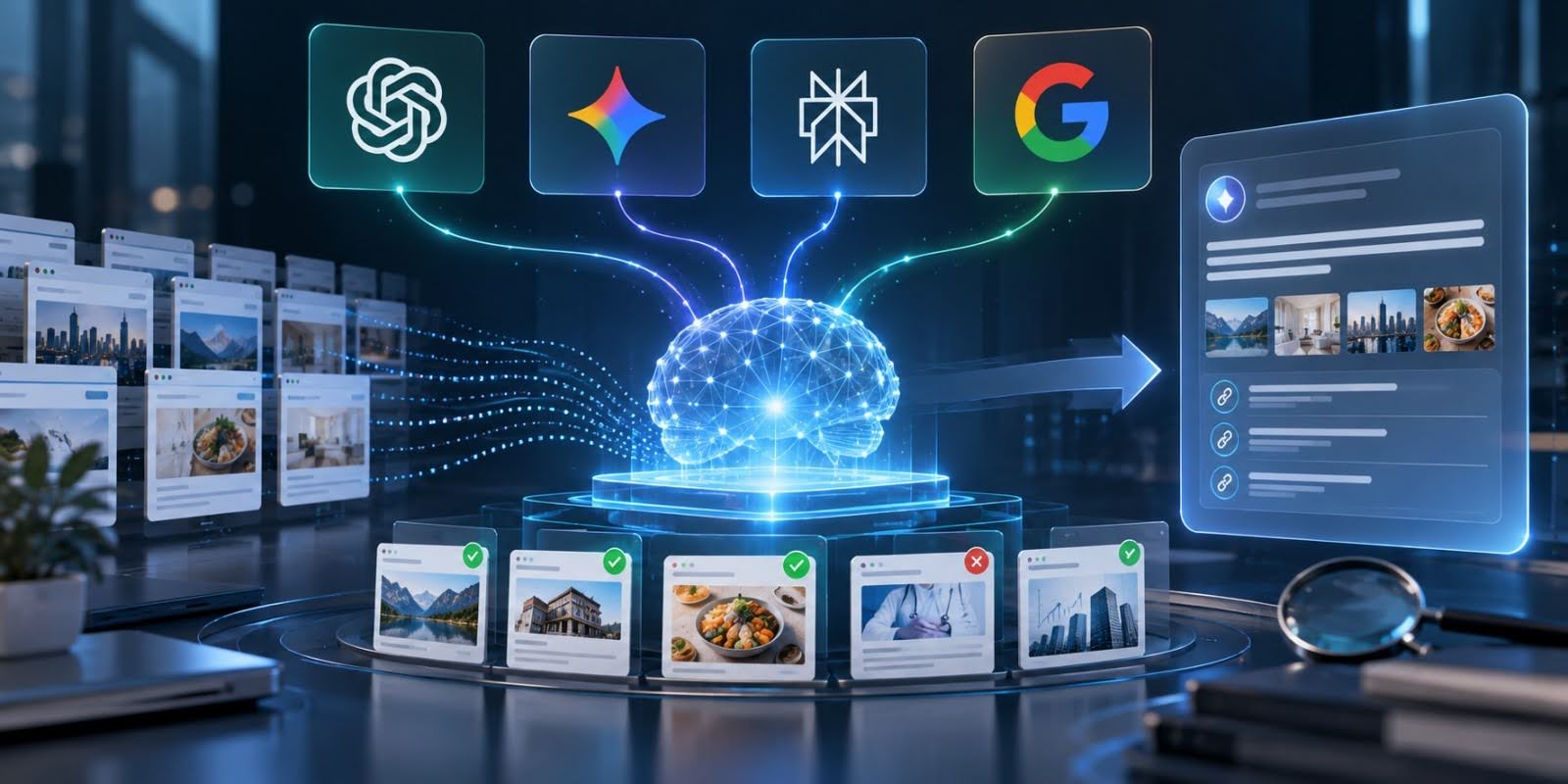
On-page SEO is the optimisation of individual web pages to improve visibility in both traditional search engines and AI-generated search experiences. It focuses on content structure, search intent alignment, semantic relevance, internal linking, metadata, headings, and entity clarity.
Onpage SEO in Singapore has evolved beyond keyword placement alone. Search engines now evaluate whether content demonstrates topical relevance, contextual accuracy, and clear relationships between topics, entities, and user intent. At the same time, AI-generated answers and search summaries increasingly rely on well-structured and extractable information from websites.
Businesses in Singapore are also competing within highly localised industries where search intent can differ significantly between sectors such as healthcare, finance, legal services, education, and B2B services. Therefore, on-page SEO needs to supports both human readers and AI systems by ensuring information is structured, understandable, and contextually complete.
What On-Page SEO Means in Modern Search
On-page SEO is the process of improving the elements within a webpage so search engines and AI systems can understand its purpose, relevance, and topical coverage.
Traditional SEO primarily focused on keyword targeting and technical formatting. However, modern search systems now evaluate additional factors such as:
- Semantic relationships between topics
- Search intent fulfilment
- Entity recognition
- Contextual completeness
- Content structure and readability
- Internal topical relationships
Search engines no longer analyse pages purely through isolated keywords. They also interpret the meaning behind queries and compare that intent against the completeness and structure of a webpage. This shift means businesses in Singapore must optimise content for understanding rather than only for rankings.
Why AI Search Is Changing On-Page SEO
AI-generated search experiences summarise information directly within search interfaces. These systems extract and reorganise information from multiple sources to answer questions more efficiently.
This changes how websites gain visibility since instead of only competing for clicks, websites now compete to become trusted reference sources for AI-generated answers. Content that is structured clearly and written factually has a stronger chance of being extracted into AI summaries.
AI search systems commonly prioritise content that includes:
- Direct definitions
- Structured headings
- Clear topical segmentation
- Concise explanations
- Strong entity signals
- Supporting contextual information
Pages that rely heavily on vague marketing language or fragmented structure are more difficult for AI systems to interpret accurately.
The Role of Search Intent in On-Page SEO
Search intent refers to the reason behind a user’s query. Effective on-page SEO aligns content with the actual information users expect to find. There are four common types of search intent:
Search Intent Type | Purpose | Example |
Informational | Learning or researching | “What is semantic SEO” |
Navigational | Finding a specific website or brand | “W360 SEO Singapore” |
Commercial | Comparing services or solutions | “best SEO agency Singapore” |
Transactional | Taking action or making contact | “SEO consultation Singapore” |
A webpage performs better when its structure and content match the intended purpose of the query. For example, informational pages should prioritise explanations, definitions, and educational clarity. Transactional pages require stronger service clarity and conversion-focused elements.
Search engines analyse behavioural signals to determine whether users found relevant information. Poor intent alignment can reduce visibility even when keywords are present.
Semantic SEO and Contextual Relevance

- Structured headings
- Meta descriptions
- Internal linking
- Search intent
- Content hierarchy
- Entity optimisation
- Topical authority
Entity Optimisation and AI Understanding
Entity optimisation involves helping search engines identify and understand people, organisations, services, products, and concepts referenced within content. An entity is a uniquely identifiable subject. Search engines use entities to build relationships between information across the web.
Examples of entities include:
- Companies
- Locations
- Industries
- Products
- Services
- Public figures
- Concepts
AI systems use entity recognition to improve information accuracy and contextual understanding. For Singapore businesses, entity optimisation involve clearly defining:
- Business names
- Industry categories
- Service specialisations
- Geographic relevance
- Associated topics
Clear entity signals help search engines determine what a website represents and how it relates to broader industry topics.
Why Structured Headings Matter
Structured headings improve both readability and machine understanding. Search engines use headings to determine the hierarchy and topical organisation of content. AI systems also rely on headings when extracting information for summaries and answer generation.
A strong heading structure typically includes:
- One clear H1 heading
- Logical H2 topic segmentation
- Supporting H3 subtopics where needed
- Clear descriptive wording
- Consistent topical organisation
Headings should explain the subject of each section directly rather than using vague or overly creative phrasing.
For example:
| Weak Heading | Improved Heading |
| “Things to Know” | “How Internal Linking Supports SEO” |
| “The Future” | “How AI Search Impacts SEO Visibility” |
| “Optimisation Tips” | “Ways to Improve Search Intent Alignment” |
Clear headings improve extractability and help AI systems isolate relevant information more effectively.
Internal Linking and Topical Relationships
Internal linking connects related pages within a website. This helps search engines understand content relationships and site structure. Strong internal linking supports:
- Topical authority
- Crawl efficiency
- User navigation
- Contextual relevance
- Page discovery
Internal links should connect logically related topics rather than being added excessively. For example, an on-page SEO page may naturally connect to related topics such as:
- Technical SEO
- Content optimisation
- AI SEO
- Local SEO
- Keyword research
- Structured data
Search engines evaluate how pages support one another contextually. Websites with stronger topical clustering often demonstrate clearer expertise signals.
How Content Structure Affects AI Visibility

- Short explanatory paragraphs
- Clear definitions
- Topic-focused sections
- Descriptive headings
- Minimal ambiguity
- Supporting examples where useful
| Less AI-Friendly Structure | More AI-Friendly Structure |
| Long unbroken paragraphs | Short structured sections |
| Vague headings | Descriptive topic headings |
| Mixed topics within sections | One topic per section |
| Heavy promotional wording | Neutral informational language |
| Repetitive keyword usage | Contextual semantic coverage |
Metadata and Search Relevance
These metadata elements help search engines interpret the purpose and context of a webpage.
- Title tags
- Meta descriptions
- Canonical tags
- Open Graph data
- Structured data markup
Title tags remain important because they influence relevance signals and search visibility. Meta descriptions do not directly affect rankings, but they help summarise page content for users and search systems. Effective metadata should:
- Reflect actual page content
- Match user intent
- Avoid keyword stuffing
- Remain concise and descriptive
Metadata also contributes to clearer interpretation when pages appear within AI-generated search environments.
The Importance of Content Hierarchy
Content hierarchy refers to how information is organised within a page. A strong hierarchy improves comprehension by guiding users and search systems through information logically.
Effective content hierarchy generally follows this sequence:
- Topic introduction
- Definitions or foundational explanations
- Supporting details
- Examples or classifications
- Related considerations
- Summary or conclusion
Disorganised content structures reduce clarity and make extraction more difficult for AI systems. Content hierarchy also influences engagement because users can scan and navigate information more efficiently.
Structured Data and Search Interpretation
Structured data is code added to webpages that helps search engines interpret information more accurately and enhances search visibility by clarifying page elements such as:
- FAQs
- Organisations
- Services
- Articles
- Reviews
- Events
- Products
Structured data does not guarantee visibility, but it improves contextual understanding.
Search engines use schema markup to validate relationships between entities and page topics. For Singapore businesses, structured data can help clarify business information, service categories, geographic relevance, and industry classification.
How Content Freshness Supports SEO

Content freshness refers to maintaining accurate and updated information over time. Search engines evaluate whether content remains relevant and current, particularly for industries where information changes frequently.
Content updates may include:
- Revising outdated statistics
- Expanding topical coverage
- Updating internal links
- Improving structure
- Refreshing examples
Freshness does not always require rewriting an entire page. Strategic updates often improve relevance signals while preserving existing authority. Businesses in Singapore operating within rapidly evolving industries benefit from periodic content reviews to maintain informational accuracy.
Local Relevance in Singapore SEO
Local relevance helps search engines understand geographic context and audience targeting. For on-page SEO in Singapore, local relevance should appear naturally within content rather than through excessive location repetition.
Local signals may include:
- Singapore-specific search behaviour
- Industry regulations
- Local terminology
- Regional market context
- Local service considerations
Search engines evaluate whether content is contextually useful for users within a geographic region. Businesses targeting Singapore audiences should ensure local references remain accurate and naturally integrated into the topic.
User Experience and On-Page SEO
User experience affects how search engines evaluate page quality and usability. Poor usability can reduce engagement signals even when content is relevant.
Important user experience considerations include:
User Experience Factor | SEO Impact |
Mobile responsiveness | Improves usability across devices |
Readable formatting | Supports engagement and comprehension |
Fast loading speeds | Reduces abandonment rates |
Logical navigation | Improves content discovery |
Clear visual hierarchy | Enhances readability |
Search systems increasingly evaluate how accessible and usable content is for users. AI systems also favour content that demonstrates clarity and organisation because it improves information extraction reliability.
Common On-Page SEO Mistakes
Many websites reduce their search visibility through inconsistent or outdated optimisation practices, such as:
- Overusing keywords unnaturally
- Publishing thin or incomplete content
- Using vague headings
- Ignoring internal linking opportunities
- Creating overlapping content topics
- Writing primarily for algorithms instead of users
Another common issue is treating SEO as purely technical while overlooking contextual relevance and topical depth. Modern search visibility depends on clarity, completeness, and semantic understanding rather than isolated optimisation tactics.
How Topical Authority Supports Rankings

Topical authority refers to the perceived expertise and comprehensiveness of a website within a subject area.
Search engines evaluate whether a website consistently publishes useful and interconnected content around a topic.
Topical authority develops through:
- Comprehensive topic coverage
- Consistent terminology
- Strong internal linking
- Clear entity relationships
- Accurate informational content
A website covering multiple related SEO topics demonstrates broader expertise than a site relying on isolated pages. This is particularly important for AI-generated search because AI systems often favour sources with consistent thematic relevance.
Measuring On-Page SEO Performance
On-page SEO performance can be evaluated through multiple indicators rather than rankings alone. Important performance indicators include:
- Organic traffic growth
- Search visibility trends
- Click-through rates
- User engagement metrics
- Indexing coverage
- AI search visibility
- Internal page discovery
Businesses should also evaluate whether pages effectively answer user questions and maintain topical relevance over time. Performance analysis helps identify whether content structure, search intent alignment, and semantic coverage are functioning effectively.
Frequently Asked Questions
On-page SEO refers to optimising the elements within a webpage to improve search visibility and user understanding. This includes headings, metadata, content structure, internal linking, semantic relevance, and search intent alignment. Modern on-page SEO also supports AI-generated search systems by improving content clarity and extractability.
Semantic SEO helps search engines understand the meaning and context behind content rather than relying only on exact-match keywords. It improves topical relevance by connecting related concepts and entities. This supports broader visibility across traditional search and AI-generated answers.
AI search systems summarise information directly within search interfaces, reducing reliance on traditional ranking positions alone. Websites now need structured, factual, and extractable content to improve visibility within AI-generated answers. Clear headings and self-contained sections support this process.
Entity optimisation helps search engines identify and understand specific subjects such as companies, services, industries, and locations. Strong entity signals improve contextual understanding and support relevance across search systems. This also helps AI systems interpret relationships between topics more accurately.
Internal links help search engines understand how pages relate to one another within a website. They improve topical organisation, support crawlability, and help distribute contextual relevance across pages. Effective internal linking also improves navigation for users.
Structured data does not directly improve rankings, but it helps search engines interpret page content more accurately. It can improve eligibility for enhanced search features and strengthen contextual understanding. Structured data also supports AI interpretation by clarifying entities and page elements.
Building Content for Search and AI Visibility
On-page SEO now supports more than just keyword rankings as search engines and AI systems also evaluate content based on clarity, entity understanding, and search intent fulfilment. Businesses in Singapore increasingly benefit from content structures that are both informative and extractable.
Strong improves how webpages are interpreted across both traditional search results and AI-generated search experiences. Well-structured content, clear topical organisation, and semantic optimisation collectively support long-term search visibility and stronger informational relevance.
If you are seeking a digital marketing agency to assist in developing efficient strategies for on-page SEO in Singapore, get in touch with W360 Asia to get started.