
Measuring the effectiveness of an AI SEO strategy in Singapore requires more than traditional keyword rankings because businesses can now appear through brand mentions, citations, recommendations and generated answers across ChatGPT, Gemini, Perplexity and Google AI.
Traditional SEO metrics such as rankings, impressions, clicks and conversions remain important, but they do not fully explain how visible a brand is within generative search. A business may be mentioned frequently by AI platforms without receiving direct website traffic, while another company may receive citations from its own website but limited brand recommendations.
AI search visibility should therefore be measured through several connected indicators. These include prompt coverage, brand mention rate, citation rate, citation share of voice, recommendation frequency, source URL visibility and referral traffic.
The W360 measurement framework is designed to help Singapore businesses assess these signals consistently. The goal is not to create an artificial score that hides the underlying data, but to establish a transparent benchmark that can be tracked over time and compared against competitors.
Why Traditional Rankings Are No Longer Enough
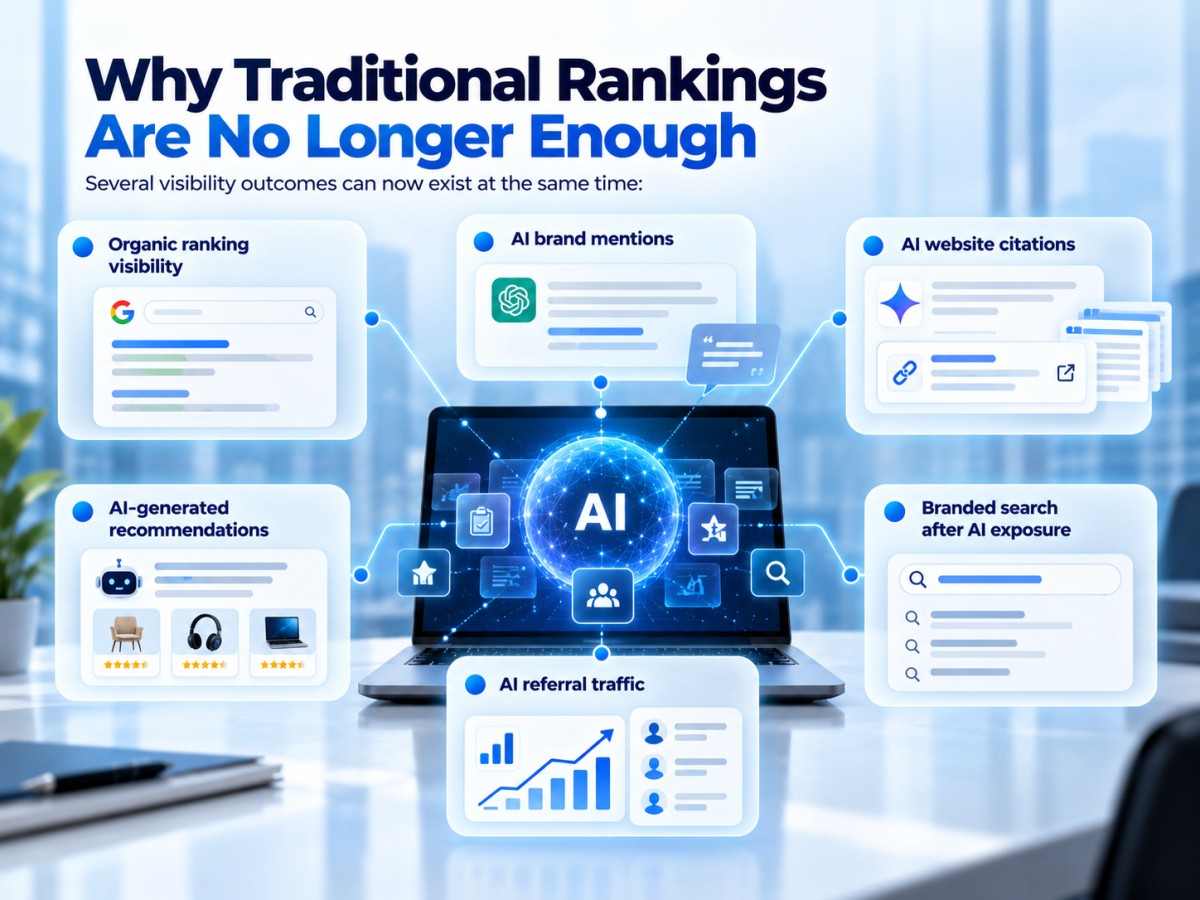
Traditional rankings measure where webpages appear in conventional search engine results, but they do not capture every way a business can become visible through AI-assisted search.
Generative platforms can summarise information from multiple sources and present a direct answer without requiring the user to visit a webpage. A company can therefore gain meaningful exposure even when no traditional ranking position is involved in the interaction.
Several visibility outcomes can now exist at the same time:
- Organic ranking visibility
- AI brand mentions
- AI website citations
- AI-generated recommendations
- AI referral traffic
- Branded search after AI exposure
These outcomes should not be collapsed into one metric.
A page ranking first in Google and a brand being recommended by ChatGPT represent different forms of visibility. Both can support discovery, but they should be evaluated separately.
For Singapore businesses, this means they need to expand their strategies from traditional optimisation to AI SEO.
What AI Search Visibility Means
AI search visibility measures how often, where and in what context a brand or website appears across generative search platforms.
Visibility can occur through several mechanisms.
A brand may be mentioned by name. Its website may be cited as a source. The company may be recommended as a provider. A third-party source may describe the business. The brand may also appear across multiple related prompts without receiving a direct click.
This means AI visibility has both entity-level and source-level dimensions. Entity-level visibility asks whether the AI system recognises the brand as relevant.
Source-level visibility asks whether the business's own content is used as supporting information. A strong AI SEO measurement framework should track both.
Visibility vs Traffic

AI visibility and website traffic are related but separate outcomes. Traffic measures visits to a website. Visibility measures whether a business appears within the search or AI experience, regardless of whether the user clicks.
This distinction is important because generative answers can satisfy part or all of the user's information needed before a website visit occurs.
A user may see a company recommended in an AI answer, remember the brand name and later search for it directly. That journey creates value that may not appear as a direct AI referral in analytics.
For this reason, AI SEO measurement should include visibility metrics alongside traffic metrics.
A useful reporting model can therefore separate:
| Measurement Area | Examples |
|---|---|
| Visibility | Mentions, citations, recommendations |
| Search demand | Branded impressions, branded queries |
| Traffic | AI referrals, organic visits |
| Engagement | Time on site, page interactions |
| Commercial outcome | Enquiries, leads, assisted conversions |
This gives businesses a more complete view of performance.
The W360 AI Search Measurement Framework
The W360 AI search measurement framework evaluates visibility across five layers: prompt coverage, brand visibility, source visibility, competitor position and commercial outcome.
Each layer answers a different question.
The first layer asks whether the business appears for the right questions.
The second asks whether the brand is recognised.
The third asks whether the website itself is used as a source.
The fourth compares visibility with competitors.
The fifth examines whether increased visibility contributes to measurable business value.
This structure prevents AI SEO reporting from relying on a single unexplained score.
Prompt Coverage

Prompt coverage measures the proportion of relevant AI-search questions in which a brand appears. The first step is to define a prompt universe.
A prompt universe is a controlled set of questions that represent the ways potential customers may research a topic, service or provider. For Singapore businesses, these prompts should reflect realistic search behaviour.
They can include:
- Category discovery questions
- Provider recommendation prompts
- Service comparison questions
- Problem-solving queries
- Commercial evaluation prompts
- Local Singapore questions
Prompt coverage then measures how many of these questions produce some form of visibility. A brand appearing in 40 out of 100 relevant prompts has broader coverage than a brand appearing in only five, even if both receive similar traffic.
Prompt coverage should therefore be one of the foundational AI visibility metrics.
Brand Mention Rate
Brand mention rate measures how often an AI platform names a business within relevant generated responses. The calculation is straightforward:
Brand Mention Rate = Number of prompts with a brand mention ÷ Total prompts tested
However, context matters. A neutral mention is different from a recommendation. A brand appearing in a list of examples should not automatically be counted as strongly as a brand clearly suggested as a suitable provider.
The reporting framework should therefore classify mentions into categories such as:
- Neutral mention
- Positive inclusion
- Provider recommendation
- Comparative reference
This creates a more useful interpretation of brand visibility.
Citation Rate
Citation rate measures how often a business's website is explicitly used or presented as a source. This metric should be tracked separately from brand mentions.
A business can be named frequently without its own domain being cited. The basic calculation is:
Citation Rate = Number of prompts where the domain is cited ÷ Total prompts tested
Citation rate can be measured at both domain and URL level. Domain-level citation rate shows overall source visibility.
URL-level citation rate reveals which specific content assets are being used. This distinction is important because one strong research article may account for a large proportion of a site's citations.
Citation Share of Voice
Citation share of voice compares a business's citation frequency with competitors across the same prompt set. The purpose is to measure relative source visibility.
A basic formula is:
Citation Share of Voice = Brand citations ÷ Total citations among tracked competitors
For example, if five competitors collectively receive 100 citations and one brand receives 25, that brand has a 25% citation share of voice within the defined dataset. The percentage should always be interpreted within the selected prompt universe.
It does not represent the entire internet or all AI search activity. Citation share of voice is most useful when the same competitors, prompts and platforms are tracked consistently over time.
Recommendation Rate
Recommendation rate measures how often a brand is actively suggested as a relevant option rather than simply mentioned. This is particularly important for commercial AI SEO.
A user asking “What is AI SEO?” is seeking information. A user asking “Which AI SEO agency in Singapore should I consider?” is expressing provider-selection intent.
A brand appearing in the second type of answer has a stronger commercial signal. The basic calculation is:
Recommendation Rate = Number of prompts where the brand is recommended ÷ Relevant commercial prompts tested
Recommendation rate should therefore be calculated only for prompts where a recommendation makes sense. Using it across all informational queries would distort the result.
Source URL Frequency
Source URL frequency identifies which individual webpages are cited most often. This helps businesses understand which content assets are functioning as AI-search sources.
A domain may receive ten citations through ten different pages, or ten citations from the same page. These patterns indicate different strengths.
Multiple cited URLs can suggest broad topical coverage. Repeated citation of one URL can indicate that the page contains especially useful information.
For AI SEO strategy in Singapore planning, this metric helps determine which pages should be strengthened, updated or used as models for future content.
Competitor AI Visibility

Competitor AI visibility measures how often competing brands are mentioned, cited or recommended across the same prompt dataset. This is one of the most important parts of AI SEO measurement because visibility without competitive context can be misleading.
A brand with a 30% mention rate may appear strong until a direct competitor is found to have a 70% mention rate. Competitive benchmarking should therefore compare:
| Metric | Brand A | Brand B | Brand C |
|---|---|---|---|
| Prompt coverage | Track | Track | Track |
| Mention rate | Track | Track | Track |
| Citation rate | Track | Track | Track |
| Recommendation rate | Track | Track | Track |
| Cross-platform visibility | Track | Track | Track |
The exact figures should come from the validated dataset. The value lies in consistent comparison.
AI Referral Traffic
AI referral traffic measures visits sent directly from generative platforms to a website. This metric can be tracked through analytics tools when the referring source is identifiable.
Potential referral sources can include ChatGPT, Perplexity and other AI platforms that expose clickable links. Referral traffic should still be interpreted carefully.
A low volume does not necessarily indicate weak AI visibility. Users can see a brand in an AI answer and later visit the website through direct search, branded Google queries or another channel.
AI referrals therefore provide useful evidence, but they should not be treated as the complete measure of AI SEO performance.
Branded Search Demand
Branded search demand measures how often users search directly for a company or brand name. It can provide an indirect signal of increased awareness.
If a brand gains stronger AI visibility and branded search impressions rise during the same period, this may indicate that AI exposure is contributing to demand.
However, causation should not be assumed automatically. Branded search can also increase because of advertising, PR, offline campaigns, social media or seasonality.
The best approach is to monitor branded search alongside AI visibility and other marketing activity. This creates a broader interpretation of demand rather than attributing every change to one channel.
Assisted Conversions
Assisted conversions occur when AI visibility contributes to the customer journey without generating the final conversion click.
A user may discover a company in ChatGPT, search for the brand later and submit an enquiry through organic search. In this case, AI may have influenced discovery even though the final conversion is attributed elsewhere.
This makes AI SEO attribution more difficult than simple referral reporting. Businesses should therefore examine:
- Branded search growth
- Direct traffic
- Returning visitors
- Assisted conversion paths
- Lead source comments
- Enquiry behaviour
No single signal proves AI influence. Together, however, they can help identify patterns.
How to Build an AI Search Benchmark
An AI search benchmark is a fixed baseline used to compare visibility over time. The benchmark should begin with a clearly defined prompt set.
Each prompt should be categorised by:
- Intent
- Topic
- Service
- Funnel stage
- Location relevance
The same prompt set should then be tested across selected platforms. For each response, record:
- Brand mentions
- Brand recommendations
- Website citations
- Cited URLs
- Competitor visibility
- Source types
This creates the baseline. Future tests should retain the same core prompts so changes remain comparable.
Example AI Visibility Dashboard
An AI visibility dashboard should present the underlying metrics clearly rather than hiding them behind one proprietary score. A practical dashboard can include the following.
| KPI | What It Measures | Why It Matters |
|---|---|---|
| Prompt coverage | Breadth of visibility | Shows topic reach |
| Mention rate | Brand recognition | Shows entity visibility |
| Citation rate | Owned-source visibility | Shows source authority |
| Recommendation rate | Commercial inclusion | Shows provider visibility |
| Citation share of voice | Competitive source position | Shows relative strength |
| Cross-platform presence | Consistency | Shows dependence on individual engines |
| Referral traffic | Direct visits | Shows measurable traffic contribution |
| Branded search | Brand demand | Helps assess indirect visibility |
Each metric should be reported by platform where possible. This makes it easier to identify whether visibility problems are broad or platform-specific.
Cross-Platform Visibility
Cross-platform visibility measures whether a brand appears across ChatGPT, Gemini, Perplexity and Google AI. This matters because strong performance on one platform does not necessarily translate into strong performance elsewhere.
A brand can therefore be classified as:
- Single-platform visible
- Multi-platform visible
- Consistently visible
- Broadly absent
The most useful goal is not simply to appear everywhere at once. It is to build consistent visibility for the topics and commercial prompts that matter most.
Cross-platform tracking also protects businesses from overreacting to changes in one system.
Platform Weighting
Platform weighting determines how much importance should be assigned to each AI-search environment within a combined visibility score.
Not every business needs to weigh all platforms equally. The appropriate weighting depends on user behaviour, industry, available data and commercial relevance.
For example, a B2B business may discover that ChatGPT and Google AI generate more commercially relevant visibility than another platform.
A consumer-focused business may see a different pattern. W360's framework therefore recommends transparent weighting rather than arbitrary scoring.
Any weighted index should clearly show the formula used.
Building a Prompt Universe
A prompt universe is the complete set of questions used to measure AI visibility. It should be broad enough to represent real customer behaviour but focused enough to remain commercially relevant.
A strong prompt universe typically contains several clusters.
Brand-Neutral Discovery Prompts
These prompts do not mention the business by name. Examples can ask for providers, solutions or recommendations within a category. They are useful for measuring organic AI discovery.
Problem-Based Prompts
These prompts describe a need without naming a specific service. They measure whether the AI platform connects the brand or service with the underlying problem.
Comparison Prompts
Comparison prompts users to evaluate alternatives, approaches or providers. These can reveal whether a brand is visible during consideration.
Informational Prompts
Informational prompts measure topical authority. They are useful for understanding whether the business's website is cited as an explanatory source.
Commercial Prompts
Commercial prompts involve provider selection or purchase evaluation. These are particularly useful for recommendation-rate analysis.
A balanced prompt universe should contain all of these categories.
Prompt Coverage by Funnel Stage
Prompt coverage becomes more useful when divided by customer journey stage. A business may have strong informational visibility but weak commercial visibility.
The benchmark can therefore divide prompts into:
| Funnel Stage | Example Purpose |
|---|---|
| Awareness | Learn about a problem or concept |
| Discovery | Identify possible solutions |
| Consideration | Compare approaches or providers |
| Evaluation | Assess suitability |
| Decision | Ask for recommendations or next steps |
This reveals where AI visibility is strongest and where gaps remain.
For example, a business cited frequently for educational content but never recommended commercially may need stronger entity, service or third-party authority signals.
Measuring Brand Mentions Properly
Brand mentions should be classified by context because not all mentions have equal value. A strong measurement model distinguishes between:
- Incidental mention
- Contextual mention
- Positive inclusion
- Recommendation
- Primary recommendation
This prevents reporting from exaggerating weak visibility. A brand appearing once in a long list should not be treated as equivalent to being the main recommendation in the generated answer.
The classification rules should remain consistent across reporting periods.
Measuring Citations Properly
Citation measurement should record both domain and page-level visibility. For every citation, track:
- Domain
- Exact URL
- Query
- Platform
- Source type
- Citation context
This creates a more actionable dataset. If one article receives most of the citations, the business can analyse why that content performs differently.
If the homepage is repeatedly cited, the brand may have stronger entity-level authority. If third-party pages are cited while the company's own website is ignored, there may be an owned-content visibility gap.
Tracking Recommendation Visibility
Recommendation visibility is particularly important for agencies, professional services and commercial providers. The metric should measure whether the business is explicitly suggested when users ask for suitable companies, providers or solutions.
Recommendations can be categorised by prominence. For example:
- Mentioned among many options
- Included in a shortlist
- Presented as a strong fit for a specific requirement
- Named as the primary recommendation
The purpose is not to judge sentiment subjectively. It is to record the position and context consistently.
AI Visibility Score
An AI visibility score can be useful as a summary metric, but it should never hide the underlying data. A transparent score can combine several measurements. For example:
AI Visibility Score = Prompt Coverage + Mention Share + Citation Share + Recommendation Share + Cross-Platform Presence
Each component can be normalised and weighted according to business relevance. The exact weighting should be disclosed.
A score without transparent methodology is difficult to interpret and can make competitor comparisons unreliable. For this reason, it is recommended to use the score as a summary layer rather than the primary dataset.
How Often AI Visibility Should Be Measured
AI visibility should be measured frequently enough to identify meaningful changes without overreacting to normal response variation. A monthly benchmark is suitable for many ongoing campaigns.
High-priority commercial prompts can be monitored more frequently if visibility changes quickly. Quarterly reviews can provide a broader strategic perspective.
The reporting cadence should remain consistent. Changing the prompt set, platform selection or methodology every month makes trend analysis unreliable.
A practical structure can be:
- Monthly visibility tracking
- Quarterly strategic analysis
- Annual benchmark review
This balances monitoring with interpretation.
Common Measurement Mistakes
AI SEO measurement can become misleading when visibility signals are combined incorrectly or tracked inconsistently. Several errors should be avoided.
Treating a Mention as a Citation
A brand mention does not mean the website was used as a source. The two metrics should remain separate.
Tracking Only One Platform
Visibility on ChatGPT alone does not represent the entire AI-search environment. Cross-platform measurement provides a more complete picture.
Changing Prompts Constantly
If the prompt dataset changes every reporting period, trend comparisons become weak. A stable core benchmark is necessary.
Treating One Response as Permanent
Generative answers can vary. Repeated visibility is more meaningful than a single appearance.
Reporting Traffic Only
AI visibility can influence users without producing a direct click. Referral traffic should therefore be measured alongside mentions, citations and branded demand.
AI Search Monitoring
AI search monitoring is the ongoing process of tracking how a business appears across selected AI platforms. Monitoring should focus on important prompts rather than attempting to track every possible question.
A practical monitoring programme should include:
- Priority commercial prompts
- Brand-neutral category prompts
- Competitor comparison prompts
- Core informational topics
- Brand-specific reputation questions
The results should then be compared over time. Monitoring becomes more useful when changes can be traced to specific content, authority or technical actions.
Competitor Benchmarking
Competitor benchmarking helps determine whether a visibility change is specific to the business or part of a wider market shift. For example, if all competitors lose citation visibility on one platform, the change may reflect a platform update rather than a problem with one website.
A competitive benchmark should therefore track the same metrics for direct competitors. Useful comparisons include:
- Mention share
- Citation share
- Recommendation share
- Prompt coverage
- Cross-platform presence
- Most-cited pages
This identifies which competitors consistently dominate important AI-search situations.
Linking AI Visibility to Content Strategy
AI visibility data should guide content decisions rather than exist only as a reporting exercise.
If a competitor is cited repeatedly from a research article, the opportunity may be to produce stronger first-party evidence.
If third-party comparison pages dominate recommendations, the opportunity may involve external authority rather than creating another owned article.
If a business is mentioned often but its website is rarely cited, the issue may be source quality or content usefulness.
If the website is cited but the brand is rarely recommended, commercial entity signals may need strengthening.
Measurement should therefore lead to diagnosis.
Linking AI Visibility to Traditional SEO
Traditional SEO and AI search visibility should be evaluated together. A useful analysis compares organic position with AI visibility for the same topic. This creates four broad situations.
| Search Position | AI Visibility | Interpretation |
|---|---|---|
| Strong | Strong | Broad search visibility |
| Strong | Weak | Generative visibility gap |
| Weak | Strong | AI source opportunity with SEO weakness |
| Weak | Weak | Foundational search gap |
Each situation requires a different strategy. A website strong in Google but weak in AI should not automatically create more pages. It may need better source-ready content, stronger third-party authority or clearer entity relationships.
Linking AI Visibility to Commercial Outcomes
Commercial measurement should remain part of AI SEO because visibility alone does not guarantee business results. Relevant indicators can include:
- AI referral visits
- Branded search growth
- Enquiry volume
- Qualified leads
- Assisted conversions
- Lead quality
- Sales pipeline influence
These should be interpreted together. An increase in AI citations is useful, but it is more meaningful when accompanied by stronger branded demand or qualified enquiries.
Framework Limitations
AI search measurement has several limitations because generative platforms are dynamic. Responses can change according to:
- Model updates
- User context
- Prompt wording
- Location
- Session history
- Retrieval availability
- Time of testing
This means AI visibility should not be treated as a fixed ranking system. The benchmark is an observational tool. It shows how a business appears during controlled testing. It does not reveal the proprietary ranking or retrieval algorithms used by individual platforms.
The framework should therefore be used for trend analysis, competitive benchmarking and strategic decision-making rather than claims of guaranteed AI rankings.
Frequently Asked Questions
What is AI search visibility?
AI search visibility measures how often a brand or website appears in generative search responses. It can include mentions, citations, recommendations, prompt coverage and visibility across platforms such as ChatGPT, Gemini, Perplexity and Google AI.
How is AI SEO measured?
AI SEO can be measured through prompt coverage, brand mention rate, citation rate, recommendation rate, citation share of voice, source URL frequency and AI referral traffic.
What is the citation share of voice?
Citation share of voice measures the proportion of AI citations received by one brand compared with tracked competitors. It is useful for understanding relative source visibility within a defined prompt dataset.
What is prompt coverage?
Prompt coverage measures how many relevant AI-search questions produce visibility for a brand. It helps determine whether the brand appears across a broad range of customer needs rather than only one isolated query.
Is AI referral traffic enough to measure AI SEO?
No. AI referral traffic measures only direct visits. A brand can gain exposure through mentions or citations without receiving an immediate click, so visibility metrics should also be tracked.
How often should AI search visibility be tracked?
Monthly tracking is suitable for many campaigns, while high-priority prompts can be monitored more frequently. The methodology and core prompt set should remain consistent to make trend comparisons meaningful.
Can AI visibility be compared with competitors?
Yes. Businesses can compare prompt coverage, mention rates, citation rates, recommendations and cross-platform presence against direct competitors. Competitor comparison is important because absolute visibility figures provide limited context on their own.
Does a high Google ranking guarantee high AI visibility?
No. Strong Google rankings can support discoverability and authority, but generative platforms can choose different sources. Google rankings and AI visibility should therefore be measured separately and analysed together.
Measuring Search Visibility Beyond Rankings
An effective AI SEO strategy in the Singapore framework should recognise that search visibility now extends beyond traditional ranking positions. Businesses can be discovered through brand mentions, citations, recommendations and generated answers before a website visit occurs.
This does not reduce the importance of traditional SEO. Instead, it expands the measurement model.
Prompt coverage shows whether the brand appears for the right questions. Mention rate measures entity recognition. Citation rate measures source visibility. Recommendation rate measures commercial inclusion. Citation share of voice shows competitive position.
When these metrics are combined with rankings, traffic, branded demand and conversions, businesses gain a clearer view of how search visibility is evolving.
Create a Measurable AI Search Strategy
AI search visibility becomes more useful when businesses can measure it consistently against a defined prompt set, relevant competitors, and commercial objectives.
W360 Group Pte Ltd can help Singapore businesses build an AI SEO strategy in Singapore measurement framework covering prompt visibility, brand mentions, citations, competitor benchmarking and traditional search performance. Businesses that want to assess their current AI search position can get a quote to check their performance and discuss suitable strategies.