GEO and AI SEO focuses on improving how a brand, website or source is understood and surfaced within generative search environments. Unlike traditional SEO, where visibility is usually measured through ranking positions, generative search can expose businesses through citations, brand mentions, recommendations and summarised answers.
ChatGPT, Gemini, Perplexity and Google AI Overviews all use different systems to retrieve, interpret and present information. They may cite the same source for one query yet choose completely different sources for another. This means there is no single universal source-selection pattern that applies equally across all AI search engines.
For Singapore businesses, the practical challenge is understanding what types of information these platforms consistently find useful. Relevant factors can include source authority, topical relevance, freshness, information depth, entity clarity, content structure and the availability of corroborating information from third-party websites.
This article compares the source patterns that should be examined across the four platforms. The aim is not to claim that one factor guarantees citation, but to provide a practical framework for understanding how different generative engines can select and use sources.
Executive Summary
AI search engines do not operate as identical copies of one another. Each platform can differ in retrieval methods, source presentation, query interpretation and the way generated answers are supported.
A useful GEO AI SEO strategy should therefore avoid assuming that one optimisation technique will produce the same result everywhere.
Several principles are important when comparing ChatGPT, Gemini, Perplexity and Google AI Overviews:
- Relevant and authoritative information remains important across platforms.
- A source can be cited on one platform but ignored by another.
- Brand mentions and website citations should be measured separately.
- Commercial pages, informational guides, research pages and third-party sources can all serve different query types.
- Local relevance can matter for Singapore-focused prompts, but location references should be genuine and useful.
- Structured, answer-first content can improve clarity without guaranteeing citation.
- Third-party corroboration can strengthen how confidently a brand or fact is represented.
The central implication is that businesses should optimise for broad information quality, topical authority and source credibility rather than trying to reverse-engineer one platform.
Why Compare AI Search Platforms?
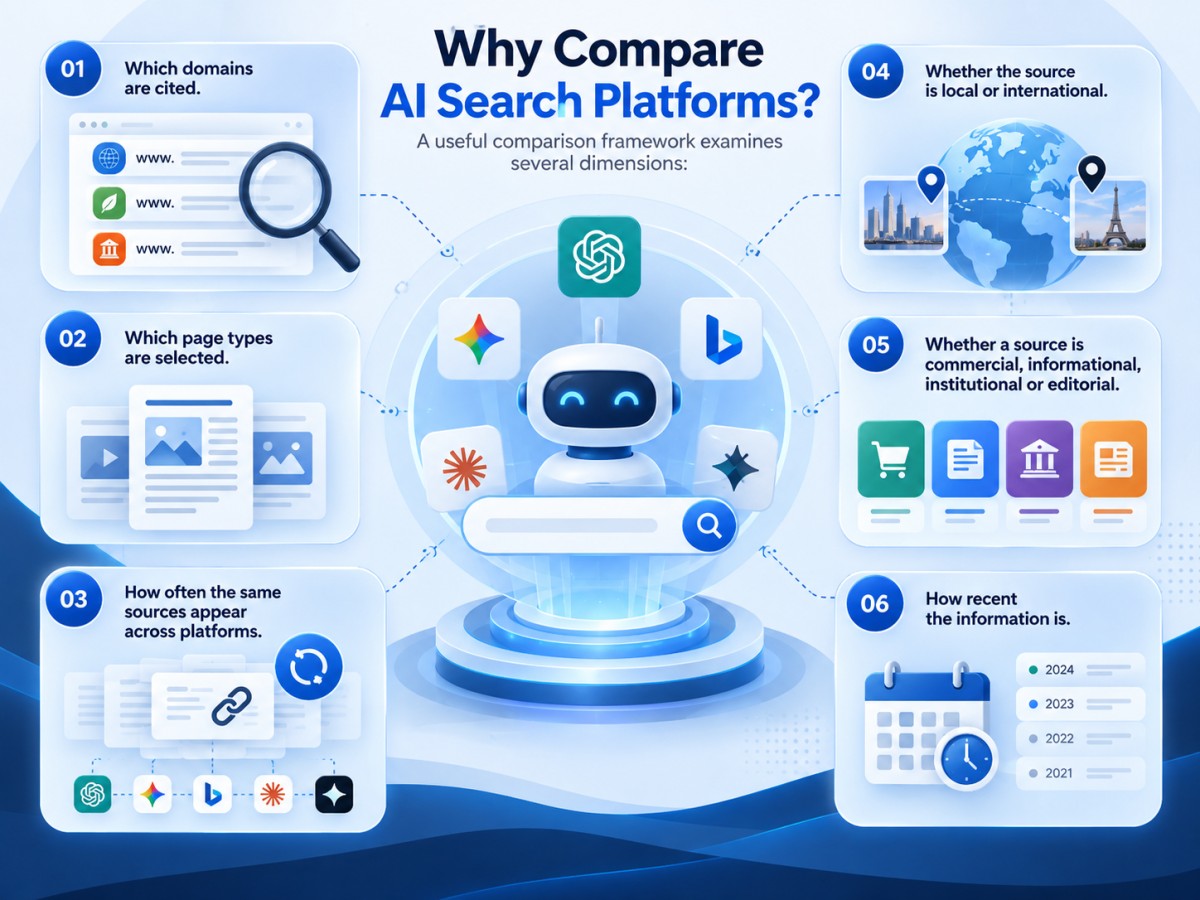
Comparing AI search platforms is necessary because generative visibility is fragmented. A business may perform well in ChatGPT but receive limited visibility in Gemini, or be frequently cited in Perplexity while appearing less often in Google AI Overviews.
This means AI search visibility cannot be represented accurately by one platform alone. A useful comparison framework examines several dimensions:
- Which domains are cited.
- Which page types are selected.
- How often the same sources appear across platforms.
- Whether the source is local or international.
- Whether a source is commercial, informational, institutional or editorial.
- How recent the information is.
This allows businesses to understand where visibility is broad and where it is platform-specific. For Singapore businesses, the comparison is especially relevant when users ask commercially oriented questions such as which provider to choose, how a service works, what solution fits a specific requirement or which local company has relevant expertise.
Research Methodology
A cross-platform source study requires the same or closely matched prompts to be tested across ChatGPT, Gemini, Perplexity and Google AI Overviews. The purpose is to compare observable source-selection behaviour without assuming that the underlying systems are identical.
Each prompt should be recorded together with:
- Platform tested
- Date of test
- Brands mentioned
- Domains cited
- Exact URLs cited
- Page type
- Source category
- Whether the source is Singapore-based or international
The same query set should then be grouped by intent. A practical intent model can include informational, commercial, comparison, recommendation and problem-solving queries.
This structure helps determine whether platform differences are caused by query type rather than by the platform alone.
How Identical Prompts Were Tested

Identical prompts provide the clearest basis for cross-platform comparison because they reduce differences caused by wording.
A prompt such as “Which AI SEO agencies in Singapore should a business compare?” should be tested using the same wording wherever possible. The resulting brands, citations and source types can then be recorded.
However, identical prompts do not guarantee identical conditions. Different platforms may interpret context differently, have access to different retrieval systems or apply different answer-generation processes. Personalisation, location, session state and product updates can also influence results.
The findings should therefore be treated as a comparative snapshot rather than a permanent ranking table. Repeated testing over time can improve reliability by showing whether a source appears consistently rather than only once.
ChatGPT Source Analysis

ChatGPT source analysis should distinguish between direct citations and brand mentions. A brand may be included in an answer even when the company's own website is not cited. For each prompt, the analysis should record:
- Whether the brand is named
- Whether the brand is recommended
- Whether the website is cited
- Which URL is cited
- Whether a third-party source is used instead
This distinction is important for GEO AI SEO because a business can achieve entity visibility without owned-site citation visibility.
ChatGPT may also use different page types depending on the question. A broad explanation may draw from an educational guide, while a provider-selection query may reference commercial pages, comparison resources or third-party listings.
The practical implication is that businesses should not optimise only their homepage or service page. Supporting content can strengthen the wider information environment around the brand.
Gemini Source Analysis
Gemini should be assessed using the same query and source-classification framework. Because Gemini operates within Google's broader ecosystem, businesses often assume that its source behaviour will closely mirror traditional Google rankings. In practice, a generated answer can still use a different mix of sources from the standard organic results.
The analysis should therefore compare:
- Gemini citations
- Google organic rankings
- Page types
- Domain authority patterns
- Local versus international sources
- Brand mentions without citation
For Singapore businesses, this is particularly useful when evaluating queries with both local and commercial intent. A company may rank organically for a local service keyword yet fail to appear in Gemini-generated recommendations. That difference may indicate a broader authority, source relevance or entity-recognition gap.
Perplexity Source Analysis
Perplexity is especially useful for citation analysis because its answer format generally places strong emphasis on visible source attribution. This makes it easier to identify which domains and URLs contribute to an answer.
The analysis should examine whether Perplexity tends to cite:
- Primary company sources
- Editorial publications
- Specialist websites
- Government pages
- Research resources
- Community discussions
The cited URL should be evaluated in relation to the question. If the same domain appears repeatedly across related prompts, this can indicate strong source relevance within that topic. If different URLs are used from the same site, the website may have broader topical depth.
For businesses, this makes Perplexity a useful platform for identifying which content assets function as source material.
Google AI Overview Source Analysis
Google AI Overviews should be analysed alongside conventional organic search because both appear within the broader Google Search environment. The study should record whether an AI Overview appears, which domains are included and how those sources compare with the normal ranking order.
Three useful visibility patterns can emerge:
- High-ranking organic pages also appear as AI Overview sources.
- High-ranking pages are absent from the AI Overview.
- Lower-ranking or alternative sources are selected for the generated answer.
The third pattern demonstrates why AI search should not be measured only through traditional rank tracking.
Google AI Overviews may require different pieces of supporting information to construct an answer. A page that directly addresses one component of the query can therefore be useful even if it is not the first traditional result.
Which Domains Appear Most Often?

Frequently appearing domains can indicate broad source visibility, but citation frequency should always be interpreted within the tested query set. A domain that dominates one narrow industry may appear frequently because the prompts heavily represent that topic.
The correct analysis should therefore normalise citation counts by industry and query category. A useful comparison table can include:
| Metric | What It Shows |
|---|---|
| Total citations | Overall source frequency |
| Unique prompts cited | Breadth of visibility |
| Unique pages cited | Depth of useful content |
| Platform coverage | Cross-platform presence |
| Industry coverage | Breadth across topic categories |
| Recommendation frequency | Commercial visibility |
This prevents raw citation volume from being treated as a complete measure of source authority.
Cross-Platform Source Overlap
Source overlap measures whether the same domains or pages appear across multiple generative platforms. High overlap can indicate that a source is consistently relevant across different retrieval environments.
Low overlap can indicate that platforms have different preferences, retrieval indexes or response requirements. Domain-level and URL-level overlap should be measured separately.
A company may appear across all four platforms while each platform cites a different page. This would indicate strong domain-level relevance but lower consistency at the individual page level. By contrast, one page repeatedly cited across platforms may represent a particularly strong source asset.
For GEO AI Singapore strategies, repeated cross-platform visibility is valuable because it reduces dependence on any single generative engine.
Sources Unique to Each Platform
Unique sources are domains or webpages appearing on only one platform during the testing period. These sources are important because they reveal platform-specific opportunities.
A website cited only by Perplexity, for example, may have characteristics that align strongly with Perplexity's retrieval behaviour but not with the other systems. Likewise, a source appearing only in Google AI Overviews may benefit from strong alignment with Google's broader Search ecosystem.
Unique citations should not automatically be interpreted as weaker visibility. They can indicate that the source is particularly suitable for a specific answer format or retrieval system.
Businesses should therefore monitor both shared and unique visibility.
Commercial vs Informational Sources
Commercial and informational sources serve different purposes. A commercial source explains products, services, providers or purchase decisions. An informational source provides definitions, research, guidance or supporting evidence.
Generative engines may use both within the same answer. For a question such as “What is AI SEO?”, an informational guide may be more suitable. For a question such as “Which AI SEO agency in Singapore should I consider?”, commercial pages and third-party comparison resources may become more relevant.
The appropriate content strategy should therefore map page type to user intent. Businesses should avoid forcing all topics into commercial pages. Supporting informational content can build authority and provide source material without competing directly with the primary service page.
Singapore vs International Sources
Singapore-focused prompts can surface both local and international websites.
The source mix depends on the question. A local regulatory, service-provider or market-specific question may require Singapore-based information. A broader technical question may rely on international sources because the underlying concept is not location-specific.
For GEO AI Singapore, local relevance should therefore be meaningful rather than repetitive. Useful local signals can include:
- Singapore-specific examples
- Local regulations or standards
- Local business context
- Singapore market data
- Locally relevant service information
Simply repeating the word “Singapore” does not create stronger source relevance. The information itself must answer something that is genuinely different in the Singapore context.
Government and Institutional Sources
Government and institutional websites can be especially important for questions involving regulations, standards, official statistics and public-sector information. These sources are generally suitable because they provide primary or authoritative information.
For Singapore-focused topics, relevant institutional sources can include government agencies, statutory boards, educational institutions and recognised industry bodies. Businesses should not try to compete with official sources by rewriting official information and presenting it as original.
A better approach is to explain how official rules or data affect the user's practical decision, while citing the authoritative source where appropriate. This creates additional value rather than duplication.
Media and Editorial Sources
Media and editorial sources can contribute independent context, comparisons, reporting and third-party validation. These sources are especially relevant when AI systems need information about companies, market developments, reputation or industry trends.
Editorial coverage can also reinforce brand authority. A company discussed positively and accurately across credible third-party publications creates a broader information environment than a company described only on its own website.
For AI SEO, this means off-page activity still matters. Digital PR, expert contributions, research citations and legitimate media coverage can strengthen the relationship between a brand and its area of expertise.
Forums and User-Generated Content
Forums and user-generated content can provide experience-based information that official or commercial websites do not always contain. These sources can be useful for questions involving:
- User experiences
- Product limitations
- Service comparisons
- Real-world problems
- Community recommendations
However, user-generated content should be interpreted carefully because accuracy can vary. For businesses, the importance of these sources lies partly in reputation and public discussion.
A brand repeatedly mentioned in relevant community discussions may become easier for generative systems to associate with a topic or product category. This does not mean businesses should manipulate forums. Authentic community visibility is more useful than artificial mentions.
Business Websites
Business websites remain important primary sources for information about the organisation itself. A company website is often the most appropriate source for service descriptions, product details, official company information and first-party research.
However, a business website has an inherent commercial interest. Generative engines may therefore combine first-party information with third-party corroboration when answering broader or comparative questions.
A strong GEO AI SEO strategy should ensure that owned pages are accurate, detailed, and easy to understand while also building credible external references.
Content Freshness Analysis
Freshness describes how current the information is relative to the topic. It matters more for fast-changing subjects than for stable concepts.
AI search, software, regulations, technology and market data can change quickly. Pages covering these topics should therefore be reviewed regularly. A freshness audit should examine:
- Publication date
- Meaningful update date
- Current references
- Accuracy of statistics
- Whether tools or features still exist
Updating only the year in a title does not create meaningful freshness. The information itself needs to reflect current reality. For AI search topics in particular, this is important because platforms and interfaces can change substantially within months.
Relationship With Google Rankings
Google rankings and AI citations can overlap, but they should be measured separately. Strong organic rankings can indicate relevance, authority and technical quality. These same characteristics can support visibility in generative systems.
However, a generative engine may use a source that is not the top-ranking organic result. This can happen because the AI system needs a specific piece of information that another page provides more clearly.
For GEO AI SEO, the practical implication is straightforward. Traditional SEO should remain strong, but businesses should also create source-ready information that answers specific questions in greater depth.
The two strategies should reinforce each other rather than compete.
AI Source Selection
AI source selection refers to the process through which a generative platform retrieves and uses information to support a response. The exact internal process varies by platform and is not fully observable from the outside.
However, source studies can evaluate several measurable characteristics. These include:
- Relevance to the query
- Source credibility
- Information specificity
- Topical authority
- Freshness
- Entity clarity
- Third-party corroboration
No one factor should be presented as a guaranteed citation trigger. Source selection is likely influenced by combinations of signals, retrieval systems and answer requirements.
Source Authority
Source authority describes how credible and established a website is within a topic. Authority can come from several places.
A government body may have institutional authority. A specialist publisher may have editorial authority. A business may have first-party authority about its own services or proprietary data.
For AI search, the type of authority should match the question. A company cannot become the best source for every topic simply by publishing more content.
It should instead focus on the subjects where it can demonstrate genuine expertise, evidence or first-hand knowledge. This is especially important for businesses trying to build topical authority around competitive AI SEO topics.
Entity Recognition
Entity recognition refers to how clearly a system can identify a brand, organisation, person, product or concept and understand its relationships.
For a business, entity clarity can be strengthened through consistent information across its website and third-party sources. Useful signals include:
- Consistent brand naming
- Clear service descriptions
- Accurate organisation information
- Relevant internal linking
- Structured data where appropriate
- Credible third-party references
Entity recognition should not be confused with keyword repetition. The objective is to establish what the organisation is, what it does and which topics it is legitimately associated with.
Topical Authority
Topical authority describes the depth and consistency of a website's coverage around a subject. It does not require creating dozens of near-identical pages.
Strong topical coverage is usually built through complementary content. For example, an AI SEO service page can be supported by separate resources covering ChatGPT citations, AI search measurement, GEO, AEO, AI Overviews, source selection and AI search research.
Each page should address a distinct question. This creates a coherent topical ecosystem without causing keyword cannibalisation.
For W360 Group Pte Ltd, this type of structure allows the main AI SEO service page to retain its commercial intent while supporting research strengthens informational authority.
Content Extractability
Content extractability refers to how easily a section can be understood independently and reused in a summary or generated answer.
Clear structure can improve extractability. Helpful features include concise definitions, descriptive headings, short paragraphs, comparison tables and direct factual statements.
However, extractability should not come at the expense of quality. A highly structured article containing generic information still provides limited value.
The strongest content combines clear structure with useful substance. For GEO AI SEO, the goal is to make valuable information easy to identify rather than simply making every paragraph short.
Information Gain
Information gain means contributing useful information beyond what competing pages already provide. This is one of the most important ways a business can differentiate its content. Examples include:
- Original research
- Proprietary data
- Verified testing
- Expert frameworks
- Case evidence
- Local market analysis
Generic articles often repeat definitions already available across many websites. A research-led page adds something new. For Singapore businesses, locally relevant information can be particularly valuable when international resources do not address the market accurately.
Third-Party Corroboration
Third-party corroboration occurs when independent sources support information about a brand, product or subject. This can strengthen credibility because the information does not come only from the business itself.
Examples can include:
- Editorial coverage
- Industry publications
- Professional associations
- Research citations
- Customer reviews
- Independent comparisons
For GEO AI SEO, third-party representation can influence how a brand appears in generative answers. A business that claims expertise only on its own website has a weaker information environment than a business whose expertise is independently recognised elsewhere.
This is why off-page SEO, digital PR and brand-building remain relevant.
What Singapore Businesses Should Optimise For
Singapore businesses should optimise for relevance, authority, clarity and information value rather than attempting to target individual AI platforms with separate versions of the same content.
A practical framework includes five priorities:
- Maintain strong technical SEO and crawlability.
- Build clear commercial and informational page relationships.
- Publish distinctive content with useful information gain.
- Strengthen credible third-party references.
- Measure platform visibility separately.
This approach reduces dependence on short-term platform behaviour. Even if one AI engine changes its retrieval system, strong content and authority remain useful across traditional and generative search.
Building a Cross-Platform GEO Strategy
A cross-platform GEO strategy should focus on shared fundamentals while monitoring differences between platforms. The shared foundation includes technical accessibility, content quality, topical depth and brand authority. The measurement layer should then track:
| Metric | Purpose |
|---|---|
| Brand mentions | Measures entity visibility |
| Website citations | Measures source attribution |
| Recommendations | Measures commercial inclusion |
| Prompt coverage | Measures breadth |
| Cross-platform visibility | Measures consistency |
| Source URL frequency | Identifies strongest content assets |
These metrics provide a broader view than rankings alone. Businesses can then identify whether visibility problems are platform-specific or systemic.
Study Limitations
Cross-platform AI search studies have significant limitations because generative systems change continuously. Responses can vary according to:
- Prompt wording
- Time of testing
- User context
- Product updates
- Model versions
- Retrieval availability
Citation interfaces also differ between platforms. A source visible in one system may not be presented in the same way elsewhere. This means the results should be treated as observational evidence rather than a permanent ranking benchmark.
No cross-platform study can fully reveal proprietary source-selection algorithms. The purpose is to identify patterns that can guide testing and strategy.
Frequently Asked Questions
What is GEO AI SEO?
GEO AI SEO refers to improving how a brand and its content appear in generative search environments. It combines traditional SEO principles with additional attention to AI citations, brand mentions, source authority, entity clarity and answer-ready content. It should complement traditional SEO rather than replace it.
Do ChatGPT and Gemini use the same sources?
Not necessarily. ChatGPT and Gemini can cite different sources for the same or similar question because their retrieval systems, indexes and answer-generation methods are different. Businesses should therefore monitor each platform separately.
Is Perplexity better for citation analysis?
Perplexity can be useful for citation analysis because its interface generally exposes sources prominently. This makes it easier to identify which domains and URLs contribute to generated answers.
Do Google AI Overviews use only top-ranking pages?
No fixed public rule states that Google AI Overviews use only the top organic results. A source can be selected because it provides information relevant to a specific part of the generated answer. Traditional rankings and AI Overview citations should therefore be measured separately.
Does domain authority determine AI citations?
No single domain authority metric can be treated as a guaranteed AI citation factor. Strong websites often have multiple advantages, including backlinks, topical depth, brand recognition and relevant content.
Can service pages be cited by AI search engines?
Yes. Service pages can be appropriate sources for commercial or provider-related questions. Informational, research and comparison pages may be more suitable for other query types, which is why a balanced site architecture is important.
Does local Singapore content improve GEO visibility?
Local relevance can help when the query genuinely requires Singapore-specific information. Useful local content can include regulations, local examples, market data and service context. Repeating Singapore unnecessarily does not create stronger GEO relevance.
Should every AI platform have its own content strategy?
Not necessarily. The strongest foundation is usually shared across platforms: clear information, strong authority, topical relevance, technical accessibility and original value.
Building Authority Across Generative Search
ChatGPT, Gemini, Perplexity and Google AI Overviews do not consistently rely on the same sources, which means generative visibility should be measured across multiple platforms rather than through a single AI-search result.
The strongest common patterns to monitor are source relevance, authority, topical depth, information gain, entity recognition and third-party corroboration. Traditional SEO remains important because search visibility, crawlability and authority continue to support the broader information environment.
For Singapore businesses, GEO AI SEO is therefore best approached as an extension of search strategy rather than a replacement for SEO. The objective is to become a useful and credible source wherever customers search, whether that discovery happens through a conventional results page or a generative answer.
Strengthen Your Visibility Across AI Search Platforms
Businesses that want to improve generative search visibility should first identify where their brand appears across ChatGPT, Gemini, Perplexity and Google AI Overviews, then compare citations, brand mentions and source gaps against relevant competitors.
At W360 Group Pte Ltd, we help businesses evaluate these signals alongside traditional search performance and build a coordinated GEO AI SEO strategy around content, authority and visibility. If you are looking to assess your business or website’s current position, get a quote today!