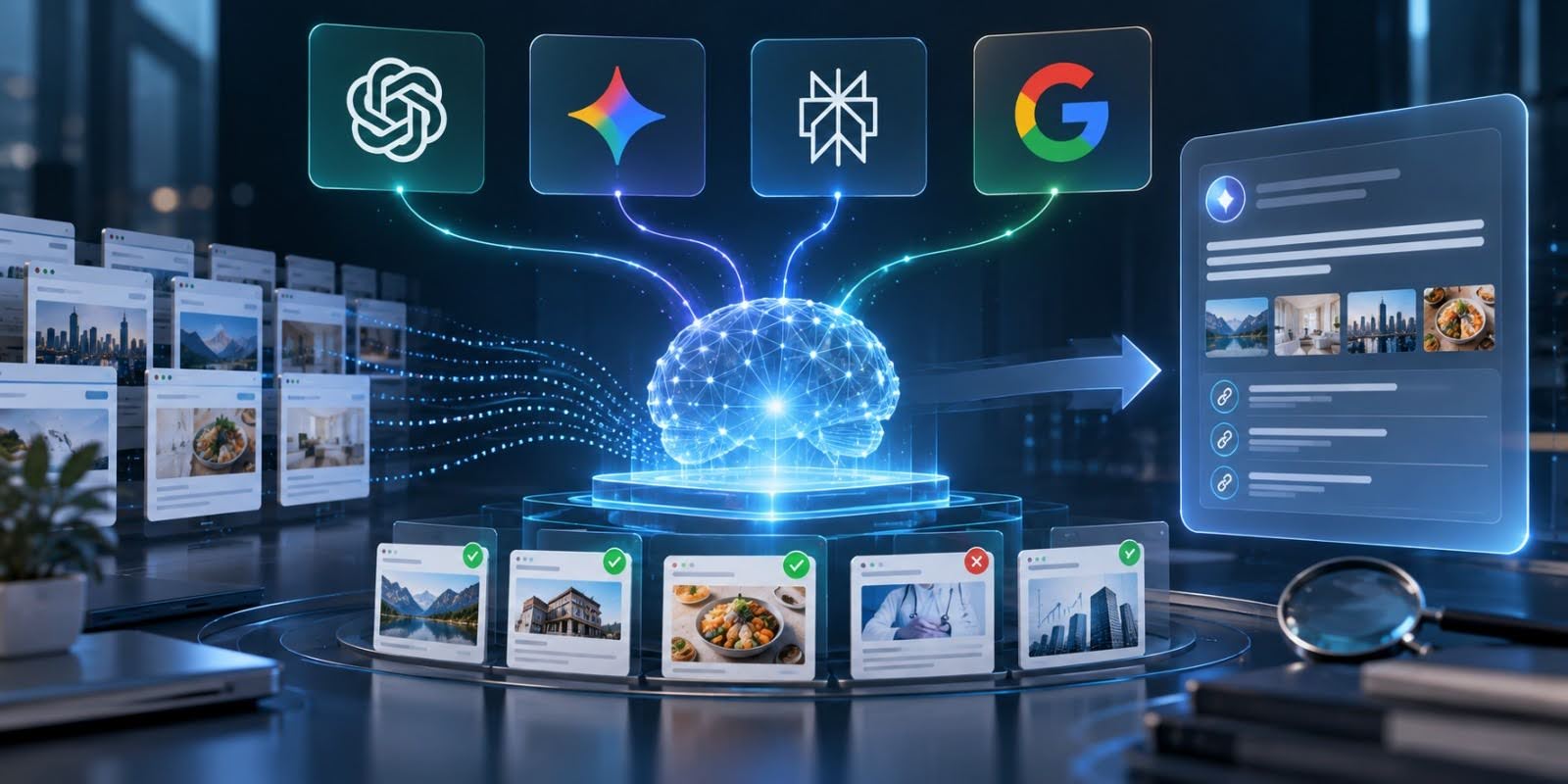
When it comes to AI SEO strategy in Singapore, measurement cannot rely on GA4 alone because AI search visibility often happens before, or without, a measurable website visit. A brand can be mentioned in ChatGPT, cited in Perplexity, surfaced in Google AI Overviews or recommended by an AI assistant even when the user never clicks directly to the website.
GA4 remains important because it measures visits, engagement, conversions and identifiable referral traffic. However, analytics data represents only the portion of the AI search journey that reaches the website and can be attributed through available referral information.
AI visibility is broader. It includes whether a brand appears, whether its website is cited, whether it is recommended, which prompts trigger visibility and how often competitors appear instead.
Google’s 2026 Search documentation reinforces this distinction by providing dedicated Search Console reporting for visibility in generative AI features such as AI Overviews and AI Mode. These reports focus on impressions and search visibility rather than treating website sessions as the only measure of generative search performance.
For Singapore businesses, AI SEO measurement should therefore combine traffic analytics with citation tracking, prompt monitoring, brand visibility, Search Console data and commercial outcomes.
AI Visibility Is Not the Same as AI Traffic
AI visibility measures whether a business or its content appears within an AI-generated search experience, while AI traffic measures users who actually visit the website from that experience.
The two metrics are related but not equivalent.
A business may have substantial AI visibility but very little direct AI referral traffic.
For example, an AI-generated answer could:
- Mention the company.
- Cite its research.
- Recommend it as a provider.
- Summarise information from its website.
The user may still choose not to click.
They could remember the company name, search for it later, visit through Google or contact the business through another route.
That exposure has occurred even though the original AI interaction is not visible as a GA4 session.
Why GA4 Tells Only Part of the Story

GA4 primarily observes what happens after a user reaches a measurable digital property.
It can show sessions, traffic sources, engagement events, conversions and other on-site behaviours.
What it generally cannot reveal is every interaction that occurred before the website visit.
An AI platform may influence a user’s decision without sending measurable referral traffic.
This creates a visibility gap.
GA4 can answer:
“What happened when identifiable AI traffic reached the website?”
It cannot fully answer:
“How often was the brand visible inside AI-generated answers before users clicked or searched elsewhere?”
That second question requires additional measurement.
The Difference Between Exposure and Visit

Exposure occurs when a user encounters the brand or website within an AI-generated response.
A visit occurs when the user enters the website.
This distinction is important because exposure can affect behaviour without producing an immediate click.
Consider a user asking:
“Which AI SEO agencies in Singapore should I consider?”
If the generated response mentions W360 Group Pte Ltd alongside several competitors, the company has gained AI visibility.
If the user later searches “W360 AI SEO” on Google instead of clicking directly from the AI answer, GA4 may record the resulting visit as organic search.
The earlier AI exposure is not necessarily visible within that session’s acquisition data.
AI Search and the Zero-Click Problem
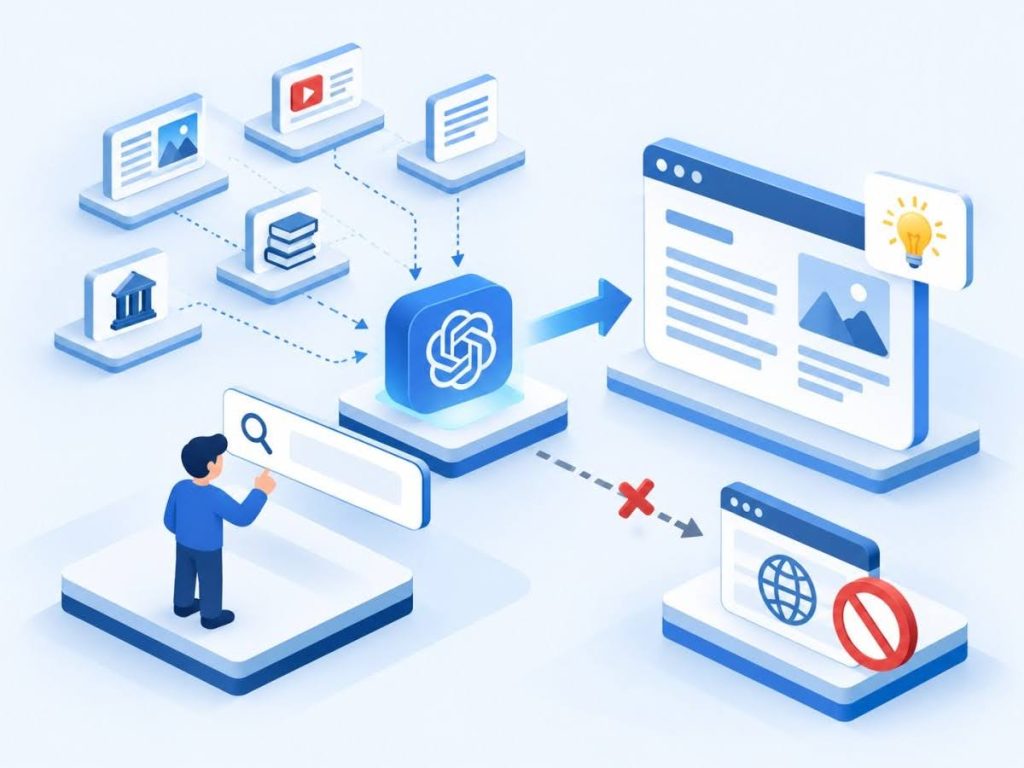
Zero-click search occurs when a user receives enough information from the search experience that no website visit is required.
Generative search can increase this possibility because AI systems can combine information from several sources and provide a direct answer.
For simple informational questions, the generated response may satisfy the user’s need entirely.
For commercial searches, zero-click behaviour can still create value.
A user may:
- Discover a brand.
- Compare providers.
- Remember a company name.
- Return through another channel later.
This means zero-click visibility should not automatically be interpreted as zero business value.
However, it should also not be assigned arbitrary monetary value without supporting evidence.
Why Zero-Click Visibility Needs Separate Measurement
Zero-click visibility requires its own KPIs because conventional web analytics begins after the click.
Useful visibility measures include:
- AI brand mentions
- Website citations
- Recommendation appearances
- Prompt coverage
- Citation share of voice
These metrics show whether the business is participating in relevant AI-generated answers.
The objective is not to replace traffic measurement.
It is to capture the part of the customer journey that traffic analytics cannot directly observe.
Tracking ChatGPT Referral Traffic
ChatGPT referral traffic can be measured when users click through to a website and the referral information is preserved.
GA4 can then classify those visits according to the source information available.
Businesses should create reporting views that identify AI-platform referrals separately from general referral traffic where possible.
The traffic analysis should examine:
- Sessions
- Engaged sessions
- Landing pages
- Conversions
- Lead quality
- Revenue or pipeline where available
This helps determine whether direct AI referrals behave differently from conventional organic or referral visitors.
However, ChatGPT referral traffic should not be interpreted as total ChatGPT visibility.
A brand can appear in many ChatGPT answers without receiving proportionate direct clicks.
Tracking ChatGPT Visibility Beyond Traffic
ChatGPT visibility requires controlled prompt monitoring.
Businesses should define a stable set of relevant questions and test them consistently.
For every prompt, the benchmark should record:
- Brand mentioned or absent
- Website cited or not cited
- Exact cited URL
- Competitors mentioned
- Recommendation context
This creates a visibility dataset independent of website sessions.
Traffic and prompt visibility can then be compared.
For example, increasing ChatGPT citations without increasing direct referral traffic may still indicate that source visibility is improving.
Whether that visibility contributes to commercial performance requires additional evidence.
Tracking Perplexity Referral Traffic
Perplexity can generate identifiable referral visits when users follow cited sources.
These visits can be monitored in GA4 in the same way as other referral sources where referral information is available.
Perplexity traffic is particularly useful for evaluating source-driven engagement because citations are central to the platform’s user experience.
Businesses should review which landing pages receive these visits.
Research pages may attract one type of visitor.
Service pages may attract another.
Referral traffic should therefore be analysed at page level rather than only as an aggregate source.
Tracking Perplexity Citation Visibility
Perplexity citation tracking should go beyond referral sessions.
The platform may repeatedly cite a website even when most users do not click.
A proper benchmark should record:
- Domain citation rate
- URL citation rate
- Prompt coverage
- Competitor citations
- Citation context
This can reveal whether a particular research study or guide is becoming a strong source asset.
If that page receives consistent citations across many related prompts, it may be strategically valuable even before significant referral traffic develops.
Tracking Other AI Referrals
Other AI platforms can also generate referral traffic when users follow links.
Potential traffic sources can include:
- Gemini
- Microsoft Copilot
- Google AI experiences
- Other AI assistants and research tools
The exact referral information available can differ by platform and interface.
Analytics configurations should therefore be reviewed periodically.
Traffic classification rules can become outdated as AI platforms change their domains, redirect behaviour or link structures.
Businesses should avoid assuming that every AI-originated visit will arrive under one clearly labelled “AI traffic” channel.
AI Traffic Classification Challenges
AI traffic classification is imperfect because referral information can be lost or transformed.
A user can also move between devices or channels.
For example:
AI assistant → branded Google search → website
GA4 may attribute the final website session to organic search rather than the original AI exposure.
Another journey could be:
AI assistant → browser copy-and-paste → direct visit
The resulting session may appear as direct traffic.
This means AI influence and AI-attributed traffic are different concepts.
Analytics should reflect that distinction rather than presenting every AI-influenced conversion as directly measurable.
AI Citations Without Website Visits
AI citations create source visibility even when no referral session occurs.
A citation means the website has been presented as supporting material within the generated response.
This can provide several forms of value.
The citation may:
- Expose the brand.
- Reinforce expertise.
- Provide evidence for a recommendation.
- Create later search demand.
- Produce occasional direct clicks.
The immediate website session is only one possible outcome.
Citation reporting should therefore remain separate from referral traffic reporting.
A content team may successfully increase source visibility even if the click-through effect remains limited.
Brand Mentions Without Clicks
Brand mentions represent another form of visibility that GA4 cannot directly measure.
A business can be named in an AI-generated answer without receiving a website citation.
This can still influence user awareness.
For example, a user researching Singapore service providers may see a company mentioned repeatedly across ChatGPT, Gemini and Perplexity.
The user may later type the brand name directly into Google.
The business gains recognition before any measurable website session occurs.
This is why brand mention rate should form part of AI SEO reporting.
It represents entity visibility rather than traffic.
Branded Search Lift
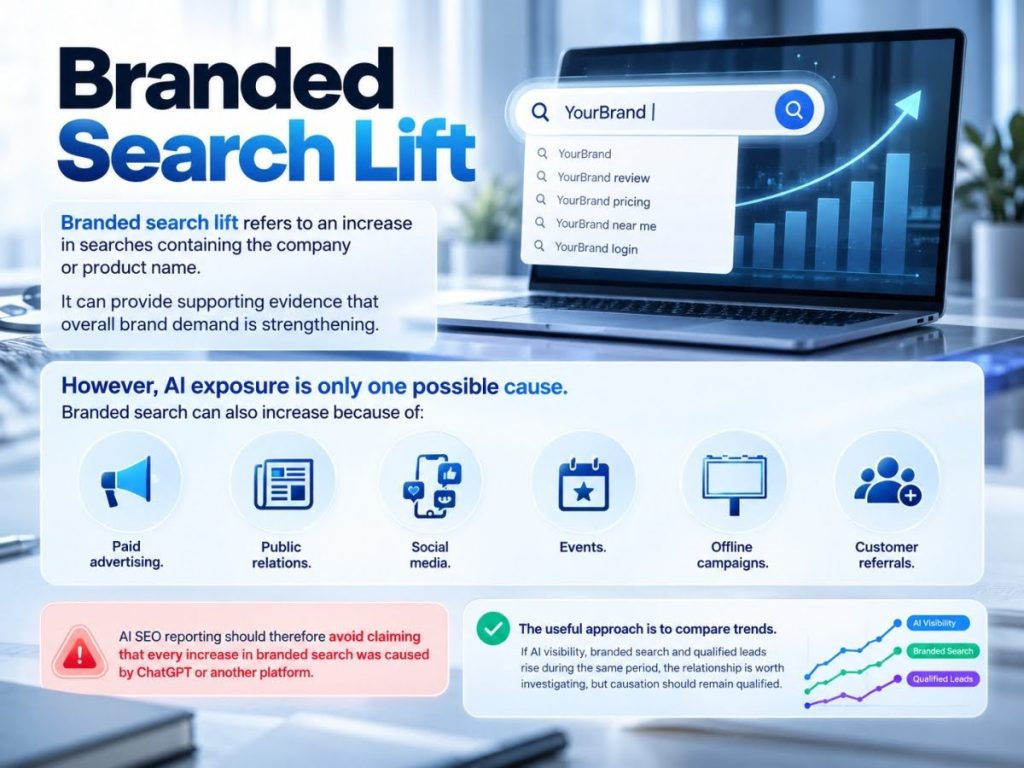
Branded search lift refers to an increase in searches containing the company or product name.
It can provide supporting evidence that overall brand demand is strengthening.
However, AI exposure is only one possible cause.
Branded search can also increase because of:
- Paid advertising
- Public relations
- Social media
- Events
- Offline campaigns
- Customer referrals
AI SEO reporting should therefore avoid claiming that every increase in branded search was caused by ChatGPT or another platform.
The useful approach is to compare trends.
If AI visibility, branded search and qualified leads rise during the same period, the relationship is worth investigating, but causation should remain qualified.
How to Measure Branded Search
Google Search Console can provide useful branded query data.
Businesses can monitor:
- Branded impressions
- Branded clicks
- Brand-plus-service searches
- Brand-plus-location searches
- Changes over time
A Singapore business may track queries such as:
“Brand Name Singapore”
“Brand Name AI SEO”
“Brand Name reviews”
“Brand Name services”
Growth in these searches can indicate increasing consideration.
The data should be compared against campaign activity across all channels.
AI Share of Voice
AI Share of Voice measures a brand’s relative visibility against competitors across a defined prompt universe.
It is particularly useful because raw mention numbers lack competitive context.
A company appearing in 40 prompts may look strong until the analysis reveals that its leading competitor appears in 80.
AI share of voice can include:
Component | Purpose |
Mention share | Brand recognition |
Citation share | Source visibility |
Recommendation share | Commercial inclusion |
Prompt coverage | Visibility breadth |
Platform coverage | Cross-platform consistency |
These metrics cannot be derived from GA4.
They require direct AI-search monitoring.
Prompt Coverage
Prompt coverage measures the percentage of relevant prompts where the brand appears.
The formula is:
Prompt Coverage = Prompts Where Brand Appears ÷ Total Relevant Prompts × 100
This helps businesses understand visibility breadth.
A brand may perform strongly for a few branded or narrow topics while remaining absent from most category-level queries.
Prompt coverage reveals that weakness.
For Singapore AI SEO campaigns, the prompt set should include informational, commercial, comparison and recommendation questions.
This provides a more representative picture of AI discovery.
Citation Share of Voice
Citation share of voice compares owned-domain citations against competitor citations.
The formula is:
Citation Share = Brand-Owned Citations ÷ Total Owned Citations Across Tracked Competitors × 100
Citation share is useful for determining whether the company’s website is becoming a meaningful source within its market.
It should be calculated separately by platform.
A site may have strong citation visibility in Perplexity but weak performance in ChatGPT or Google AI.
The combined figure should therefore never hide platform-level differences.
Recommendation Tracking
Recommendation tracking measures whether the brand appears when users explicitly ask AI systems to suggest providers, products or solutions.
This is one of the most commercially relevant forms of AI visibility.
Useful prompts can include:
- Which companies provide this service in Singapore?
- What are good providers for this requirement?
- Which supplier should a business consider?
- What agencies specialise in this service?
Recommendation tracking should classify the brand’s context.
Being included in a list is different from being presented as the strongest option for a specific use case.
This qualitative detail should remain visible in reporting.
AI Visibility and Google Search Console
Google Search Console now provides a more direct view of generative search visibility for Google Search.
In June 2026, Google introduced dedicated Generative AI performance reports covering visibility in generative AI features such as AI Overviews and AI Mode. Google stated that these insights were rolled out worldwide by 31 August 2026.
This is important because it moves generative visibility measurement beyond GA4 sessions.
Search Console can show search-side impressions before a click occurs.
Google also confirms that generative search remains rooted in core Search ranking and quality systems, reinforcing the need to connect AI visibility analysis with conventional SEO reporting.
For Singapore businesses, Search Console should therefore become part of the AI SEO measurement stack rather than relying exclusively on analytics sessions.
Search Console vs GA4 for AI Search
Search Console and GA4 answer different questions.
Search Console focuses on visibility and search interaction.
GA4 focuses on website behaviour after arrival.
A simplified comparison is:
Platform | Main Question |
Search Console | Did the site appear and receive search interaction? |
GA4 | What did the visitor do after arriving? |
AI prompt tracker | Was the brand mentioned, cited or recommended? |
CRM | Did visibility contribute to a qualified commercial outcome? |
No single tool covers the complete journey.
Combining them creates a more useful measurement framework.
Assisted Conversions
An assisted conversion occurs when a marketing interaction contributes to a conversion without being the final recorded source immediately before the lead or sale.
AI search can create these kinds of journeys.
For example:
ChatGPT recommendation → user remembers brand → Google search → service page → enquiry
The final conversion may be attributed to organic search.
The ChatGPT interaction may have influenced the journey but remain invisible within conventional analytics.
Another example could be:
Perplexity citation → website visit → no conversion → branded return visit three days later → lead
The relationship is more measurable but still not a simple last-click conversion.
This is why AI SEO reporting needs assisted-conversion thinking.
What AI SEO Cannot Reliably Attribute
AI SEO cannot reliably attribute every later branded search, direct visit or conversion to an earlier AI-generated exposure.
The connection is often unobservable.
Businesses should therefore avoid constructing artificial attribution models that assign unsupported value to every mention or citation.
The safer distinction is:
Observed: A brand was cited.
Observed: Branded search increased.
Observed: Leads increased.
Not proven: The citation caused those leads.
This methodological discipline protects the credibility of AI SEO reporting.
Lead-Source Questions
Lead-source questions can provide useful first-party evidence about AI influence.
Sales or enquiry forms can include optional fields such as:
“How did you hear about us?”
Possible responses could include:
- ChatGPT
- Gemini
- Perplexity
- Social media
- Referral
- Other
This does not create perfect attribution because users may forget or simplify their journeys.
However, it adds qualitative information that GA4 may not contain.
Sales teams can also record AI references when prospects explicitly mention them during calls.
AI Visibility and Lead Quality
Lead quality is more commercially meaningful than raw AI referral traffic.
A small number of AI-originated leads could be more valuable than a larger volume of unqualified sessions.
Businesses should therefore compare:
- Lead volume
- Qualification rate
- Conversion rate
- Deal size
- Sales cycle
- Service relevance
These metrics should be connected to identifiable AI-originated traffic where possible.
For less directly attributable visibility, the data should be described as supporting evidence rather than a proven AI-generated pipeline.
Recommended AI SEO KPI Stack
An AI SEO KPI stack combines visibility, traffic and commercial metrics.
The first layer should measure generative visibility.
The second should measure website activity.
The third should measure business outcomes.
A useful framework is:
Layer | KPI Examples |
AI visibility | Mentions, citations, recommendations |
Search visibility | Organic rankings, AI Overview impressions |
Traffic | AI referrals, organic sessions |
Engagement | Engaged sessions, key page activity |
Demand | Branded searches |
Commercial | Leads, qualified leads, conversions |
Each layer provides different evidence.
Together, they show a more complete AI-search journey.
Layer 1: Visibility Metrics
Visibility metrics measure whether the business is present inside relevant AI experiences.
Recommended metrics include:
- Brand mention rate
- Citation rate
- Recommendation rate
- Prompt coverage
- AI share voice
These metrics should be reported by platform.
A combined average can be useful for management, but the detailed platform view should remain available.
This prevents one strong channel from hiding weaknesses elsewhere.
Layer 2: Search Metrics
Search metrics connect AI SEO with traditional organic performance.
Useful measurements include:
- Keyword rankings
- Search impressions
- Search clicks
- Generative AI impressions in Search Console
- AI Overview visibility
- AI Mode visibility
Google explicitly states that conventional SEO best practices remain relevant for generative AI search because its AI features rely on core Search ranking and quality systems.
This means AI SEO should not be reported separately from foundational organic performance.
The two systems should be interpreted together.
Layer 3: Traffic Metrics
Traffic metrics measure visits reaching the website.
These can include:
- ChatGPT referrals
- Perplexity referrals
- Gemini referrals were identifiable
- Google organic traffic
- Direct traffic
- Branded organic visits
Traffic should be segmented by landing page.
A research article can attract users with very different intent from a service page.
Understanding landing-page behaviour makes traffic analysis more meaningful than simply reporting AI sessions as one number.
Layer 4: Engagement Metrics
Engagement metrics show what visitors do after arrival.
Useful examples include:
- Engaged sessions
- Time spent on key pages
- Internal navigation
- Form starts
- Downloads
- Contact actions
The appropriate metric depends on the website.
A B2B service business may care about contact-page progression.
An ecommerce business may care about product views and checkout behaviour.
Engagement should reflect meaningful user actions rather than arbitrary event volume.
Layer 5: Demand Metrics
Demand metrics show whether people are actively seeking the brand or its services.
Branded search is one useful example.
Other signals can include:
- Direct visits
- Returning visitors
- Brand-plus-service searches
- Enquiry references to AI platforms
These metrics should not be treated as proof of AI influence.
Their value comes from supporting broader trend analysis.
When AI visibility and branded demand rise together, the relationship becomes an important area for ongoing measurement.
Layer 6: Commercial Metrics
Commercial metrics determine whether visibility ultimately contributes to business outcomes.
These can include:
- Enquiries
- Qualified leads
- Sales opportunities
- Revenue
- Pipeline value
- Assisted conversions
Not every business needs to report all six.
The KPI set should match the organisation’s sales process.
For a Singapore B2B company with a long sales cycle, qualified opportunity value may matter more than immediate ecommerce revenue.
Building an AI SEO Dashboard
An AI SEO dashboard should connect the full measurement stack without presenting unsupported attribution.
A useful executive view can contain:
Area | KPI | Trend |
AI Visibility | Prompt coverage | Monthly |
Brand | Mention share | Monthly |
Sources | Citation share | Monthly |
Google AI | Generative impressions | Monthly |
Traffic | AI referrals | Monthly |
Demand | Branded search | Monthly |
Leads | AI-attributed enquiries | Monthly |
The dashboard should also include competitor benchmarks.
Absolute visibility matters less when competitors are gaining faster.
A share-of-voice view provides that context.
Platform-Level Reporting
AI visibility should be reported separately by platform because ChatGPT, Gemini, Perplexity and Google AI do not necessarily use identical source-selection processes.
A business can be highly visible on one platform and almost absent on another.
A platform report can include:
- Mention rate
- Citation rate
- Recommendation rate
- Top cited URLs
- Competitors
- High-value prompt gaps
This makes the reporting actionable.
If Perplexity visibility is already strong, additional effort may be better directed toward a platform where competitors dominate.
Prompt-Level Reporting
Prompt-level reporting identifies exactly where the business appears and where it is missing.
This is more useful than one aggregated AI visibility score.
For each prompt, record:
- Prompt wording
- Intent
- Platform
- Brand appearance
- Citation source
- Competitor visibility
The dataset should remain stable across reporting periods.
Otherwise, trend comparisons become unreliable.
New prompts can be added, but the original benchmark should remain intact whenever possible.
Content-Level Reporting
Content-level reporting identifies which URLs contribute to generative visibility.
A business may discover that its strongest source assets are not the pages receiving the most organic traffic.
For example, a research report may receive few visits but repeated AI citations.
A service page may generate leads while receiving few citations.
Both pages can be valuable for different reasons.
Content reporting should therefore classify pages according to their role.
Possible roles include:
- Citation asset
- Traffic asset
- Conversion asset
- Brand authority asset
- Supporting content
This avoids evaluating every page using the same KPI.
Common Attribution Mistakes
AI SEO reporting becomes unreliable when visibility and conversion data are combined without clear evidence.
Several mistakes are particularly common.
Treating Every AI Citation as Traffic
A citation does not mean a user clicked.
Citation visibility and referral traffic should remain separate metrics.
Treating Every Branded Search as AI-Driven
Branded searches can be influenced by many channels.
AI exposure may contribute, but causation should not be assumed.
Treating Direct Traffic as AI Traffic
Users can reach the site directly for many reasons.
A direct session is not evidence of AI influence by itself.
Ignoring Third-Party Citations
A brand can gain recommendation visibility through external sources even if its own website is not cited.
Owned-domain reporting alone misses this.
Reporting Only Referral Sessions
Referral sessions measure one downstream outcome.
They do not measure uncited mentions, zero-click citations or recommendation visibility.
Common GA4 Reporting Mistakes
GA4 reporting can create a false impression of AI SEO weakness if teams look only for direct AI traffic.
For example, management may see 30 AI referral sessions and conclude that the channel has little value.
That conclusion is incomplete if the brand appears across a large number of commercial AI prompts.
The opposite mistake is also possible.
A business may report hundreds of AI sessions as proof of strategic success without checking whether those visitors become qualified leads.
Traffic requires context.
The appropriate questions are:
- Where did users land?
- What did they do?
- Did they convert?
- Was the traffic commercially relevant?
AI Search and Multi-Channel Journeys
AI search increasingly sits within multi-channel research journeys rather than operating as an isolated acquisition channel.
A user may move through several touchpoints:
AI search → Google → LinkedIn → website → enquiry
Another may follow:
Google AI Overview → research article → return visit → contact
A third may see:
ChatGPT recommendation → direct brand search → Google Business Profile → phone enquiry
These journeys make single-channel attribution increasingly difficult.
AI SEO should therefore be evaluated as part of wider search and brand discovery rather than forcing every interaction into one last-click channel.
Reporting AI SEO to Management
Management reporting should explain AI SEO using commercial language rather than technical platform jargon alone.
A useful summary should answer four questions.
- Are we visible?
- Are competitors more visible?
- Is visibility producing measurable website activity?
- Is that activity contributing to commercial outcomes?
An executive report can therefore show:
Visibility: Brand appears in X% of tracked prompts.
Competitive position: Citation share is above or below key competitors.
Traffic: Identifiable AI referrals increased or decreased.
Commercial impact: AI-attributed leads and assisted indicators.
The numbers should always be tied to a defined measurement methodology.
AI SEO Reporting for Singapore Businesses
Singapore businesses should tailor AI SEO reporting to their commercial model.
A local service company may prioritise:
- Provider recommendations
- Branded search
- Calls
- Enquiries
A B2B organisation may prioritise:
- Citation authority
- Qualified leads
- Pipeline
- Research engagement
An ecommerce business may focus on:
- Product citations
- Referral sessions
- Product views
- Transactions
There is no universal dashboard that fits every organisation.
The KPI stack should follow the customer journey.
The Role of Google Search Console in 2026
Google Search Console now provides a more useful direct measurement layer for generative search than it did previously.
Google announced dedicated generative AI performance reporting in June 2026, including visibility information for AI Overviews and AI Mode, with worldwide rollout completed by 31 August 2026.
This means businesses should no longer rely solely on manual observation when assessing Google generative search visibility.
Search Console can provide Google-specific impression data.
Manual or specialised tracking remains useful for:
- Prompt context
- Competitor comparison
- Exact citation analysis
- Cross-platform measurement
Search Console and prompt monitoring therefore complement each other.
Why Traditional SEO Metrics Still Matter
Traditional SEO metrics remain relevant because generative search has not replaced conventional search systems.
Google states that its generative AI features are rooted in core Search ranking and quality systems and continue to depend on foundational SEO practices such as crawlability, useful content and technical accessibility.
Google also advises publishers to focus on unique, valuable, non-commodity content rather than creating pages solely for generative search tricks.
AI SEO reporting should therefore retain:
- Rankings
- Search impressions
- Organic clicks
- Indexing health
- Content performance
The measurement model becomes broader, not entirely new.
AI SEO Measurement Framework
A practical AI SEO measurement framework can be divided into five stages.
Stage 1: Establish the Baseline
Record current visibility across a fixed prompt universe.
Include competitors.
Stage 2: Measure Source Visibility
Track which owned pages receive citations.
Identify third-party sources mentioning the brand.
Stage 3: Track Traffic
Create AI referral reporting in GA4 where identifiable.
Measure landing-page quality and conversion behaviour.
Stage 4: Track Demand
Monitor branded search and explicit AI mentions in lead-source data.
Stage 5: Connect Commercial Outcomes
Compare AI visibility trends with leads, qualified pipeline and assisted conversion indicators.
This structure separates what is directly observed from what is inferred.
What Success Should Look Like
AI SEO success should not be defined as “more ChatGPT traffic”.
A stronger definition includes several dimensions.
The business should aim to achieve:
- Broader prompt coverage.
- Higher citation share.
- More commercially relevant recommendations.
- Stronger generative search impressions.
- Qualified referral traffic.
- Improving branded demand.
- Commercially useful leads.
Not every metric needs to increase at the same rate.
For example, a research campaign may initially improve citations before producing measurable referral traffic.
The reporting should reflect the role of each activity.
What Businesses Should Not Measure in Isolation
Several metrics become misleading when viewed alone.
AI referral traffic alone ignores zero-click exposure.
Citation count alone ignores commercial relevance.
Brand mentions alone ignore whether the website is a useful source.
Rankings alone ignore generative visibility.
Leads alone can hide upper-funnel progress.
The strongest AI SEO reporting model therefore uses a balanced set of metrics rather than treating any one number as definitive.
Frequently Asked Questions
GA4 can track identifiable visits arriving from AI platforms when referral information is available. It cannot measure every AI-generated brand mention, citation or zero-click interaction.
AI visibility measures whether the brand or website appears in generated answers. Referral traffic measures users who actually click through to the website. A business can have visibility without receiving a visit.
Yes. Users can click cited or linked sources in ChatGPT and reach a website. Those visits may be measurable in analytics when referral information is preserved.
Useful metrics include brand mention rate, citation rate, recommendation rate, prompt coverage, AI share of voice, branded search and qualified leads. These provide a broader view of generative search performance.
Yes. Citations can create source visibility and brand exposure without generating an immediate referral session. Their commercial impact should still be evaluated cautiously rather than assumed.
It can potentially contribute to branded search because users may encounter a company in an AI-generated answer and search for it later. However, branded demand has many possible causes, so direct attribution should not be assumed.
Google introduced dedicated Generative AI performance reports in Search Console in 2026 covering visibility within generative search features such as AI Overviews and AI Mode. This provides a direct Google-specific measurement layer alongside GA4.
There is no single universal KPI. Businesses should combine visibility, citations, recommendations, traffic, branded demand and commercial outcomes according to their objectives.
AI SEO Performance Begins Before the Click
AI SEO strategy in Singapore measurement needs to reflect a search journey in which meaningful exposure can happen before a website session exists.
GA4 remains essential.
It shows what identifiable visitors do after reaching the website.
However, it cannot independently measure every ChatGPT mention, Perplexity citation, Gemini recommendation, Google AI Overview appearance or zero-click brand exposure.
That requires a wider measurement framework.
Singapore businesses should combine prompt tracking, citation monitoring, competitive share of voice, Google Search Console, GA4, branded search data and CRM outcomes.
The purpose is not to invent attribution where none exists.
It is to separate what can be observed directly from what requires supporting evidence.
AI search visibility, AI traffic and AI-driven commercial performance are three different layers.
Reporting becomes more credible when those layers are measured separately and then analysed together.
Build an AI SEO Measurement Model Beyond GA4
Businesses evaluating generative search performance should measure whether their brand appears, whether their website is cited, whether competitors are recommended more frequently and whether identifiable AI traffic contributes to meaningful business outcomes.
W360 Group Pte Ltd. can help businesses develop an AI SEO strategy in Singapore measurement framework covering AI visibility, citations, prompt tracking, generative search impressions, referral traffic and commercial KPIs. Businesses that want a clearer benchmark beyond GA4 traffic alone can get a quote from W360 Group Pte Ltd.