When it comes to AI Overviews, Google in Singapore visibility is not distributed evenly across every industry or search intent. Google AI Overviews are more relevant to some queries than others because the usefulness of a generated summary depends heavily on the information users are seeking.
Informational searches often create stronger conditions for an AI-generated explanation because the user is asking for facts, definitions, comparisons or guidance. Commercial, transactional and local searches can produce different result structures because users may need provider information, products, maps, reviews or direct action rather than a summarised answer alone.
For Singapore businesses, this means the impact of Google AI Overviews should be assessed at keyword and intent level rather than through broad assumptions such as “AI Overviews reduce all organic traffic”.
The appropriate analysis is to determine which types of searches within an industry are exposed, which source categories Google uses, whether cited pages overlap with traditional organic rankings and where businesses can contribute useful supporting information.
This study framework examines healthcare, finance, education, ecommerce, B2B services and property. It does not assign unsupported occurrence percentages where a completed W360 dataset has not yet validated them. Instead, it establishes the methodology and interpretation required for a reliable Singapore AI Overview benchmark.
Executive Summary
Google AI Overview exposure depends more on search intent and information requirements than on industry labels alone.
Within the same sector, one query may be highly suitable for a generated summary while another may require local listings, transactional results or official documentation.
The clearest patterns to examine are:
- Informational queries that require explanations.
- Comparison queries requiring multiple considerations.
- Commercial research before a purchase.
- High-stakes topics requiring authoritative sources.
- Local queries where physical proximity matters.
Businesses should therefore avoid evaluating AIO SEO Singapore performance using one visibility figure for an entire domain.
A more useful benchmark separates keywords by intent, industry and source type.
This shows where AI Overviews represent an organic visibility risk, where they create citation opportunities and where conventional Google rankings remain the dominant search objective.
Research Methodology
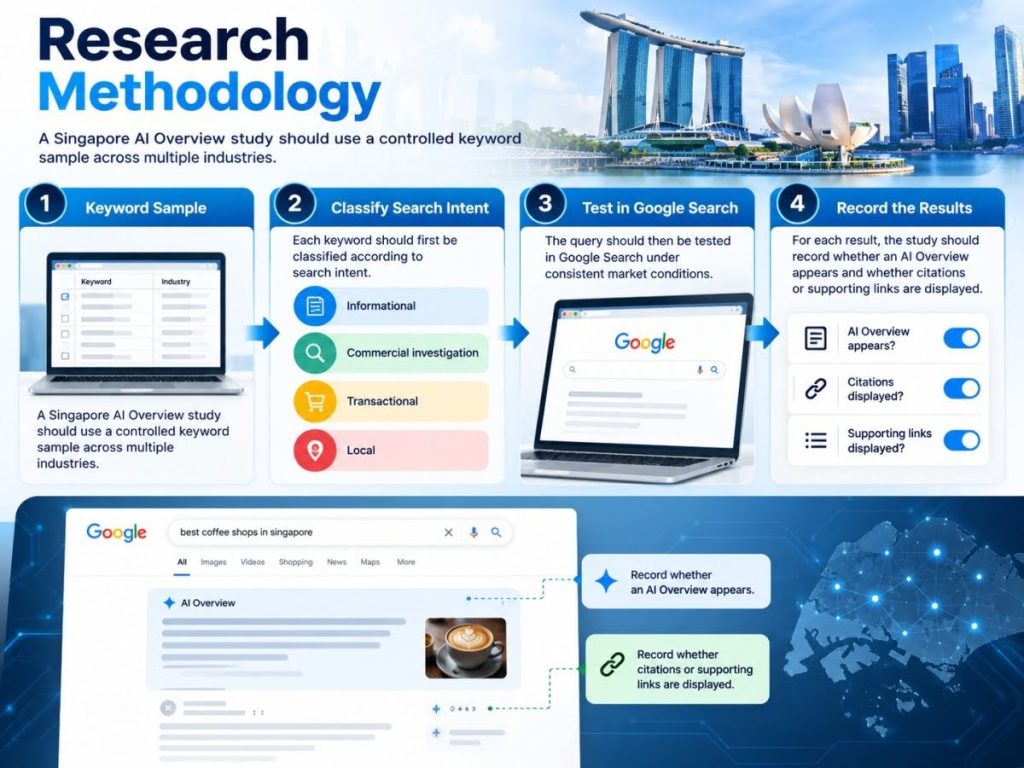
A Singapore AI Overview study should use a controlled keyword sample across multiple industries.
Each keyword should first be classified according to search intent.
The core intent categories are:
- Informational
- Commercial investigation
- Transactional
- Local
The query should then be tested in Google Search under consistent market conditions.
For each result, the study should record whether an AI Overview appears and whether citations or supporting links are displayed.
The following data should also be captured:
| Measurement | Purpose |
| AI Overview present | Measures occurrence |
| Cited domains | Identifies source competition |
| Exact cited URLs | Identifies page-level visibility |
| Organic position | Measures ranking overlap |
| Source type | Shows preferred information category |
| Singapore relevance | Identifies local vs global sourcing |
| Search intent | Explains exposure pattern |
This methodology allows the final analysis to separate raw AI Overview frequency from strategic significance.
Keyword Sample

The keyword sample should represent how Singapore users actually research products, services and decisions.
A useful dataset should avoid relying only on broad head terms.
Head terms can produce result formats very different from specific long-tail questions.
For example, the following searches all relate to physiotherapy but represent different information needs:
- physiotherapy Singapore
- what does physiotherapy treat
- physiotherapy vs chiropractic care
- how long does physiotherapy take
- sports physiotherapy near me
The first may be strongly commercial and local.
The second and third are informational.
The final query depends heavily on geographic relevance.
A balanced study should therefore include several search patterns within each industry rather than assuming one keyword represents the whole sector.
Industries Analysed
The industries selected for this framework reflect sectors where Singapore users frequently conduct substantial online research before taking action.
They include:
- Healthcare
- Finance
- Education
- Ecommerce
- B2B services
- Property
These categories also provide useful contrast.
Healthcare and finance contain high-stakes information.
Education combines informational and commercial research.
Ecommerce has strong transactional intent.
B2B services often involve longer research journeys.
Property combines financial, legal, informational and local considerations.
This makes the industries useful for analysing how intent can influence AI Overview exposure.
Overall AI Overview Occurrence Rate
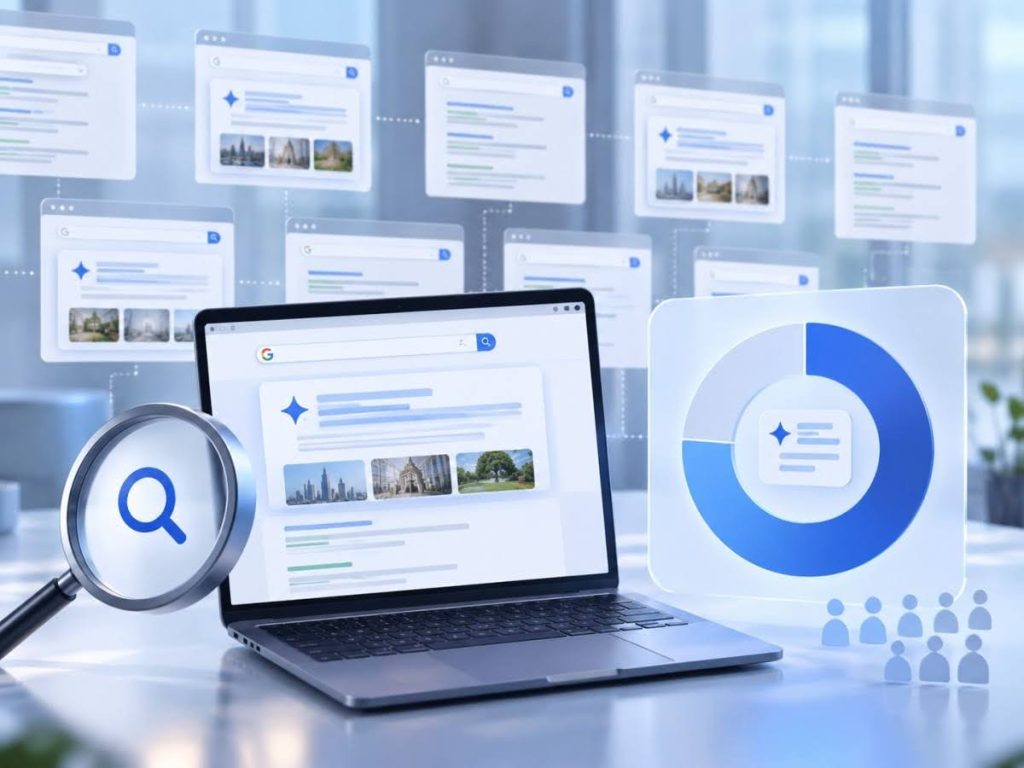
An overall AI Overview occurrence rate should represent the percentage of tested searches where an AI Overview appears.
The formula is:
AI Overview Occurrence Rate = Queries Triggering an AI Overview ÷ Total Queries Tested × 100
However, one overall percentage should not be used as the primary business conclusion.
A dataset could show a moderate overall occurrence rate while hiding major differences between informational and transactional searches.
The final validated benchmark should therefore report occurrence by:
- Industry
- Search intent
- Query length
- Topic type
- Commercial stage
Until the actual test has been completed, a specific Singapore occurrence percentage should not be presented as a W360 finding.
The methodological value comes from identifying which categories consistently trigger AI-generated results.
Informational Queries
Informational queries are generally the most important group to monitor because their purpose aligns naturally with summarised explanations.
These searches often begin with phrases such as:
- What is
- How does
- Why does
- When should
- Difference between
The user expects an explanation rather than immediate navigation to one provider.
Google can potentially assemble such answers from multiple sources.
For example, a search about the differences between two professional services may require definitions, advantages, limitations and practical context.
This creates more opportunities for supporting sources.
For SEO teams, informational content therefore deserves particular attention when evaluating AIO visibility.
Commercial Queries
Commercial queries occur when users are researching options before making a decision.
Examples include:
- best accounting software for SMEs
- suitable corporate training courses
- office rental options Singapore
- types of business insurance
- comparison of mortgage packages
These queries can contain enough informational complexity for generated summaries while also requiring commercial context.
AI Overviews in this area may influence consideration earlier in the conversion journey.
The risk is not necessarily losing the final conversion click.
The more immediate risk is losing brand exposure during the research stage.
Businesses should therefore track whether competitors, publishers or third-party platforms are being cited for the questions that shape customer evaluation.
Transactional Queries
Transactional queries indicate a stronger intention to perform an action.
Examples can include:
- buy office chair Singapore
- book yacht charter Singapore
- apply for business loan
- enrol in course Singapore
These queries usually require products, providers, prices, booking systems or action-oriented pages.
A generated summary can still appear in some transactional search environments, but the search journey depends more heavily on actionable results.
For businesses, the primary SEO objective often remains strong commercial landing pages.
AI Overview optimisation should not replace:
- Product optimisation
- Service-page SEO
- Local visibility
- Conversion usability
The exposure should be monitored, but transactional intent requires a different strategy from informational content.
Local Queries
Local queries depend heavily on geography and physical availability.
Examples include:
- dentist near me
- physiotherapist Tampines
- office rental Raffles Place
- forklift supplier Singapore
Users may need addresses, operating hours, local reviews and map information.
This changes the value of a generated summary.
A general explanation cannot replace proximity information where location determines the decision.
For Singapore businesses with physical premises, AI SEO should therefore complement local SEO rather than replace it.
Local search optimisation still depends on accurate business information, relevant landing pages, reviews and geographic relevance.
Search Intent Is More Important Than the Industry Label

Search intent is often a better predictor of AI Overview exposure than a broad industry category.
A healthcare query asking “what causes lower back pain” is informational.
A healthcare query asking “physiotherapist near me” is local and commercial.
Both belong to healthcare, but they require very different Google results.
The same pattern applies across industries.
An accounting company may face AI Overview exposure for “what is corporate tax filing” but not necessarily for a direct navigational search for its own brand.
SEO teams should therefore map AI Overview opportunities to intent clusters within an industry.
This produces a more precise AIO strategy Singapore businesses can act on.
Healthcare
Healthcare is highly exposed to informational AI search because patients often research symptoms, treatments and conditions before deciding whether to seek professional care.
Typical searches can include:
- what causes shoulder pain
- symptoms of hearing loss
- physiotherapy for scoliosis
- what is root canal treatment
These questions invite explanatory content.
However, healthcare information is also high-stakes.
Sources need to be accurate, carefully written and appropriately attributed.
Commercial clinics can contribute useful content, but they should not replace official medical guidance or make unsupported claims.
For Singapore healthcare providers, AI SEO should emphasise factual educational content, practitioner attribution and clear separation between general information and individual medical advice.
Healthcare AI Overview Opportunities
Healthcare businesses can create useful source material by explaining treatments, processes and commonly misunderstood conditions accurately.
The strongest opportunities often include:
- Treatment explanations
- Procedure preparation
- Recovery expectations
- Condition comparisons
- Frequently asked patient questions
The content should reflect qualified professional expertise.
A clinic should also ensure that medical claims can be supported by appropriate sources.
The objective is not simply to mention the clinic more frequently.
It is to produce reliable information that can support the user’s research journey.
Healthcare AI Overview Risks
The main healthcare risk is that informational queries can be answered substantially within the search results.
If a user receives a complete basic explanation, they may not need to click a generic article.
This creates greater pressure on healthcare content to contribute unique value.
Useful differentiation can come from:
- Singapore-specific treatment processes
- Practitioner commentary
- Original patient education
- Detailed procedure guidance
- Clear service pathways
Generic health articles copied from widely available sources are increasingly difficult to justify.
Finance
Finance is another high-information sector because users frequently need definitions, comparisons and regulatory explanations.
Possible queries include:
- how mortgage refinancing works
- fixed vs floating home loan
- business insurance coverage
- what is directors and officers insurance
These topics often require multi-part answers.
The user may need to understand terminology before evaluating providers.
This creates potential AI Overview exposure.
However, financial information can change with regulations, market conditions and product terms.
Accuracy and freshness are therefore critical.
Finance AI Overview Opportunities
Financial businesses can create useful source assets by explaining complicated decisions clearly.
Useful formats include:
- Comparison tables
- Decision frameworks
- Regulatory explainers
- Loan terminology guides
- Insurance coverage explanations
Singapore-specific context can add genuine value when regulations or market structures differ from other countries.
Businesses should cite primary sources where official rules are involved.
The commercial provider can then add practical interpretation.
This creates a stronger distinction between official facts and professional guidance.
Finance AI Overview Risks
Finance has substantial risk of generic informational traffic becoming less click-dependent.
Basic definitions can often be summarised effectively.
For example, a user asking what refinancing means may receive enough introductory information directly in the search experience.
The opportunity lies further down the information journey.
Users still need:
- Provider-specific details
- Calculators
- Personalised comparisons
- Current market information
- Professional advice
SEO content should therefore progress beyond definitions and provide deeper decision support.
Education
Education combines informational research, course discovery and commercial decision-making.
Users may search for:
- what is WSQ training
- leadership courses Singapore
- data analytics certification
- part-time professional courses
- skills needed for cybersecurity
Some questions are educational.
Others involve direct course selection.
This creates a mixed AI Overview environment.
Educational providers should therefore separate informational authority from course conversion pages.
A course page should remain focused on the programme.
Supporting content can address industry trends, career skills, qualifications and learning pathways.
Education AI Overview Opportunities
Education providers can build authority through specialist learning content.
Useful topics can include:
- Career progression.
- Qualification pathways.
- Skills requirements.
- Certification differences.
- Industry demand.
These pages can support discovery before a user is ready to enrol.
For Singapore providers, local qualification structures and workforce programmes can create meaningful localisation.
Where official programme rules are involved, the original institutional source should remain clearly referenced.
Education AI Overview Risks
Generic career content can be highly vulnerable to summarisation.
A basic article such as “What is project management?” provides little information that cannot be synthesised from many existing pages.
Stronger educational content should therefore contribute something more specific.
This can include:
- Instructor insight
- Curriculum context
- Singapore workforce trends
- Industry-specific examples
- Original learner research
The objective is to become a useful specialist source rather than another publisher of broad definitions.
Ecommerce
Ecommerce is generally more transaction-oriented than healthcare, finance or education.
However, substantial informational search occurs before product selection.
Examples include:
- which mattress material is best
- teak vs oak furniture
- electric vs diesel forklift
- portable speed bumps vs permanent humps
These comparison and buying-guide searches can create AI Overview opportunities.
The actual purchase query may still depend on product listings and transactional results.
This makes ecommerce AI SEO particularly relevant during the research phase.
Ecommerce AI Overview Opportunities
Ecommerce websites can create valuable content through detailed buying guidance.
Useful content can include:
- Product comparisons
- Material explanations
- Selection criteria
- Technical specifications
- Use-case guidance
Product data should be accurate and consistent with the commercial pages.
Supporting articles should then help users understand which product suits a particular need.
For AI search, this creates source material that goes beyond a basic product catalogue.
Ecommerce AI Overview Risks
The primary risk is losing early-stage comparison visibility to publishers, marketplaces or competitors with stronger educational resources.
A product page may rank well commercially while a competitor’s buying guide becomes the preferred explanatory source.
This creates a source-type gap.
The response should not be to convert every product page into a long-form article.
Instead, ecommerce sites should maintain clear product pages while building supporting guides for informational and comparison intent.
The two content types should support each other through internal linking.
B2B Services
B2B services can be significantly affected by AI Overviews because business buyers often conduct extensive research before contacting a provider.
Examples include:
- what is AI SEO
- BizSAFE certification process
- commercial printing methods
- material handling equipment guide
- corporate workspace solutions
These searches can occur weeks or months before a purchase decision.
AI-generated summaries may influence which terminology, providers and solutions enter the buyer’s consideration set.
This makes informational visibility strategically important even when direct referral traffic remains limited.
B2B AI Overview Opportunities
B2B businesses often possess specialised expertise that general publishers lack.
This creates strong information-gain opportunities.
Useful assets can include:
- Technical guides
- Industry benchmarks
- Implementation frameworks
- Original research
- Procurement guidance
- Case evidence
These resources can complement service pages.
The service page should focus on the commercial offering.
The supporting resource should answer a distinct research question.
This reduces cannibalisation while expanding topical authority.
B2B AI Overview Risks
The greatest B2B risk is becoming invisible during the research phase.
A business can rank for its service keyword but lose informational visibility to publishers and competitors.
This can weaken future brand consideration.
For example, a company may rank for “material handling equipment Singapore” but never appear when buyers ask what equipment they need for a warehouse.
The commercial ranking remains valuable.
However, competitors providing stronger educational content may enter the buyer’s consideration earlier.
AI SEO therefore extends the B2B funnel rather than replacing conventional lead-generation pages.
Property
Property searches combine financial, regulatory, commercial and local information.
Possible searches include:
- serviced office vs traditional office
- office rental considerations
- lease terms Singapore
- coworking vs private office
- property buying process Singapore
Many of these queries require explanation.
Others depend on listings, availability or location.
This creates a mixed AI Overview exposure similar to education and ecommerce.
Businesses should separate evergreen informational content from live commercial inventory.
Property AI Overview Opportunities
Property-related businesses can provide useful decision frameworks.
Examples include:
- Leasing checklists
- Workspace comparisons
- Location considerations
- Fit-out planning
- Occupancy guidance
Singapore-specific factors can add substantial value where market practices differ internationally.
However, time-sensitive information should be clearly maintained.
Outdated market conditions can reduce usefulness.
The strongest property content therefore combines evergreen guidance with carefully dated market information.
Property AI Overview Risks
Property content can lose visibility when generic guides fail to add anything beyond what major portals and publications already provide.
Large platforms often possess substantial inventories, data and authority.
Smaller businesses need a clearer reason to be cited.
That reason can come from specialised expertise.
For example, a serviced office provider can contribute practical workspace-selection guidance based on operational experience rather than attempting to compete directly with a national property portal on every property topic.
Specialisation can create stronger source relevance.
Most Common AIO Source Types
AI Overview source analysis should classify citations according to what type of website provides the information.
Useful categories include:
Source Type | Typical Role |
Government | Official rules and facts |
Academic | Research evidence |
Editorial | Independent explanation |
Business | First-party expertise |
Marketplace | Product or provider data |
Community | Experience and sentiment |
The final study should count these categories by industry.
This can reveal important differences.
Finance may rely more heavily on institutional information.
Ecommerce comparisons may use publishers and commercial websites.
B2B topics may use specialist businesses and industry publications.
Source type should therefore form part of every AIO competitor analysis.
Singapore Sources vs International Sources
Singapore-specific queries do not automatically guarantee Singapore sources.
International publishers can still provide useful general information.
The strategic question is whether local context materially changes the answer.
For example, a general explanation of schema markup can be international.
A guide to a Singapore workplace certification should require Singapore-specific evidence.
The study should therefore classify citations according to whether they are:
- Singapore-based
- Singapore-specific international sources
- Global sources
- Official Singapore sources
This shows whether local publishers are contributing enough relevant information.
Where global sources dominate a genuinely local topic, there may be an information gap Singapore businesses can address.
Google Ranking and AIO Overlap
Google ranking and AI Overview citation visibility overlap, but they should not be treated as identical.
A page ranking strongly has already demonstrated relevance within Google’s conventional Search systems.
That can create a strong foundation for AI visibility.
However, AI-generated answers may require supporting information from pages other than the exact top-ranking result.
A page can therefore contribute to one part of an answer even when it does not hold the highest position for the original query.
The appropriate benchmark should compare:
Organic Position | AI Citation Status |
Top 3 | Cited / not cited |
Positions 4–10 | Cited / not cited |
Outside Top 10 | Cited / not cited |
This allows the study to examine overlap objectively.
Why Traditional Rankings Still Matter
Traditional rankings still matter because Google’s AI search features remain part of the wider Search ecosystem.
Strong SEO supports:
- Crawlability
- Indexability
- Relevance
- Authority
- User-focused content
- Page discovery
Businesses should therefore avoid creating separate “AI-only” pages with little conventional search value.
The stronger strategy is to build pages useful in both environments.
A clear, authoritative guide can rank organically, support internal linking and potentially function as an AI source.
This provides more durable value than optimising for one search feature alone.
Industries With the Highest Exposure
Industry exposure should be determined from the completed keyword dataset rather than assumed from anecdotal observations.
However, the study framework expects greater exposure where queries frequently require explanatory synthesis.
This means sectors containing many educational, comparison and decision-support searches deserve the closest monitoring.
Healthcare, finance, education, B2B services and property all contain substantial informational layers.
Ecommerce exposure may be more concentrated around comparisons and buying guidance rather than direct purchase queries.
The final benchmark should validate these patterns quantitatively before declaring one sector “most affected”.
No industry ranking should be published as a W360 finding until the tested occurrence rates are available.
Industries With the Greatest Opportunity
The greatest AI Overview opportunity exists where businesses possess expertise or data that is currently underrepresented in available search sources.
Opportunity is therefore not identical to exposure.
A highly exposed industry with dominant government and institutional sources may offer limited commercial citation opportunities for basic facts.
A moderately exposed B2B sector with weak existing explanatory content may offer greater room for specialist businesses.
Opportunity analysis should consider:
- AI Overview frequency
- Competitor source strength
- Quality of existing content
- Local information gaps
- Commercial relevance
This creates a more realistic prioritisation model.
Singapore AI Overview Risk and Opportunity Matrix
A risk and opportunity matrix helps businesses decide which content deserves attention first.
Search Environment | Visibility Risk | Opportunity | Recommended Focus |
High informational exposure | High | High | Original guides and evidence |
High commercial exposure | High | High | Comparison and provider authority |
High official-source dependence | Medium | Medium | Expert interpretation |
Low AIO, strong local intent | Low | Medium | Local SEO |
Low AIO, transactional intent | Low | Medium | Product/service optimisation |
High AIO, weak competitors | Medium | High | Build citation-ready content |
This framework should be applied at keyword-cluster level.
A whole industry can contain several different risk categories.
High-Risk, High-Opportunity Queries
High-risk, high-opportunity queries are informational searches that frequently trigger AI Overviews and are also commercially relevant to the business.
These deserve priority.
For example, a B2B service company may discover that buyers consistently encounter AI Overviews for questions asked before selecting a provider.
If competitors are being cited and the company is absent, there is both visibility risk and an authority opportunity.
The response should be to create stronger information.
This may include:
- Original evidence
- Better explanations
- Specialist frameworks
- Local examples
- Expert attribution
The objective is not to imitate the existing citations.
It is to contribute information the current source set lacks.
Low-Risk Queries
Low-risk queries are those where AI Overviews have limited effect on the user’s need to visit a website or take direct action.
Local searches can fall into this category when users need maps or provider information.
Transactional product searches can also remain strongly click-dependent.
These queries should still be monitored.
However, resources should not be diverted from proven SEO and conversion work simply because AI Overviews exist elsewhere in the customer journey.
An effective AI SEO strategy is selective.
Not every keyword needs an AIO-specific content project.
Zero-Click Search and AI Overviews
Zero-click search occurs when the user obtains enough information from the search results to avoid visiting another webpage.
AI Overviews can contribute to this behaviour for certain informational queries.
However, zero-click exposure does not automatically mean zero business value.
A brand can still be:
- Cited
- Mentioned
- Recognised
- Searched later
- Considered in a future decision
This makes visibility measurement broader than referral traffic.
Businesses should track citations and brand mentions alongside Search Console and analytics data.
Traffic remains important, but it is no longer the only indicator of informational search presence.
Organic CTR and AI Overview Exposure
Organic click-through rate can change when search result layouts change.
AI Overviews add another interface element competing for user attention.
However, the effect should be measured rather than assumed.
Different query types can produce different user behaviour.
A simple factual question may require no additional click.
A complicated commercial decision can still lead users to inspect several sources.
Businesses should therefore segment CTR analysis by keyword group and search intent.
An overall sitewide CTR decline is not enough to identify whether AI Overviews caused the change.
Paid results, SERP features, ranking movement and seasonality can also influence clicks.
Citation Visibility as a New SEO Metric
Citation visibility measures whether a website appears as a supporting source within AI-generated search experiences.
This metric complements conventional rankings.
A page can have four possible outcomes:
- Rank and receive citation
- Rank without citation
- Receive citation without strong exact-query ranking
- Have neither visibility type
Each outcome provides useful diagnostic information.
Rank-without-citation pages may need stronger source value.
Citation-without-ranking pages may contain useful supporting information but weak conventional SEO.
The best outcome is often broad visibility across both systems.
Recommendation by Industry: Healthcare
Healthcare businesses should prioritise accuracy, practitioner expertise and genuinely useful patient education.
The strongest content should explain treatments and conditions without making unsupported medical claims.
Local context can be added where care pathways or service availability differ in Singapore.
Healthcare providers should also:
- Review high-volume patient questions
- Strengthen author attribution
- Cite credible medical sources
- Keep content medically current
- Separate education from diagnosis
The objective is reliable information, not aggressive optimisation.
Recommendation by Industry: Finance
Finance businesses should focus on decision-support content that explains complex options accurately.
Basic definitions are unlikely to provide enough differentiation.
Stronger resources can include:
- Comparison frameworks
- Regulatory context
- Practical decision factors
- Calculators
- Current market explanations
Official Singapore sources should be referenced where regulations are involved.
Commercial providers should then contribute interpretation relevant to customer decisions.
Recommendation by Industry: Education
Education providers should develop content around learning pathways, job skills and qualification decisions.
Course pages should remain commercially focused.
Supporting educational resources can explain:
- Skills requirements
- Certification differences
- Career pathways
- Industry trends
- Learning formats
This creates a more complete information journey.
Generic definitions should be consolidated where they provide little unique value.
Recommendation by Industry: Ecommerce
Ecommerce businesses should prioritise product-selection information.
Useful formats include:
- Buying guides
- Comparison pages
- Material explanations
- Technical selection criteria
- Use-case articles
These resources should connect directly to relevant product categories.
The content should help customers make a better decision rather than merely repeat product descriptions.
Recommendation by Industry: B2B Services
B2B service companies should convert specialist knowledge into source-worthy content.
This is one of the strongest opportunities for Singapore businesses because practical professional expertise can provide substantial information gain.
Useful formats include:
- Research
- Technical guides
- Procurement checklists
- Industry frameworks
- Case evidence
These pages should support commercial service pages through clear internal linking.
The content should not duplicate the same sales intent.
Recommendation by Industry: Property
Property businesses should separate evergreen guidance from rapidly changing market information.
Useful resources can explain:
- Workspace selection
- Leasing considerations
- Location factors
- Office configurations
- Decision criteria
Where market conditions are discussed, publication dates and sources should be clear.
Specialised practical expertise can provide more value than generic property commentary.
Building an AIO Content Strategy
An AIO strategy Singapore businesses can implement should begin with query-level research.
The first step is to identify target queries where AI Overviews regularly appear.
The second step is to classify the current cited sources.
The third step is to analyse what information they provide.
The fourth step is to identify whether the business has something useful to add.
The fifth step is to improve or create content only where a genuine information gap exists.
This avoids producing dozens of generic “AI Overview optimised” pages without a clear purpose.
Combining SEO, AIO and GEO
SEO, AIO and GEO should not operate as disconnected strategies.
Traditional SEO helps content become discoverable and competitive.
AIO analysis focuses specifically on Google’s AI-generated search environment.
GEO looks more broadly at generative search visibility across multiple platforms.
A unified strategy can therefore measure:
Area | Primary Focus |
SEO | Rankings and organic visibility |
AIO | Google AI Overview citations |
GEO | Generative engine visibility |
Entity SEO | Brand and topic recognition |
Content authority | Information value |
Digital PR | Third-party corroboration |
These areas reinforce one another.
The goal is broader information visibility rather than chasing one platform feature.
Measuring AI Overview Performance
AI Overview performance should be measured through a fixed keyword set.
A practical reporting framework can include:
- AI Overview occurrence
- Owned-domain citations
- Competitor citations
- Source type
- Organic ranking
- Branded visibility
- Traffic changes
The benchmark should be repeated consistently.
A citation appearing once should not be treated as permanent visibility.
Likewise, one missing citation does not prove a page has lost all AI relevance.
Repeated measurement produces a more reliable pattern.
Study Limitations
A Singapore AI Overview intent study has several limitations.
Google result layouts can change.
AI Overviews may appear for one query at one time and not another.
Search results can also be affected by location, device, language, user context and ongoing platform changes.
A finite keyword dataset cannot represent every search performed in Singapore.
Industry classification also simplifies complex sectors.
Healthcare, for example, includes informational, local and transactional searches that behave differently.
For these reasons, the study should be presented as a controlled benchmark rather than a universal measure of all Singapore searches.
Any final industry occurrence percentages must be tied directly to the tested dataset.
Frequently Asked Questions
Industries with large amounts of informational and comparison search activity are likely to require the closest monitoring. Healthcare, finance, education, B2B services and property all contain many queries suited to generated explanations. A validated study is still required before assigning definitive Singapore industry occurrence rankings.
Informational searches are particularly relevant to AI Overviews because users often want definitions, explanations or comparisons. However, actual occurrence should still be measured at query level rather than assumed.
Yes, AI Overviews can affect commercial research when users compare services, products or providers. The impact can occur earlier in the buying journey even when the final transaction still requires a website visit.
Local searches can interact with AI-generated results, but geographic information, maps and business listings remain essential for many location-based decisions. Local SEO should therefore remain a core priority.
Yes. Traditional SEO remains important for discoverability, relevance and organic visibility. AI Overview citations should be measured alongside rankings rather than treated as their replacement.
AIO SEO Singapore refers to optimising and measuring website visibility within Google's AI Overview search experience for queries relevant to Singapore users. It should be built on conventional SEO rather than treated as a separate shortcut.
It can reduce the need to click for some informational questions when the generated result provides enough information. The actual impact varies by query, ranking position, search layout and user intent.
Businesses should identify which target queries trigger AI Overviews, analyse cited competitors and improve content only where they can contribute stronger information. Rankings, citations, brand mentions and conversions should then be measured together.
AI Overview Exposure Is Primarily an Intent Question
AI Overviews Google in Singapore visibility should not be treated as a uniform threat across every industry.
The more useful question is what users are trying to accomplish.
Informational questions often create greater opportunities for generated summaries.
Commercial comparisons can influence provider consideration.
Transactional and local searches still require direct action, product information and geographic relevance.
Healthcare, finance, education, ecommerce, B2B services and property therefore face different combinations of exposure rather than one simple industry-wide outcome.
For Singapore businesses, the appropriate strategy is to identify the query clusters where AI Overviews materially affect visibility, determine which sources Google is using and create better information where genuine gaps exist.
The objective remains the same as strong SEO: become a useful, authoritative source for the questions that matter to potential customers.
Identify Where AI Overviews Affect Your Search Market
Businesses should measure Google AI Overview exposure at keyword and intent level before changing their content strategy. This reveals whether the priority is informational authority, commercial visibility, local SEO, stronger source content or traditional ranking improvement.
W360 Group Pte Ltd. can assess AI Overviews Google in Singapore visibility alongside traditional SEO, AI citations, competitor source patterns and generative search performance. Businesses that want to establish which queries present the greatest AI search risk and opportunity can get a quote from W360 Group Pte Ltd.