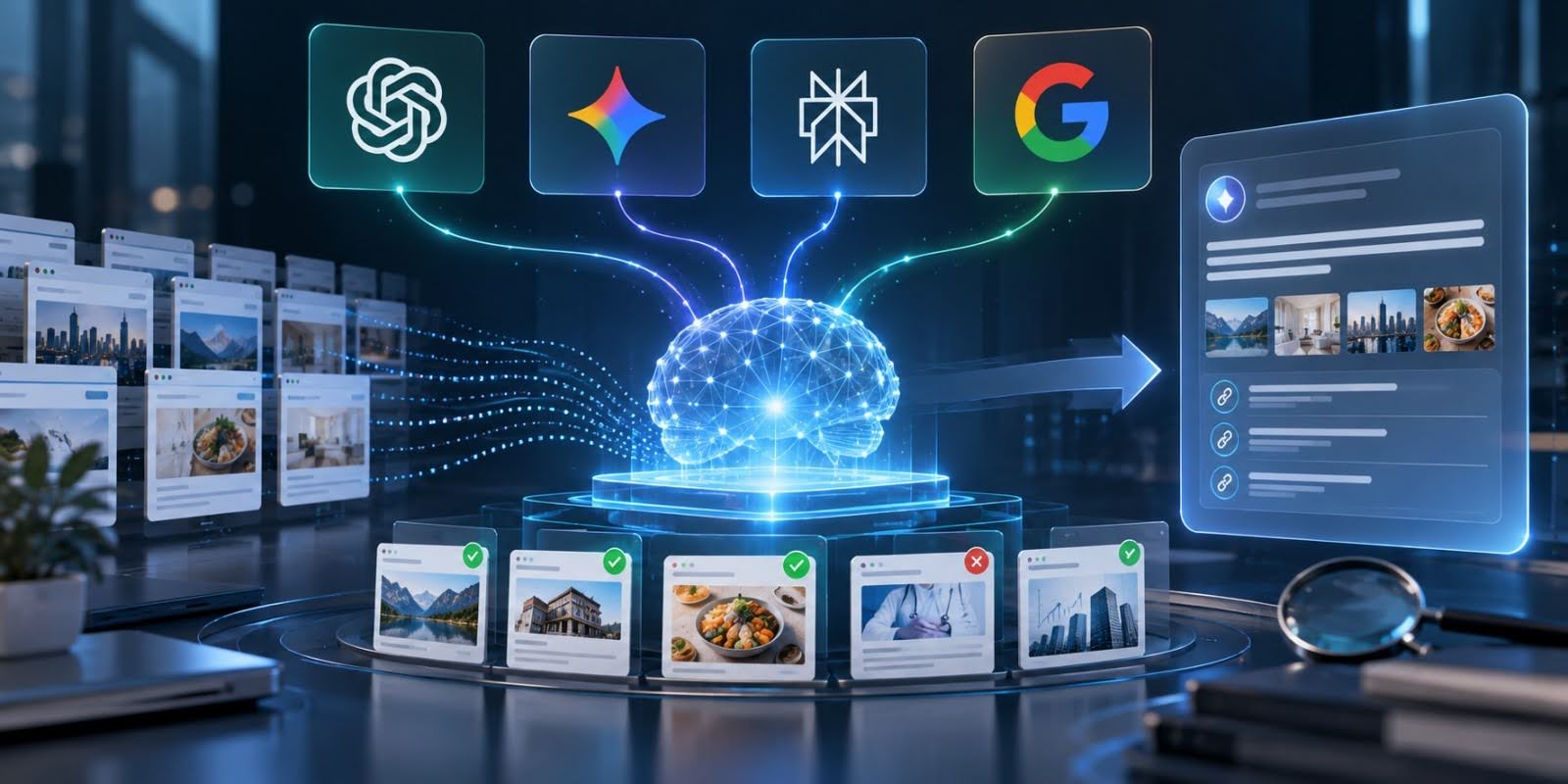
In Singapore, AI SEO is becoming a broader discipline because search visibility is no longer limited to traditional Google rankings. Businesses can now appear through brand mentions, website citations, recommendations and generated answers across ChatGPT, Gemini, Perplexity and Google AI Overviews.
This creates a different measurement challenge. A company may rank well in organic search but receive little AI visibility, while another brand may appear in generative answers even when its website is not the primary source. AI search visibility therefore needs to be assessed separately from rankings and traffic.
This benchmark framework examines how Singapore brands can be evaluated across multiple AI-search environments. It focuses on visibility, citations and mentions rather than relying on a single score or one platform.
The objective is to establish a repeatable approach for measuring AI search in Singapore across industries, prompts and platforms without presenting unverified figures as fact.
Executive Summary
AI search visibility is best measured through several connected signals rather than one metric. The core benchmark should include:
- Brand mentions frequency.
- Website citation frequency.
- Recommendation frequency.
- Prompt coverage.
- Cross-platform presence.
- Source type and page type.
These metrics help distinguish between a brand that is simply recognised and a website that is actively used as a source. The benchmark should also separate platform-level visibility. ChatGPT, Gemini, Perplexity and Google AI Overviews can all produce different source patterns for the same topic.
For businesses in Singapore, their AI SEO strategies should combine traditional SEO with GEO Singapore, AEO Singapore and AIO Singapore measurement rather than treating these as completely separate disciplines.
The most useful benchmark is one that can be repeated over time. This allows businesses to identify whether visibility is genuinely improving or whether apparent changes are caused by different prompts, platforms or testing conditions.
State of AI Search in Singapore
AI search in Singapore is developing as part of a wider shift towards AI-assisted discovery. Users can now ask longer, more conversational questions and receive summarised answers instead of relying only on a list of traditional search results.
This affects both informational and commercial behaviour. A user can ask an AI platform to compare providers, explain a service, recommend a business, evaluate alternatives or summarise a complex subject.
For businesses, this means visibility can occur before the user visits a website. A brand can be:
- Mentioned by name.
- Cited as a source.
- Recommended as an option.
- Referenced through third-party coverage.
These outcomes create a broader search environment than conventional SEO alone. AI SEO should therefore be measured as part of an integrated search strategy rather than as a standalone trend.
Research Methodology
A useful AI search benchmark requires consistent prompts, repeatable testing and clear definitions. The methodology should use a stable set of Singapore-relevant commercial and informational queries tested across ChatGPT, Gemini, Perplexity and Google AI Overviews.
For every query, the study should record:
- Platform used.
- Date of test.
- Brands mentioned.
- Brands recommended.
- Domains cited.
- Exact URLs cited.
- Source category.
- Page type.
- Singapore or international source classification.
This creates a structured dataset that can be compared by industry and platform. However, generative responses can vary, which means repeated testing is more reliable than isolated screenshots.
Companies Analysed
The companies included in the benchmark should represent businesses with meaningful digital visibility across several Singapore industries.
The sample should include both established brands and smaller businesses to avoid creating a benchmark that only reflects large organisations.
Each company should be evaluated based on the topics and prompts where it would reasonably be expected to appear.
This avoids unfair comparisons.
A business operating in one specialist niche should not be judged against a large company covering a much broader market.
The analysis should therefore normalise visibility according to relevant prompt coverage rather than total mentions alone.
Industries Analysed
Industry-level analysis is necessary because AI search behaviour can vary substantially by topic.
The benchmark can include industries such as:
- Professional services.
- Technology.
- Education.
- Property.
- Hospitality.
- Ecommerce.
- B2B services.
- Consumer services.
Different industries can produce different source patterns.
A regulated topic may rely more heavily on official or institutional websites. A commercial service query may surface provider websites, comparison pages or editorial sources.
An industry benchmark should therefore compare like with like.
Prompt Dataset
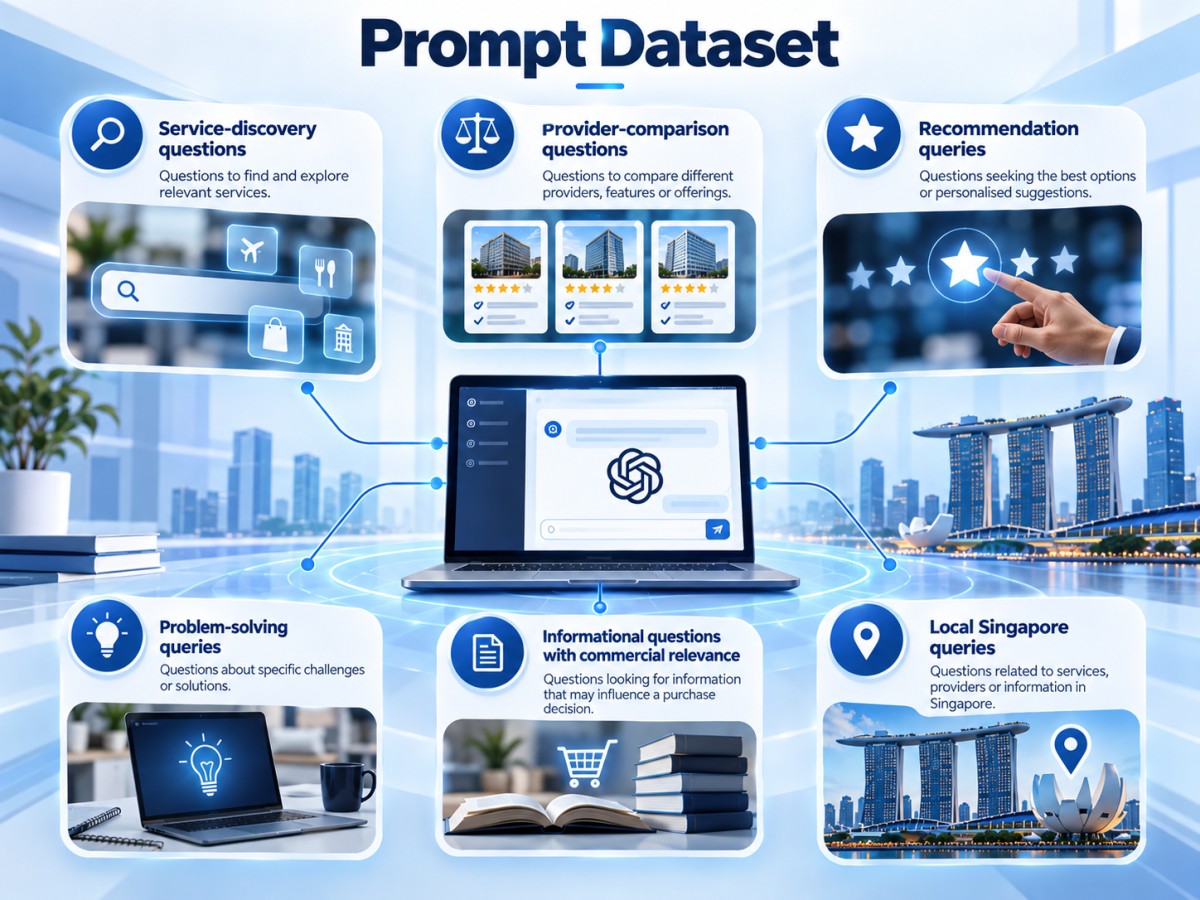
The prompt dataset should represent the way users actually ask AI systems questions.
Traditional keyword research often focuses on short phrases. AI search introduces longer queries that contain more context.
The prompt dataset should include:
- Service-discovery questions.
- Provider-comparison questions.
- Recommendation queries.
- Problem-solving queries.
- Informational questions with commercial relevance.
- Local Singapore queries.
Each prompt should have a clear intent classification.
This helps determine whether a brand performs well only for informational questions or also appears in commercially meaningful situations.
Overall AI Visibility Benchmark
AI visibility should measure whether a brand appears across the tested prompt set.
A useful overall benchmark can include several separate measurements.
| Metric | Purpose |
|---|---|
| Brand mention rate | Measures recognition |
| Citation rate | Measures source attribution |
| Recommendation rate | Measures commercial inclusion |
| Prompt coverage | Measures breadth |
| Cross-platform visibility | Measures consistency |
| Source URL frequency | Identifies strongest assets |
The final benchmark should report validated study results only.
Until the dataset is complete, the framework should remain descriptive rather than assigning unsupported percentages.
This approach keeps the benchmark credible and repeatable.
AI Citation Benchmark

An AI citation occurs when a website or webpage is explicitly presented as a supporting source.
Citation visibility should be analysed separately from brand mentions.
A business can be widely mentioned without its own website being cited.
This distinction is important because each outcome indicates a different strength.
High mention visibility can suggest strong entity recognition.
High citation visibility can suggest that the website itself contains source-worthy information.
The benchmark should therefore record both the domain and the exact URL.
This reveals whether citation visibility comes from one strong page or from a broader group of content assets.
Brand Mention Benchmark

Brand mentions show whether an AI system associates a company with a topic, category or recommendation.
These mentions may occur with or without citations.
For Singapore AI SEO, brand mention visibility is especially important for commercial prompts.
A company repeatedly mentioned in answers about a service category may have stronger category association than a competitor that appears only through its own website.
The study should also distinguish between neutral mentions and recommendations.
A brand named as an example is not the same as a brand suggested as a provider.
The benchmark should record these separately.
ChatGPT Visibility
ChatGPT visibility should be measured using both mentions and citations. A business may appear in a response even when its website is not the cited source.
The analysis should record:
- Brand mentions.
- Recommendations.
- Owned-site citations.
- Third-party citations.
- Exact cited URLs.
- Prompt coverage.
These metrics create a clearer picture than simply asking whether the business appears. For Singapore businesses, ChatGPT visibility can be particularly useful for monitoring category recognition and provider-related prompts.
Gemini Visibility
Gemini visibility should use the same core prompt set so results can be compared meaningfully with other platforms. The benchmark should examine whether Gemini cites the same sources as ChatGPT or whether it selects different domains.
The analysis should also compare Gemini visibility with conventional Google search. This can reveal whether brands with strong Google rankings are also appearing in Gemini-generated answers.
Any overlap should be interpreted cautiously. Strong ranking and AI visibility can be related without one necessarily causing the other.
Perplexity Visibility
Perplexity is useful for citation benchmarking because source attribution is usually more visible. The study should record which domains are cited repeatedly and which page types appear across related queries.
A domain appearing through multiple different URLs may indicate broader topical visibility. A single URL appearing repeatedly may indicate that the page itself is particularly useful as a source.
For AI search visibility Singapore analysis, this distinction can help identify which content assets deserve further development.
Google AI Overview Visibility
Google AI Overviews introduce another layer of visibility within the traditional search environment. The benchmark should record:
- Whether an AI Overview appears.
- Which sources are included.
- Which URLs are cited.
- Whether the same pages rank organically.
- Which industries trigger AI Overviews most often.
This helps determine whether a business is gaining both traditional and generative visibility. A page ranking on page one but not appearing in an AI Overview represents a different opportunity from a page that appears in both.
Industry-by-Industry Analysis
Industry analysis should examine visibility patterns within each sector rather than relying only on one overall average. A business-services query may produce very different sources from an ecommerce or property query.
The benchmark should compare:
| Area | What to Measure |
|---|---|
| Mention frequency | How often brands appear |
| Citation frequency | How often websites are sourced |
| Recommendation frequency | How often businesses are suggested |
| Source type | Which categories dominate |
| Platform overlap | Whether the same brands appear across engines |
| Local relevance | Balance of Singapore and international sources |
This allows businesses to compare themselves against realistic competitors.
Most Visible Singapore Brands
The most visible Singapore brands should be identified through consistent prompt coverage rather than raw mention volume alone.
A brand that appears repeatedly across relevant commercial prompts demonstrates stronger practical visibility than one appearing many times for narrow or low-value topics.
The final benchmark should therefore rank brands using transparent criteria. Useful criteria can include:
- Total mentions.
- Unique prompt coverage.
- Recommendation frequency.
- Citation frequency.
- Cross-platform visibility.
The ranking should remain data-led. No business should be labelled the most visible until the validated dataset supports that conclusion.
Most Frequently Cited Domains
Frequently cited domains can help identify which websites are consistently used as information sources. The benchmark should separate domain-level and URL-level visibility.
A website cited through several pages demonstrates broader source depth. A domain cited mainly through one page may rely on a particularly strong resource.
The analysis should also classify each domain. Common categories include:
- Company websites.
- Government websites.
- Editorial sources.
- Industry publications.
- Comparison resources.
- Community platforms.
This helps explain what kind of source is being used rather than simply counting citations.
Most Common Source Types
Source type analysis helps determine what kind of information AI systems use for different prompts. Commercial queries may rely on a mixture of first-party and third-party sources.
Informational queries may favour explanatory guides, research or institutional information. Recommendation prompts may draw more heavily on comparison pages, directories or independent editorial coverage.
The benchmark should therefore report source types by query category. This prevents one source type from being treated as universally superior.
Singapore Domains vs International Domains

Singapore-related queries do not automatically produce only Singapore sources. AI platforms may still use international information when the topic is broad or when local content does not provide sufficiently relevant information.
The benchmark should classify sources into:
- Singapore-focused domains.
- International domains.
- Mixed-market domains.
The ratio should then be analysed by query intent and industry. For GEO Singapore, this provides a useful measure of whether local websites are contributing enough information to generative search.
A lack of local sources may represent an opportunity for Singapore businesses to publish stronger market-specific content.
Relationship With Traditional Google Rankings
Traditional Google rankings and AI visibility should be compared but not combined. Strong Google rankings can indicate relevance, authority and technical quality.
These characteristics may also support generative search visibility. However, AI platforms can select sources that are not the top-ranking organic result.
The benchmark should therefore identify:
- High ranking with high AI visibility.
- High ranking with low AI visibility.
- Low ranking with high AI visibility.
- Low ranking with low AI visibility.
These groups help businesses identify different optimisation needs.
Biggest AI Search Opportunities
The strongest AI search opportunities usually occur where a business already has topical relevance but lacks generative visibility. For example, a company may rank organically for an important service yet rarely appear in AI-generated answers.
This can indicate a need to strengthen:
- Supporting informational content.
- Original research.
- Third-party mentions.
- Entity clarity.
- Source-worthy evidence.
Another opportunity can appear when competitors are being cited from generic or outdated pages. A business that can provide clearer, more useful and more current information may have an opportunity to strengthen its source relevance.
Biggest Visibility Gaps
AI visibility gaps occur when competitors are consistently mentioned or cited while a relevant business remains absent. These gaps can appear for several reasons.
A site may have:
- Weak topical coverage.
- Limited third-party validation.
- Generic content.
- Poor entity clarity.
- Few source-worthy assets.
- Weak traditional SEO foundations.
The appropriate response depends on the specific gap. Creating more content is not always the answer. Sometimes the existing commercial page needs better supporting authority rather than another competing article.
GEO in Singapore
GEO in Singapore focuses on improving visibility within generative search environments for Singapore-relevant topics. The key objective is not to create content specifically for one chatbot.
A better approach is to build information that is clear, useful, authoritative and locally relevant. GEO can include:
- Original research.
- Structured answers.
- Strong entity relationships.
- Third-party references.
- Clear internal linking.
- Local market context.
These elements support the wider information environment around the brand.
AEO Singapore
AEO Singapore focuses on making content suitable for direct-answer environments. This includes search features, voice-style questions and generative answers where users expect concise responses.
Answer-focused content should begin with a clear definition or factual response before expanding. However, AEO should not reduce the article to short fragments.
Context remains important. A useful answer needs to be both concise enough for extraction and complete enough to remain accurate when quoted independently.
AIO in Singapore
AIO refers to optimisation for AI Overview visibility and related generative search experiences.
AIO SEO for Singapore searches should remain closely connected to traditional SEO because AI Overviews operate within the broader Google Search environment. Businesses should therefore maintain:
- Strong technical SEO.
- Relevant content.
- Clear topical structure.
- Useful supporting evidence.
- Appropriate internal links.
- Strong source authority.
The goal is not to create separate duplicate pages solely for AI Overviews. The same useful content should support both conventional and generative visibility.
AEO, GEO and AIO Should Work Together
AEO, GEO and AIO represent different aspects of the same broader change in search behaviour.
AEO focuses on direct answers.
GEO focuses on generative engines.
AIO focuses on AI Overview-style search experiences.
For Singapore businesses, these should not be treated as three unrelated strategies. The underlying foundation remains similar:
- Clear relevance.
- Strong technical accessibility.
- Useful content.
- Authority and trust.
- Strong entity relationships.
- Measurable visibility.
The main difference is how performance is observed across different interfaces.
What Singapore Businesses Should Do Next
Singapore businesses should begin by establishing a baseline before creating more AI SEO content.
- The first step is to identify commercially relevant prompts.
- The second step is to test those prompts across major AI platforms.
- The third step is to record mentions, citations and recommendations separately.
- The fourth step is to compare the business against direct competitors.
- The fifth step is to identify whether the weakness is content, authority, entity recognition, technical accessibility or third-party representation.
This creates a more evidence-led strategy than simply publishing more articles about AI search.
Building a Singapore AI Search Benchmark
A benchmark should remain stable enough to measure changes over time. The core prompt set should therefore be preserved.
New prompts can be added, but the original baseline should remain available for comparison. The benchmark should record:
| Metric | Reporting Purpose |
|---|---|
| Mention share | Brand recognition |
| Citation share | Source authority |
| Recommendation share | Commercial visibility |
| Prompt coverage | Topic breadth |
| Cross-platform visibility | Platform consistency |
| Source diversity | Dependence on one page or source |
These metrics allow businesses to monitor whether visibility is improving in a meaningful way.
AI Visibility and Business Performance
AI visibility should eventually connect to business outcomes. A citation does not automatically produce a lead and a brand mention does not automatically produce revenue.
However, AI visibility can influence discovery and consideration. A user may see a brand in ChatGPT, later search for the company name and convert through another channel.
Businesses should therefore monitor AI visibility alongside branded search demand, referral traffic, assisted conversions and lead quality where possible.
2027 Outlook
AI search visibility is likely to become a more established part of digital measurement as generative search interfaces continue to develop. For Singapore businesses, the key strategic change is likely to be less about abandoning SEO and more about expanding what counts as visibility.
Rankings, citations, mentions and recommendations may increasingly sit within the same reporting framework. The businesses best positioned for this environment will likely be those with strong traditional SEO foundations, credible brand authority and useful information that can support multiple forms of discovery.
The emphasis should remain on durable search quality rather than short-term tactics designed around individual AI platforms.
Methodology Appendix
The methodology appendix should document the benchmark in enough detail for future testing to be repeated consistently. Each observation should contain:
- Prompt.
- Intent.
- Industry.
- Platform.
- Date tested.
- Brand mention.
- Recommendation.
- Citation.
- Domain.
- URL.
- Source type.
- Singapore or international classification.
Frequently Asked Questions
What is Singapore AI SEO?
Singapore AI SEO refers to optimising and measuring search visibility across both traditional search engines and AI-powered platforms for Singapore-relevant queries. It can include rankings, AI citations, brand mentions, recommendations, GEO Singapore, AEO Singapore and AIO Singapore.
What is AI search visibility?
AI search visibility measures whether a brand or website appears in AI-generated answers. It can include brand mentions, website citations, recommendations, prompt coverage and visibility across multiple platforms.
Are AI citations the same as brand mentions?
No. A brand mention occurs when a company is named in an answer, while a citation occurs when a website or webpage is explicitly used as a source.
What is the difference between GEO and AEO?
GEO focuses on visibility in generative search engines, while AEO focuses on direct-answer environments. The two overlap because both require clear, relevant and trustworthy information.
What does AIO mean in Singapore SEO?
AIO generally refers to optimisation around AI-generated search experiences such as AI Overviews. For Singapore businesses, AIO SEO should complement traditional SEO rather than operate as a separate content strategy.
Do Singapore businesses need separate pages for GEO, AEO and AIO?
Not necessarily. Creating separate pages for every acronym can create duplication and keyword cannibalisation. Pages should be created according to distinct user intent, with supporting content strengthening the main commercial pages.
How should AI search visibility be measured?
Businesses should measure brand mentions, website citations, recommendations, prompt coverage and cross-platform visibility. These metrics should be tracked separately from conventional rankings and traffic.
Can strong Google rankings improve AI visibility?
Strong Google rankings may be associated with stronger AI visibility because highly ranked pages often demonstrate relevance and authority. However, ranking well does not guarantee citation in a generative answer.
Search Visibility in Singapore Is Expanding
Singapore AI SEO is best understood as an extension of modern search visibility rather than a replacement for traditional SEO. Businesses are now competing for more than organic positions.
They can also appear through citations, mentions, recommendations and AI-generated summaries. This means search performance needs a broader benchmark.
A useful framework measures visibility by platform, prompt and outcome while maintaining clear distinctions between rankings, mentions and citations.
For Singapore businesses, the strongest strategy is to combine technical SEO, strong topical architecture, useful content, credible third-party authority and consistent AI visibility measurement.
Build a Clearer AI Search Benchmark
Businesses looking to understand their position in AI search should begin by identifying the prompts that matter most to their customers and measuring how often their brand is mentioned, cited or recommended across major generative platforms.
W360 Group Pte Ltd can help businesses assess Singapore AI SEO visibility alongside GEO Singapore, AEO Singapore, AIO Singapore and traditional search performance. Businesses that want to evaluate their current visibility can request an SEO audit to get a better understanding of their search performance.