
Content optimisation with Generative AI requires more than adding keywords or rewriting existing articles because AI search platforms can select, summarise and cite information from different types of webpages. The strongest source opportunities usually come from pages that provide clear, useful and distinctive information rather than content produced only to target a search phrase.
For Singapore businesses, the important question is therefore not simply how much content to publish. It is which content formats are most capable of answering specific questions, supporting AI-generated responses and establishing the business as a useful source.
Google’s 2026 guidance for generative search places particular emphasis on valuable, unique and non-commodity content. Google specifically advises publishers to contribute original experience, distinctive viewpoints and information that goes beyond material already available across the web.
This article provides a framework for analysing Singapore pages that receive AI citations across ChatGPT, Gemini, Perplexity and Google AI search experiences. It examines long-form guides, research, service pages, comparison content, FAQs, institutional information, editorial content and user-generated sources without presenting unsupported proprietary citation percentages.
Executive Summary
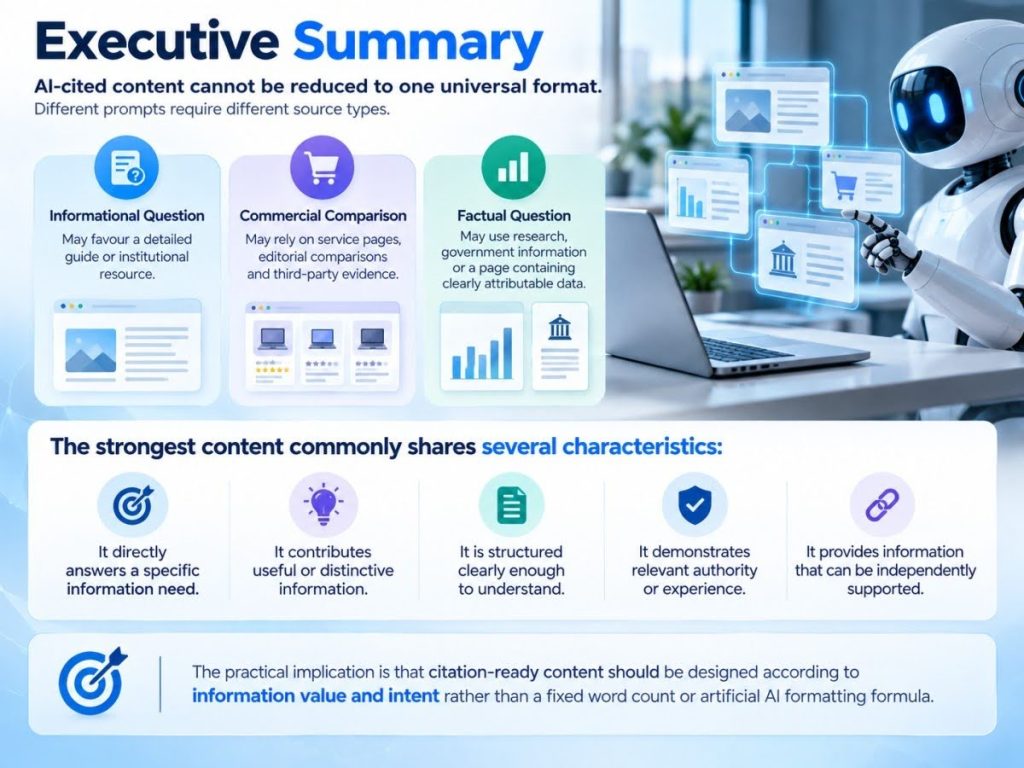
AI-cited content cannot be reduced to one universal format.
Different prompts require different source types.
An informational question may favour a detailed guide or institutional resource. A commercial comparison may rely on service pages, editorial comparisons and third-party evidence. A factual question may use research, government information or a page containing clearly attributable data.
The strongest content commonly shares several characteristics:
- It directly answers a specific information need.
- It contributes useful or distinctive information.
- It is structured clearly enough to understand.
- It demonstrates relevant authority or experience.
- It provides information that can be independently supported.
The practical implication is that citation-ready content should be designed according to information value and intent rather than a fixed word count or artificial AI formatting formula.
Research Methodology
An analysis of AI-cited pages should compare sources across a controlled set of Singapore-relevant prompts.
Each prompt should be classified by intent before testing.
Useful categories include:
- Informational
- Commercial investigation
- Comparison
- Recommendation
- Local
- Transactional
The same queries should then be tested across selected AI search platforms.
For every cited page, the analysis should record the exact URL, domain, page type, source category, topic, content format and whether the source is Singapore-based or international.
The study should also record non-cited competing pages.
This makes it possible to compare what cited pages contain that otherwise relevant pages do not.
Pages and Queries Analysed
The page sample should include a wide range of content formats rather than only blog articles.
AI search can draw from service pages, product pages, research, government resources, news publications, comparison pages and community discussions depending on the question.
The query sample should also reflect realistic customer behaviour.
For Singapore businesses, useful query groups can include:
- “What is” questions
- “How to” questions
- Provider discovery queries
- Product or service comparisons
- Local recommendation prompts
- Industry-specific factual questions
The purpose is to determine which page types are useful for specific intents.
A page should not be classified as successful merely because it receives one citation for one isolated query.
Repeated relevance across related prompts provides a stronger signal.
Most-Cited Content Types

The most useful content type depends on what the AI-generated answer needs to support.
A long guide may be appropriate for an educational question.
A government website may be preferred for regulatory information.
A service page may be useful when the user asks what a provider offers.
A research page can be valuable when the answer requires statistics or original evidence.
A comparison article may support evaluation between options.
This is why businesses should avoid looking for one “best AI content format”.
The stronger strategy is to map content types to user intent.
A practical classification framework is:
Content Type | Strongest Potential Use |
Long-form guide | Education and explanation |
Original research | Statistics and evidence |
Service page | Commercial relevance |
Comparison page | Evaluation |
FAQ content | Specific questions |
Government resource | Regulation and official facts |
Editorial article | Independent context |
Community content | Experience and sentiment |
Each format contributes differently.
Long-Form Guides
Long-form guides can perform well as AI sources when they comprehensively explain a topic without becoming repetitive.
Length itself does not create citation value.
A 3,000-word article that repeats generic definitions can provide less information than a 1,500-word guide containing original examples, expert insight and clear answers.
The main advantage of a strong long-form guide is coverage.
It can address multiple related subtopics within one coherent resource.
This gives retrieval systems several relevant sections that may match different questions.
For example, a Singapore guide about AI SEO can separately explain citations, mentions, GEO, AEO and measurement without requiring five near-duplicate articles targeting almost identical intent.
What Makes a Long-Form Guide Useful

A useful long-form guide should answer the primary question early and then expand logically.
The strongest structure usually includes:
- Clear definitions
- Distinct subtopics
- Supporting examples
- Relevant evidence
- Practical interpretation
Every section should remain self-contained.
This means an extracted paragraph should still make sense without requiring the reader to find another section.
Google’s current guidance similarly recommends organising content with clear paragraphs, sections and headings while prioritising unique information rather than formulaic optimisation.
The objective is therefore both human readability and information clarity.
Original Research and Studies
Original research is one of the strongest ways a business can contribute information that does not already exist elsewhere.
A research page can provide proprietary statistics, testing results, surveys, benchmarks or observations.
This gives other websites and AI-generated answers something specific to reference.
For research to be useful, the methodology should be visible.
A credible research page should explain:
- What was tested.
- How the sample was selected.
- How the data was measured.
- What the study found.
- What the study cannot prove.
This prevents marketing claims from being presented as research.
For Singapore companies, original local data can be especially valuable because global datasets may not reflect local consumer behaviour, regulations, market size or search patterns.
Why Original Information Matters
Original information increases the amount of information a page provides.
Information gain refers to the useful contribution that is not simply copied or reformulated from existing sources.
Google’s 2026 generative search guidance explicitly recommends non-commodity content and distinguishes original experience from simple summaries of material already available online.
This makes original information strategically important for both traditional SEO and generative search.
Examples can include:
- First-party industry surveys
- Search visibility studies
- Internal performance datasets
- Original market observations
- Expert case analysis
A business does not need to conduct a large academic study.
It does need to provide information that genuinely adds something.
Service Pages

Service pages can be cited when they provide useful information about what a business actually does.
Their purpose differs from that of informational content.
A service page should primarily explain the service, who it is suitable for, what it includes and how the provider approaches it.
For AI search, a service page can become relevant to questions such as:
“What services does this company provide?”
“Which Singapore agencies offer AI SEO?”
“What does an AI SEO service include?”
A service page should therefore contain enough factual information to support these questions.
However, turning a service page into a 7,000-word informational article can weaken conversion clarity.
Supporting research and educational content should complement the commercial page rather than duplicate it.
Service Pages and Commercial Citations
Commercial citation opportunities depend heavily on query intent.
An AI platform may use a provider’s own service page to confirm factual service information.
For independent comparisons or recommendations, it may also use third-party sources.
This means businesses need both owned and external authority.
The service page should clearly communicate:
- Service scope
- Business category
- Market served
- Relevant expertise
- Related solutions
Supporting informational pages can then deepen the topic without competing for the same commercial keyword.
This structure is particularly important for AI SEO Singapore campaigns where multiple terms such as GEO, AEO and AIO can easily become cannibalised.
Comparison Pages
Comparison pages can be useful AI sources because they help users understand differences between alternatives.
Examples include:
- SEO vs GEO
- AEO vs AIO
- ChatGPT vs Gemini
- Product A vs Product B
- Service model A vs service model B
A strong comparison should use consistent criteria.
It should not manipulate the comparison to make one option appear superior without evidence.
Useful criteria can include capabilities, intended use, limitations, suitability and implementation requirements.
Tables can improve clarity when the compared attributes are genuinely comparable.
This makes comparison pages suitable for AI extraction because individual differences can be understood without reading the entire article.
List Articles
List articles can support AI search when the list provides meaningful selection criteria and context.
The problem is not the list format itself.
The problem is generic lists created without original research or transparent methodology.
An article titled “10 Best AI SEO Agencies in Singapore” should explain how the companies were selected.
Without methodology, the list may function more as promotional content than useful research.
A stronger list article can explain:
- Inclusion criteria
- Evaluation method
- Relevant strengths
- Limitations
- Intended audience
This makes the information more defensible.
For Singapore businesses, list articles can be valuable when they genuinely reduce research effort for users rather than simply target “best” keywords.
FAQ Content
FAQ content can be useful because it matches specific questions with concise answers.
The strongest FAQs address real user uncertainty.
They should not be created by turning every keyword variation into a question.
A useful FAQ answer should usually contain enough context to stand independently.
For example:
“Does schema markup guarantee AI citations?”
A useful answer would explain that structured data can support machine-readable information but current controlled evidence does not show that schema alone guarantees increased citations.
This is more useful than responding with one unsupported sentence.
FAQ content should therefore focus on information quality rather than FAQ volume.
FAQ Content and AI Extraction
FAQ sections naturally use a question-and-answer structure, which can make information easy to extract.
However, visible content quality remains more important than implementing a particular format.
A question should be followed by a direct factual response.
Additional explanations can then clarify limitations or exceptions.
Businesses should also avoid duplicating answers already covered extensively in the article.
Repeated content creates unnecessary page length without increasing information value.
The FAQ should fill remaining questions rather than summarise every heading.
Government and Institutional Sources
Government and institutional pages can be strong sources when the query concerns regulation, official statistics, standards or public policy.
For Singapore content, relevant official sources can include government ministries, statutory boards and recognised public institutions.
Businesses should not attempt to compete directly with an official source for authoritative government facts.
Instead, commercial content can explain how official requirements apply in practical situations while citing the original source.
For example, a business article discussing a Singapore compliance requirement should link to the responsible authority when possible.
This improves verifiability.
AI systems can then distinguish between the official fact and the business’s interpretation.
Why Institutional Sources Are Difficult to Replace
Institutional sources often provide primary information.
A private blog explaining a government requirement remains a secondary source if the original regulation or guidance exists on an official website.
This does not make commercial content unnecessary.
It means the commercial page should add context.
Useful additions can include:
- Practical implementation
- Industry examples
- Step-by-step interpretation
- Common mistakes
- Local operational implications
This creates information gain without rewriting an official document.
For GEO-friendly content, the strongest relationship is often between primary evidence and useful expert interpretation.
News and Media
News and editorial sources can contribute timeliness, independent reporting and third-party context.
They are particularly useful when the AI-generated answer concerns recent developments.
A company website naturally presents the organisation’s own perspective.
Independent media can provide corroboration.
For brand visibility, this distinction matters.
A business repeatedly described by credible external publications creates a broader information environment than one mentioned only on its own website.
However, not every publication is equally useful.
Relevance, editorial standards and source quality matter more than raw article volume.
This supports an off-page strategy focused on credible coverage rather than mass syndication.
Forums and User-Generated Content
Forums and other user-generated sources can provide first-hand experiences that corporate and editorial content may not capture.
These sources can be especially relevant for questions about opinions, practical problems, product experiences or community sentiment.
However, user-generated information can also be incomplete, anecdotal or inaccurate.
AI-generated answers should therefore distinguish experience from verified fact.
For businesses, the strategic lesson is not to manufacture forum discussions.
It is to understand that genuine customer discussion becomes part of the wider information environment around a brand.
Customer experience and reputation can therefore affect AI visibility indirectly through third-party conversation.
Reviews as Source Material
Reviews provide another form of user-generated information.
They can help explain recurring customer experiences, service characteristics and reputation.
Reviews should not be treated as objective evidence for technical claims.
They are better suited to questions involving perceived experience.
A business with consistent reviews across legitimate platforms creates more independent information about itself.
However, artificial review generation can undermine credibility.
For AI SEO, genuine reputation management is more sustainable than attempting to optimise review text for specific phrases.
Content Length Analysis
Content length should be treated as a consequence of topic depth rather than a ranking target.
There is no universal word count that guarantees an AI citation.
A simple definition may need 300 words.
A technical guide may require several thousand.
The relevant question is whether the page completely answers the intended need without unnecessary repetition.
A useful content-length analysis should compare cited and non-cited pages while controlling for topic type.
Otherwise, longer pages may appear to perform better simply because complicated topics naturally require more explanation.
AI content optimisation should therefore prioritise completeness and information density.
Answer-First Structure
Answer-first structure places the clearest response at the beginning of a section.
This makes the page easier to understand for both users and systems extracting information.
A section about AI citation rate, for example, should begin by defining what citation rate measures.
The formula or interpretation can follow.
This differs from traditional copywriting structures that delay the answer to keep users reading.
For informational SEO, unnecessary delay reduces efficiency.
AI-friendly content should provide the answer first and use the rest of the section to qualify, explain and support it.
Tables and Data
Tables can improve citation-ready content when they organise genuinely comparable information.
They are particularly useful for:
- Feature comparisons
- Benchmark definitions
- Frameworks
- Category classifications
- Research results
A table should not be inserted simply to make an article appear more structured.
Each column should represent a clear dimension.
For example:
| Content Format | Main Strength | Main Limitation |
| Research | Original evidence | Requires credible methodology |
| Guide | Broad explanation | Can become generic |
| Service page | Commercial relevance | Limited independence |
| Comparison | Decision support | Requires fair criteria |
| FAQ | Direct answers | Limited depth |
This format creates compact information that can be understood independently.
Expert Attribution
Expert attribution identifies who is responsible for a claim or interpretation.
This is particularly important when content discusses specialist topics.
A page should make clear whether information comes from:
- Internal research
- A named expert
- A public institution
- A published study
- General industry knowledge
Expert attribution does not automatically make a claim true.
It improves transparency by showing the basis of the statement.
For Singapore businesses, real subject-matter experts can strengthen content by contributing observations based on practical experience.
This provides information that generic rewriting cannot easily reproduce.
First-Hand Experience
First-hand experience is useful when the topic benefits from practical observation.
Examples include implementation lessons, testing results, client patterns, operational challenges and product use.
Google’s current generative search guidance specifically highlights first-hand reviews and experience as examples of content that can contribute a distinct perspective.
The experience should still be clearly framed.
A single company case should not be presented as a universal rule.
Good first-hand content explains:
- What happened?
- Under which conditions.
- What was observed.
- What remains uncertain.
This allows both users and AI systems to interpret the evidence correctly.
Content Freshness
Content freshness matters most when the underlying information changes.
A guide about current AI platform features may require frequent updates.
A basic explanation of HTML headings may remain accurate for much longer.
Updating publication dates without materially revising content does not create genuine freshness.
A useful refresh process should check:
- Facts
- Platform capabilities
- Statistics
- External references
- Examples
- Recommendations
For AI search topics, this is particularly important because platforms and measurement features can change rapidly.
For example, Google introduced dedicated generative AI performance reporting in Search Console in 2026 and completed worldwide rollout by 31 August 2026.
An article written before that change would need substantive updating.
Information Gain
Information gain describes the amount of new value a page contributes relative to existing material.
This is one of the most important principles for content optimisation with Generative AI.
A page can create information gain through:
- Original data
- Local context
- Expert analysis
- First-hand evidence
- New comparisons
- Clear synthesis of difficult material
Simply paraphrasing five competitor articles produces little additional value.
Google’s 2026 guidance explicitly warns against commodity content and encourages publishers to provide unique, compelling material that adds value beyond what a generative AI system could easily reproduce from common knowledge.
For Singapore businesses, this provides a strong reason to move beyond high-volume generic blog production.
Most-Cited Formats by AI Platform
Different AI platforms should be analysed separately because citation patterns can vary.
A useful study should not assume ChatGPT, Gemini, Perplexity and Google AI Overviews use identical source-selection systems.
The benchmark should record the frequency of each content format by platform.
The validated percentages should be inserted only after the study is complete.
Without the underlying dataset, ranking one format as the universal winner would be misleading.
ChatGPT Content Patterns
ChatGPT content analysis should distinguish between brand mentions and source citations.
A business may be discussed without its own website being cited.
The cited pages should therefore be classified by what information they contribute.
For example, research can support statistics, editorial pages can support independent comparisons and company pages can support first-party service information.
The analysis should also examine whether the same URLs recur across related prompts.
Repeated source visibility is more meaningful than a one-time appearance.
This can help identify which pages function as strong reference assets.
Gemini Content Patterns
Gemini source analysis should use the same content taxonomy to allow comparison.
Relevant categories can include first-party business content, research, editorial material, institutional sources and community content.
The relationship with Google rankings should also be examined.
A cited page may rank strongly in conventional search, but rank position alone should not be treated as proof of citation causation.
The useful question is whether cited pages share combinations of relevance, authority, structure and information value.
These comparisons are more actionable than simply recording citation counts.
Perplexity Content Patterns
Perplexity provides visible source references that can make page-level analysis particularly practical.
The exact URLs should be recorded.
The analysis can then determine whether Perplexity repeatedly cites:
- Long-form explainers
- First-party research
- Commercial pages
- Editorial publications
- Community sources
The objective is not to optimise solely for Perplexity.
It is to understand whether certain content assets consistently function as useful references across multiple systems.
Cross-platform recurrence can strengthen the case that a page contains genuinely valuable source material.
Google AI Overview Content Patterns
Google AI Overview content should be interpreted within the wider Google Search ecosystem.
Google states that conventional SEO best practices remain foundational for visibility in its generative search features and that no separate special optimisation is required to appear.
Google’s 2026 guidance further emphasises original, useful and non-commodity content rather than specialised GEO tricks.
This reinforces the need to combine traditional SEO and AI-oriented content analysis.
Pages should still be crawlable, indexable, relevant and useful.
AI Overview optimisation should therefore build on strong SEO rather than creating an entirely separate content system.
Singapore-Specific Content
Singapore-specific content can be useful when local context materially changes the answer.
Localisation should not mean inserting “Singapore” into every heading and paragraph.
Useful local context can include:
- Singapore regulations
- Local market data
- Local terminology
- Local service conditions
- Singapore-specific examples
If the subject is universal, unnecessary localisation can make the article repetitive.
The relevant question is whether a Singapore reader requires information different from an international reader.
Where the answer is yes, local content can provide genuine information gain.
Citation-Ready Content
Citation-ready content is information structured and supported well enough to function as a source.
It does not guarantee that an AI platform will cite the page.
A citation-ready resource generally provides:
- A clear factual answer
- Evidence or source attribution
- Distinct information
- Logical structure
- Transparent limitations
The concept should not be turned into a mechanical template.
Adding short paragraphs and headings to generic content does not make it authoritative.
The source still needs something useful to contribute.
How to Build Citation-Ready Content
The first step is to identify what information the page should uniquely contribute.
The second step is to define the user question clearly.
The third step is to provide the direct answer before expanding.
The fourth step is to add supporting evidence.
The fifth step is to structure the information so individual sections remain understandable independently.
The sixth step is to ensure the content is connected to the wider website architecture.
This creates both topical relevance and internal context.
The result should serve users first while remaining easy for search and generative systems to interpret.
Avoiding Commodity AI Content
Commodity AI content is content that can be produced easily without genuine expertise, evidence or original contribution.
Generative AI tools make this type of production easier.
That does not make it strategically valuable.
Google’s guidance states that generative AI can be useful for research and structuring original content, but large-scale generation without added value can conflict with its spam policies.
For businesses, AI should therefore support content production rather than replace subject expertise.
A useful workflow can involve AI assisting with organisation while specialists provide:
- Original observations
- Business evidence
- Research
- Expert interpretation
- Fact checking
This produces more defensible content.
Content Cannibalisation and AI SEO
Content cannibalisation occurs when multiple pages compete for substantially the same intent.
AI-focused content strategies can increase this risk because businesses often create separate articles for every related acronym or keyword variation.
For example, separate generic articles targeting “AI SEO Singapore”, “SEO AI Singapore”, “GEO Singapore”, “AEO Singapore” and “AIO Singapore” can become highly repetitive if each page explains the same core concepts.
A better architecture assigns a distinct purpose to each page.
The main service page can handle commercial intent.
Research articles can provide evidence.
Supporting articles can answer narrow informational questions.
This helps each page contribute something different.
Content Clusters for AI Search
A content cluster groups complementary pages around a broader subject.
The objective is not to publish every imaginable keyword variation.
A useful AI SEO cluster might include:
- Main AI SEO service page
- AI visibility benchmark
- ChatGPT citation study
- Schema testing article
- Content citation analysis
- AI attribution framework
Each asset answers a different question.
Internal linking then connects the research back to the primary commercial topic.
This creates topical depth without duplicating page intent.
Why Content Quality Still Needs Technical SEO
High-quality content still depends on technical accessibility.
A valuable research page provides limited search value if systems cannot crawl or index it reliably.
Technical requirements include:
- Crawlable HTML
- Correct indexing directives
- Logical internal links
- Appropriate canonicalisation
- Reliable rendering
These are traditional SEO fundamentals.
Google’s documentation states that the same foundational SEO practices continue to apply to AI Overviews and AI Mode.
Content optimisation and technical SEO should therefore be treated as complementary.
Measuring Citation Performance
Citation performance should be monitored through a controlled prompt set.
For each target topic, businesses should record:
- Brand mention
- Website citation
- Exact cited URL
- Platform
- Prompt
- Date tested
The analysis should then examine whether new or improved content begins receiving more repeated citations.
This does not prove causation.
However, consistent measurement can identify whether the site’s source visibility is strengthening.
Traditional rankings and generative visibility should also be reviewed together.
A page can perform strongly in one environment while remaining weak in the other.
Measuring Content by Business Value
AI citations should not become the only content KPI.
A page can be frequently cited yet contribute little commercial value.
Content performance should therefore include:
Measurement | Purpose |
Organic visibility | Search discovery |
AI citations | Source visibility |
Brand mentions | Entity visibility |
Engagement | Reader usefulness |
Internal clicks | Journey progression |
Leads | Commercial outcome |
Different content types will naturally perform differently.
A research article may generate citations and backlinks.
A service page may generate enquiries.
Both can be successful without having identical metrics.
Recommendations for Singapore Businesses
Singapore businesses should prioritise differentiated content over publishing volume.
The first recommendation is to audit existing content before commissioning more articles.
Pages that already cover the same intent should be consolidated or differentiated.
The second recommendation is to develop original information.
This can include first-party testing, market data, operational insights or expert analysis.
The third recommendation is to select content formats according to intent.
Research works for evidence. Service pages work for provider information. Comparisons work for decision support.
The fourth recommendation is to improve extraction without sacrificing depth.
Use clear headings, concise introductions, useful tables and self-contained sections.
The fifth recommendation is to measure citations directly.
Do not assume that rankings, schema or content length automatically translate into AI visibility.
Frequently Asked Questions
AI search can cite many content types, including guides, research, service pages, comparison articles, institutional resources and editorial sources. The appropriate format depends on the information needed for the query. No single page type guarantees citations.
Not automatically. Long articles can provide broad coverage, but unnecessary length does not create authority. Content should be as detailed as the subject requires while avoiding repetition.
Original research can be useful because it provides distinctive evidence that other sources do not contain. The methodology and limitations should be clearly documented.
Service pages can be cited when an AI-generated answer requires factual information about a provider or service. Independent comparison and recommendation queries may also rely on third-party sources.
FAQs can be useful when they answer genuine questions concisely. Their value comes from clear information rather than simply having an FAQ format.
There is no reliable universal word-count threshold for AI citation visibility. Completeness, relevance, originality and source authority are more useful considerations.
Freshness is important when facts, platforms, regulations or market conditions change. Evergreen content should be updated when necessary rather than changing dates without substantive revisions.
Citation-ready content provides clear, useful and verifiable information that can function as a supporting source. It usually combines direct answers, evidence, logical structure and distinctive information.
AI-Cited Content Starts With Information Worth Using
Content optimisation with Generative AI should focus on creating information worth retrieving rather than trying to reverse-engineer one universal AI content template.
Long-form guides can provide breadth. Original studies can contribute unique evidence. Service pages can clarify commercial offerings. Comparison pages can support decisions. Institutional sources can establish official facts. Editorial and community sources can add independent context.
The format matters because different questions require different evidence.
However, the strongest common principle is information value.
Google’s current generative search guidance reinforces this by prioritising unique, useful and non-commodity content over specialised GEO shortcuts.
For Singapore businesses, the practical objective is therefore to create a balanced content ecosystem where each page has a distinct purpose, contributes something useful and supports both conventional search and generative discovery.
Create Content That Contributes Something Distinct
Businesses assessing their AI search performance should examine which existing pages provide real information gain and which pages simply repeat what is already available across the market.
W360 Group Pte Ltd. can help businesses develop AI SEO content strategies that connect citation-ready informational content with strong commercial pages, traditional SEO and generative search visibility. Businesses that want to review where their content can contribute more distinctive value can get a quote from W360 Group Pte Ltd.