
Enterprise websites often contain thousands of URLs, multiple content templates, complex navigation structures, and dynamic rendering frameworks that create scalability challenges not commonly found on smaller websites.
Technical SEO for enterprise websites focuses on improving how large websites are crawled, rendered, indexed, and understood by search engines. Large organisations in Singapore commonly operate websites with multilingual content, regional subdirectories, ecommerce catalogues, corporate resources, and integrated systems. These structures increase the risk of crawl inefficiencies, duplicate pages, indexing inconsistencies, and rendering limitations. Keep reading to learn more about technical SEO in Singapore at the enterprise level including tips for scalable automation and ensuring search engines can efficiently access and interpret your organisation’s content.
What Makes Enterprise Technical SEO Different
Technical SEO for Singapore Enterprises differs from standard website optimisation because it involves managing technical consistency across large and interconnected systems. These websites often rely on multiple teams, platforms, databases, and content workflows.
Unlike smaller websites, enterprise websites typically face:
- Large URL inventories
- High crawl demand
- Dynamic content generation
- Complex filtering systems
- Multiple content ownership teams
- Frequent deployments and updates
These environments require technical SEO processes that scale without depending entirely on manual fixes. Governance frameworks, automation rules, and technical monitoring become essential components of long-term SEO management.
Crawl Budget Optimisation for Large Websites
Crawl budget optimisation refers to improving how search engines allocate crawling resources across a website. Search engines assign limited crawl capacity to each domain, and inefficient crawling can prevent important pages from being discovered or refreshed.
Enterprise websites often waste crawl resources on low-value URLs such as filtered pages, session parameters, duplicate archives, or outdated resources.

Common Crawl Budget Problems
Large websites frequently encounter the following crawl inefficiencies:
Issue | SEO Impact |
Infinite URL variations | Excessive crawling of non-essential pages |
Parameter-based duplication | Reduced crawl efficiency |
Broken internal links | Crawl dead ends and wasted requests |
Low-value autogenerated pages | Index bloat |
Orphan pages | Important pages remain undiscovered |
Methods Used to Improve Crawl Efficiency
Technical SEO teams typically improve crawl efficiency through these key approaches:
- Blocking non-essential parameters via robots.txt
- Using canonical tags for duplicate URL versions
- Removing outdated or thin-value pages
- Strengthening internal linking pathways
- Prioritising important URLs within XML sitemaps
Crawl budget optimisation is especially important for ecommerce websites, enterprise publishers, and large educational platforms where new content is continuously generated.
Faceted Navigation and Index Control
Faceted navigation allows users to filter products or content based on attributes such as size, colour, location, category, or price. While useful for user experience, faceted systems can create millions of URL combinations.
Without technical controls, search engines may crawl and index excessive filtered variations, diluting crawl resources and generating duplicate content signals.

How Faceted Navigation Creates SEO Issues
Faceted URLs often generate combinations such as:
- /shoes?colour=black
- /shoes?size=9
- /shoes?size=9&colour=black
When multiplied across large catalogues, these combinations create massive indexing overhead. Common SEO risks include:
- Duplicate content generation
- Crawl budget wastage
- Thin pages with low search intent
- Index inflation
- Internal competition between filtered URLs
Recommended Enterprise Solutions
Enterprise SEO teams commonly use layered index management strategies. These may include:
Technical Method | Purpose |
Canonical tags | Consolidate duplicate signals |
Noindex directives | Prevent low-value page indexing |
Robots.txt controls | Restrict crawler access |
AJAX filtering | Reduce crawlable URL generation |
Static SEO landing pages | Preserve high-value filter combinations |
The correct solution depends on the website architecture and business requirements. Some filtered combinations may still provide search demand and should remain indexable.
Duplicate Content Management at Scale
Duplicate content occurs when multiple URLs contain identical or highly similar content. Enterprise websites commonly generate duplication through CMS structures, tracking parameters, pagination, regional versions, or syndicated content.
Large-scale duplication weakens search engine understanding of canonical pages and may reduce the visibility of priority URLs.
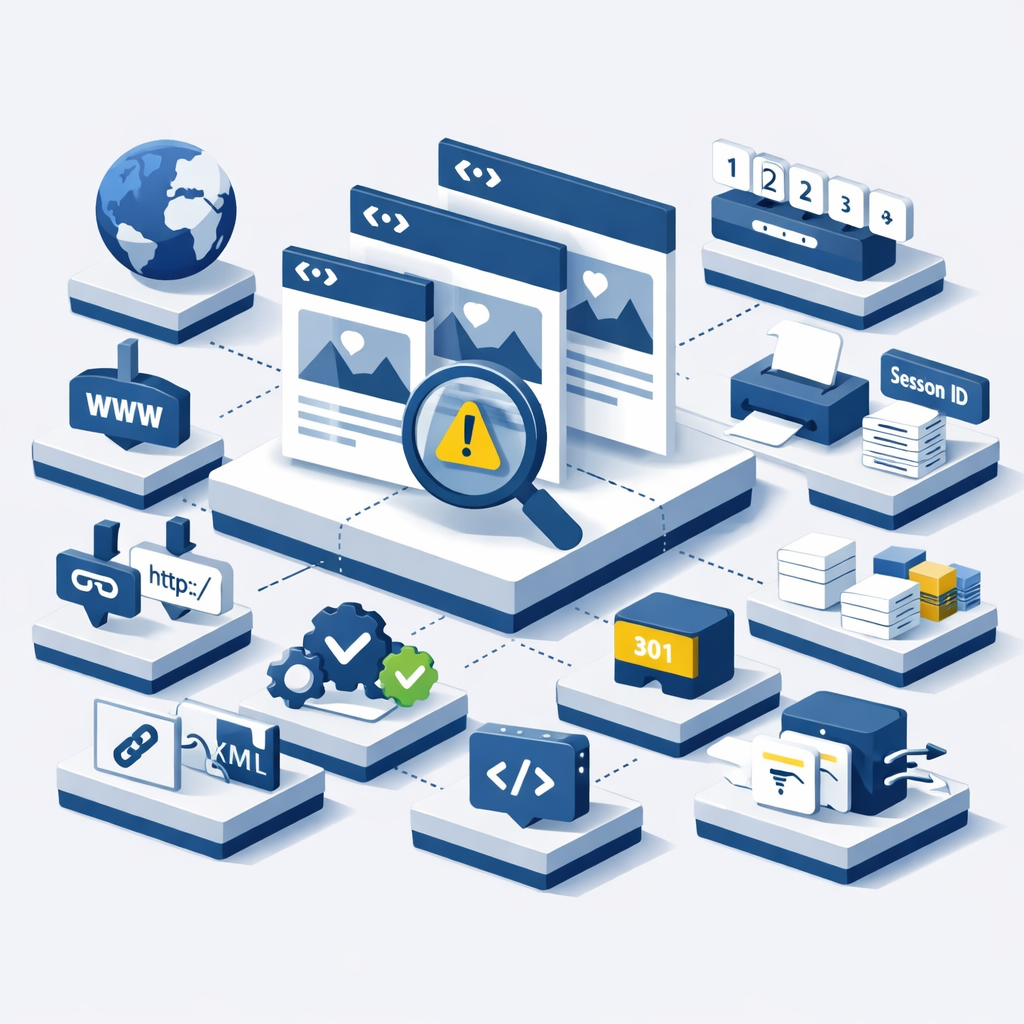
Common Sources of Enterprise Duplication
Enterprise environments typically generate duplicate content through operational complexity rather than intentional duplication. These can be caused by:
- HTTP and HTTPS duplication
- WWW and non-WWW versions
- Printer-friendly pages
- Tracking parameters
- Pagination variants
- Session IDs
- Multi-category product assignments
Canonicalisation Strategies
Canonicalisation helps search engines identify the preferred version of a page. A structured canonical strategy generally includes:
- Self-referencing canonical tags
- Consistent internal linking
- XML sitemap alignment
- Redirect consolidation
- Parameter handling governance
The goal is to ensure that ranking signals consolidate around the primary version of each URL.
JavaScript Rendering Challenges
JavaScript rendering refers to how search engines process dynamically generated content. Many enterprise websites use JavaScript frameworks such as React, Angular, or Vue to improve interactivity and user experience.
However, rendering delays or incomplete rendering can prevent search engines from accessing critical content.
Why Rendering Problems Affect SEO
Search engines crawl HTML first before rendering JavaScript. If important content only appears after rendering, indexing delays such as the following may occur.
Rendering Issue | SEO Consequence |
Delayed content loading | Missing indexed content |
Hidden internal links | Reduced crawl discovery |
Client-side rendering only | Slower indexing |
Lazy-loaded resources | Incomplete page understanding |
Blocked JavaScript files | Rendering failures |
Enterprise Rendering Solutions
Technical SEO teams typically work alongside developers to improve rendering accessibility, through these solutions:
- Server-side rendering (SSR)
- Dynamic rendering
- Hydration optimisation
- Pre-rendering for key pages
- Rendering audits using search engine tools
Rendering optimisation is especially relevant for enterprise ecommerce websites, SaaS platforms, and web applications with extensive frontend frameworks.
Large-Scale Internal Linking Structures
Internal linking helps search engines discover pages and understand content relationships. Enterprise websites often struggle with fragmented linking structures due to content silos, outdated templates, or inconsistent navigation systems.
A scalable internal linking strategy supports both crawl efficiency and topical relevance.
Internal Linking Problems in Enterprise Websites
Large websites commonly experience:
- Orphaned pages
- Excessive click depth
- Weak contextual linking
- Over-reliance on navigation menus
- Inconsistent anchor text usage
These issues reduce search engine accessibility and weaken content authority distribution.
Scalable Internal Linking Approaches
Enterprise websites often rely on template-driven linking systems to maintain consistency across thousands of pages. Effective approaches include:
- Contextual linking modules
- Related content automation
- Hierarchical breadcrumb navigation
- Topic cluster architecture
- Automated sitemap generation
The objective is to create clear pathways between related pages while reducing crawl friction.
XML Sitemaps for Enterprise Environments
XML sitemaps help search engines discover and prioritise URLs. Enterprise websites require advanced sitemap segmentation due to large page volumes and varying content types.
A single sitemap is often insufficient for enterprise-scale indexing management.
Best Practices for Enterprise Sitemaps
Large organisations commonly separate sitemaps by:
- Product categories
- Blog content
- Regional content
- Media files
- Language versions
Segmented sitemaps improve crawl prioritisation and indexing diagnostics.
Key Sitemap Governance Principles
A well-managed sitemap strategy should ensure:
Sitemap Requirement | Reason |
Only canonical URLs included | Prevent duplication confusion |
Updated automatically | Maintain freshness |
Remove redirected pages | Avoid crawl inefficiency |
Exclude noindex pages | Prevent mixed signals |
Logical segmentation | Improve monitoring clarity |
XML sitemaps should support indexing objectives rather than act as a complete inventory of all URLs.
Log File Analysis in Technical SEO
Log file analysis involves reviewing server logs to understand how search engine crawlers interact with a website. Enterprise SEO teams use logs to identify crawl waste, prioritisation issues, and indexing bottlenecks. It also provides visibility beyond what standard analytics platforms show.
What Log Files Reveal
Log files can help identify:
- Frequently crawled pages
- Ignored sections of the website
- Crawl frequency patterns
- Server response issues
- Unnecessary crawler activity
This information helps SEO teams refine crawl prioritisation strategies.
Enterprise Use Cases for Log Analysis
Log analysis becomes particularly valuable when websites experience:
- Sudden indexing drops
- Crawl spikes
- Server strain
- International SEO expansion
- Large-scale migrations
For enterprise websites, server log data often reveals hidden technical inefficiencies that are difficult to identify through frontend tools alone.
Pagination and Indexation Management
Pagination helps organise large collections of content into multiple pages. Enterprise websites often rely on pagination for product listings, articles, archives, or resource libraries.
Poor pagination handling can dilute indexing signals and create crawl inefficiencies.
Pagination SEO Challenges
Improper pagination management may cause:
- Duplicate title tags
- Thin pages
- Crawl dilution
- Weak content discovery
- Fragmented ranking signals
Search engines must clearly understand how paginated pages relate to one another.
Pagination Best Practices
Enterprise SEO implementations typically focus on improving crawl clarity and content hierarchy. Recommended methods include:
- Logical pagination URLs
- Self-referencing canonicals
- Strong category page optimisation
- Internal linking to deeper pages
- Clear user navigation paths
Pagination management should balance crawl efficiency with usability requirements.
International and Multilingual Technical SEO
Enterprise organisations in Singapore often operate across multiple countries and languages. International SEO requires structured technical implementation to prevent regional duplication and indexing confusion.
Hreflang Implementation
Hreflang annotations help search engines understand language and regional targeting. Correct implementation requires:
Element | Purpose |
Language targeting | Match user language |
Regional targeting | Match geographic audience |
Reciprocal tags | Validate alternate versions |
Consistent canonicalisation | Prevent conflicts |
Incorrect hreflang implementation may lead to ranking inconsistencies across regions.
Regional Architecture Considerations
Enterprise websites typically choose between country-specific domains, subdomains, and subdirectories. Each structure affects crawl management, authority distribution, and maintenance complexity differently.
Website Migrations and SEO Risk Management
Enterprise website migrations involve substantial SEO risk due to large URL inventories and system dependencies. Technical SEO planning is essential during redesigns, CMS changes, domain consolidations, or platform migrations.
Common Migration Risks
Migration failures often involve:
- Missing redirects
- Broken canonical tags
- Lost metadata
- Internal link failures
- Rendering inconsistencies
Even minor technical oversights can significantly affect organic visibility.
Structured Migration Frameworks
Enterprise SEO migration processes typically include:
- Full URL inventory mapping
- Redirect validation
- Pre-launch staging audits
- Post-launch crawl monitoring
- Indexation tracking
Migration success generally depends on how well SEO teams, developers, IT teams, and stakeholders, can coordinate with each other to rectify these issues.
Core Web Vitals and Enterprise Performance Optimisation
Core Web Vitals measure user experience performance signals related to loading speed, interactivity, and visual stability. Enterprise websites often struggle with performance due to:
- Heavy JavaScript frameworks
- Large media libraries
- Third-party scripts
- Complex tracking systems
Core Web Vitals Metrics
The main performance metrics include:
Metric | Measures |
Largest Contentful Paint (LCP) | Loading performance |
Interaction to Next Paint (INP) | Responsiveness |
Cumulative Layout Shift (CLS) | Visual stability |
Performance optimisation improves both user experience and crawl efficiency.
Enterprise-Level Optimisation Methods
Large websites often improve performance through:
- CDN deployment
- Image optimisation
- Script deferral
- Resource compression
- Lazy loading strategies
Performance improvements typically require collaboration between SEO, development, and infrastructure teams.
Technical SEO Governance Across Large Organisations
Technical SEO governance refers to maintaining consistent SEO standards across teams, systems, and deployments. Enterprise websites often involve multiple stakeholders managing content and technical infrastructure simultaneously.
Without governance, technical SEO quality may deteriorate over time.
Governance Areas That Affect SEO
Large organisations typically require governance around:
- URL structure standards
- Metadata consistency
- Rendering requirements
- Redirect implementation
- Indexation policies
SEO governance ensures that future deployments align with long-term search visibility objectives.
Building Scalable SEO Processes
Enterprise SEO teams commonly establish:
- Technical SEO checklists
- Automated QA systems
- Deployment testing workflows
- Monitoring dashboards
- Documentation standards
These systems reduce operational risk and improve technical consistency across departments.
Frequently Asked Questions
Technical SEO in Singapore for enterprise websites refers to the optimisation of large-scale website infrastructure to improve crawling, rendering, indexing, and search engine accessibility. It includes areas such as crawl budget management, JavaScript rendering, internal linking, and site architecture. Enterprise environments require scalable processes because of their large content volumes and complex systems.
Enterprise websites often generate large numbers of URLs through filters, parameters, pagination, and dynamic content systems. Search engines may spend excessive crawl resources on low-value pages instead of priority content. Crawl budget optimisation helps direct search engines towards important URLs more efficiently.
JavaScript can delay or prevent search engines from accessing content if important elements only appear after rendering. Enterprise websites using modern frameworks may encounter indexing delays or incomplete page rendering. Technical SEO teams typically address this through server-side rendering, pre-rendering, or rendering optimisation techniques.
Faceted navigation allows users to filter products or content using attributes such as category, size, or colour. While useful for usability, it can create millions of crawlable URL combinations. Technical SEO controls help prevent unnecessary indexing and duplicate content generation.
Internal linking helps search engines discover pages and understand content relationships across large websites. Weak linking structures can leave important pages isolated or difficult to crawl. Scalable internal linking frameworks improve crawl accessibility and authority distribution.
Enterprise websites manage duplicate content using canonical tags, redirects, parameter controls, and structured indexing policies. These methods help search engines identify the preferred version of a page. Proper duplication management reduces crawl waste and improves ranking signal consolidation.
Technical SEO as a Long-Term Enterprise Framework
Technical SEO in Singapore for enterprise websites involves managing scalability, crawl efficiency, rendering accessibility, indexing quality, and structural consistency across large digital ecosystems. Enterprise-level websites require structured governance and technical coordination because small inefficiencies can multiply rapidly across thousands of pages.
As websites continue expanding through automation, dynamic content, and international growth, technical SEO becomes increasingly tied to infrastructure management, development workflows, and long-term search visibility maintenance.
For enterprises that require structured technical SEO reviews, consider partnering with a trusted SEO agency in Singapore. Request an audit from a W360 Asia to identify crawl inefficiencies, rendering limitations, duplicate content risks, and scalability concerns.