AI search visibility describes how often and how prominently a business, brand, or website appears when people use AI-powered search and answer platforms. For businesses operating in Singapore, this extends search visibility beyond conventional Google rankings to environments such as ChatGPT, Gemini, Perplexity, and Google AI Overviews.
AI SEO in Singapore needs a broader measurement model. A business can rank well organically yet receive limited visibility in generated answers, while another brand may be mentioned by an AI system without receiving a direct website citation. Rankings, mentions, citations, and recommendations are related signals, but they are not interchangeable.
This study framework examines 500 commercial queries relevant to Singapore and evaluates how brands and sources appear across major AI-search environments. Rather than assuming that traditional ranking factors automatically translate into generative search visibility, the analysis separates brand mentions, source citations, page types, and cross-platform patterns.
The purpose is not to establish a universal formula for AI search. Generative systems change frequently, and responses can vary by query wording, context and platform. The objective is to create a repeatable way to assess AI visibility and identify practical signals that Singapore businesses can monitor alongside conventional SEO.
Executive Summary
AI search visibility should be measured as a collection of signals rather than a single ranking position. A useful benchmark examines whether a brand is mentioned, whether its website is cited, which URL is selected, how frequently it appears across prompts, and whether the brand is recommended in commercially relevant answers.
This distinction matters because generative search does not behave exactly like a traditional search engine results page. An AI-generated response can synthesise information from multiple sources, cite some sources while referring to other brands without citation, or provide an answer without generating a conventional website visit.
Google itself continues to emphasise that established SEO fundamentals remain relevant to its generative search features. In May 2026, Google Search Central also highlighted valuable, unique and non-commodity content while addressing misconceptions around AEO and GEO.
For Singapore businesses, this change is taking place alongside wider enterprise adoption of AI. However, this does not mean AI SEO will be replacing traditional SEO. Instead, it expands the visibility framework to include generative search, citations, entity recognition, and brand recommendations.
Research Objectives
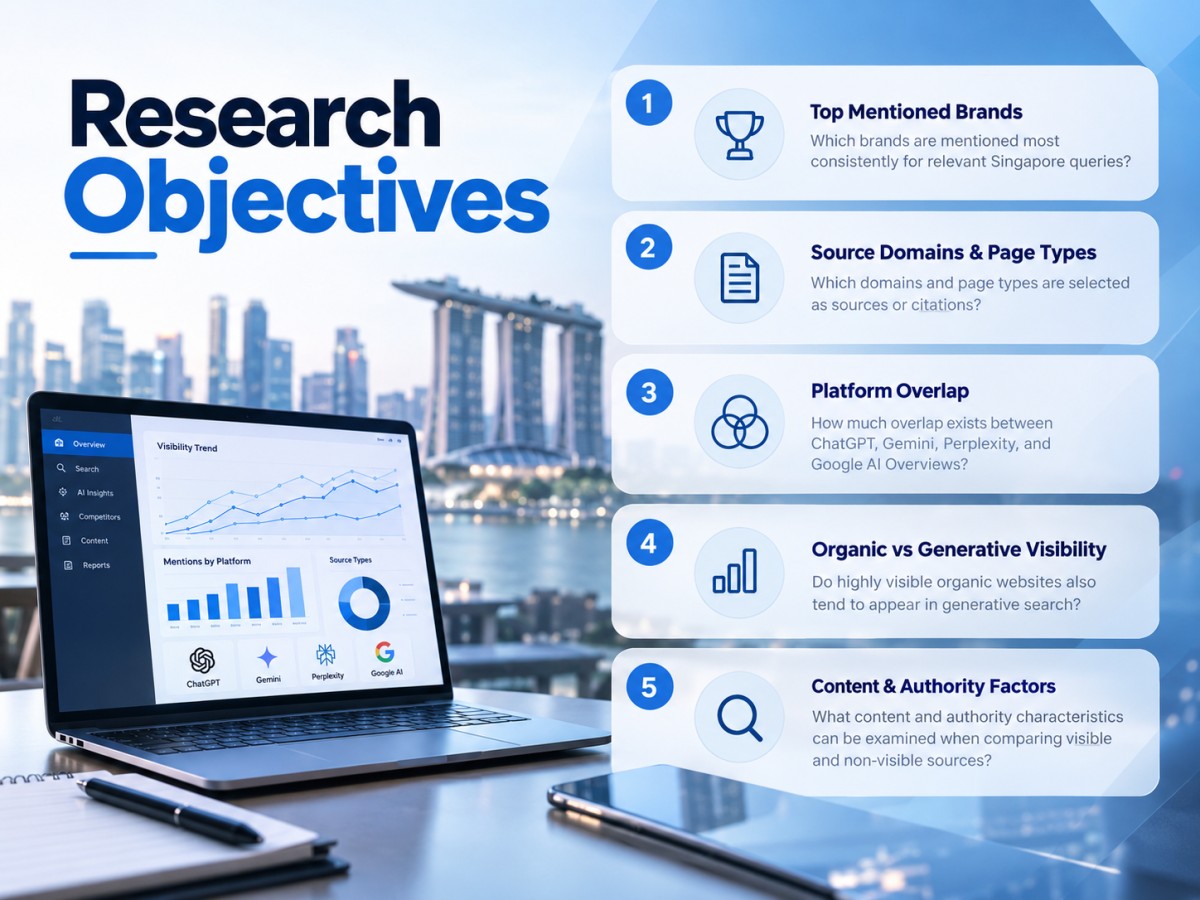
The research is designed to determine how commercial information is surfaced across AI-powered search environments for Singapore-related queries. It focuses on observable outputs rather than attempting to infer proprietary ranking algorithms.
The study addresses five core questions:
- Which brands are mentioned most consistently for commercially relevant Singapore queries?
- Which domains and page types are selected as sources or citations?
- How much overlap exists between ChatGPT, Gemini, Perplexity, and Google AI Overviews?
- Do highly visible organic websites also tend to appear in generative search?
- What content and authority characteristics can be examined when comparing visible and non-visible sources?
These questions allow AI search visibility to be evaluated without reducing it to a single metric.
Research Methodology
A useful AI search study requires consistent prompts, repeatable classifications and separate measurement of mentions and citations. The 500-query framework therefore treats each query-platform combination as an observation rather than assuming that one generated answer represents permanent visibility.
Each query is assessed across the selected platforms under controlled conditions where practical. The analysis records whether a brand appears, whether a source URL is provided, what type of page is cited, and how the answer relates to commercial intent.
The methodology distinguishes several measurements.
| Measurement | What It Represents |
|---|---|
| Brand mention | A named business or brand appears in an AI-generated response |
| Website citation | A source or link from the business's domain is attributed in the answer |
| Recommendation | The brand is presented as an option relevant to the user's request |
| Source frequency | How often a domain or URL appears across the tested query set |
| Prompt coverage | The proportion of relevant prompts in which a brand gains visibility |
| Cross-platform presence | Whether visibility occurs on more than one AI-search platform |
These measurements should remain separate. A brand mention without a citation represents a different form of visibility from an answer that directly attributes information to the brand's website.
How the 500 Queries Were Selected
The 500-query dataset is designed around commercial and research-led search behaviour rather than a random list of keywords. Queries should represent questions a Singapore consumer, procurement professional, business owner or decision-maker could reasonably ask before choosing a provider, product, or solution.
The query set can include several forms of commercial discovery:
- Category and service discovery queries
- Comparison and alternative queries
- Problem-and-solution queries
- Provider recommendation queries
- Evaluation and decision-support queries
- Informational queries with clear commercial relevance
Query variation is important because AI systems respond to natural-language prompts rather than only short keyword strings. A conventional keyword such as “SEO agency Singapore”, for example, represents different intent from “Which SEO agencies in Singapore have experience with AI search optimisation?”
The methodology should therefore preserve the commercial topic while testing realistic ways users may express the underlying need.
Industries Included in the Study

Industry coverage should be broad enough to reveal whether AI visibility patterns differ by market type. Singapore's economy contains consumer, professional, technical and regulated sectors with substantially different information environments.
The study framework can examine industries such as professional services, B2B services, education, technology, property, home services, ecommerce, hospitality, and other commercially relevant categories.
Industry segmentation matters because source selection may behave differently across subjects. A platform answering a general business-services question may rely on company websites, editorial comparisons and directories, while higher-stakes topics may place greater weight on authoritative institutional information.
Singapore's broader AI adoption also makes cross-industry analysis increasingly relevant. IMDA's 2025 enterprise findings showed that AI-using firms were applying AI across multiple business functions, with SMEs using AI in an average of three functions and non-SMEs in five.
Overall AI Search Visibility Findings
AI search visibility needs to be interpreted at three levels: presence, attribution, and consistency. A brand appearing once is evidence of visibility for that observation, but it is not sufficient to establish broad authority across an entire commercial topic.
The completed 500-query dataset should therefore report aggregate findings using a compact benchmark rather than isolated screenshots.
| Benchmark | Result |
|---|---|
| Queries tested | 500 |
| Brands appearing across tested responses | Study result to be finalised |
| Unique cited domains | Study result to be finalised |
| Brand mentions | Study result to be finalised |
| Website citations | Study result to be finalised |
| Cross-platform citations | Study result to be finalised |
The important analytical point is the relationship between these measures. If brand mentions substantially exceed website citations, businesses need to distinguish entity visibility from source visibility. If the same domains repeatedly appear across platforms, those sources deserve closer analysis for relevance, authority and content structure.
No percentage or citation total should be published until the underlying test data has been validated.
Most Frequently Mentioned Brands

Frequently mentioned brands provide a useful measure of entity-level visibility. A brand can become part of an AI-generated answer even when its own website is not the source used to support the response.
The completed study should rank brands by total mentions, prompt coverage, industry, and platform. This prevents a brand that dominates one narrow topic from being treated as universally visible.
The analysis should also separate descriptive mentions from recommendations. A business being referenced as an example is not necessarily equivalent to being recommended when a user asks which provider to consider.
For AI SEO, this distinction changes the optimisation question. Businesses should not only ask, “Does our website get cited?” They should also ask, “Does the AI system recognise our brand as relevant to the category we want to own?”
Most Frequently Cited Domains
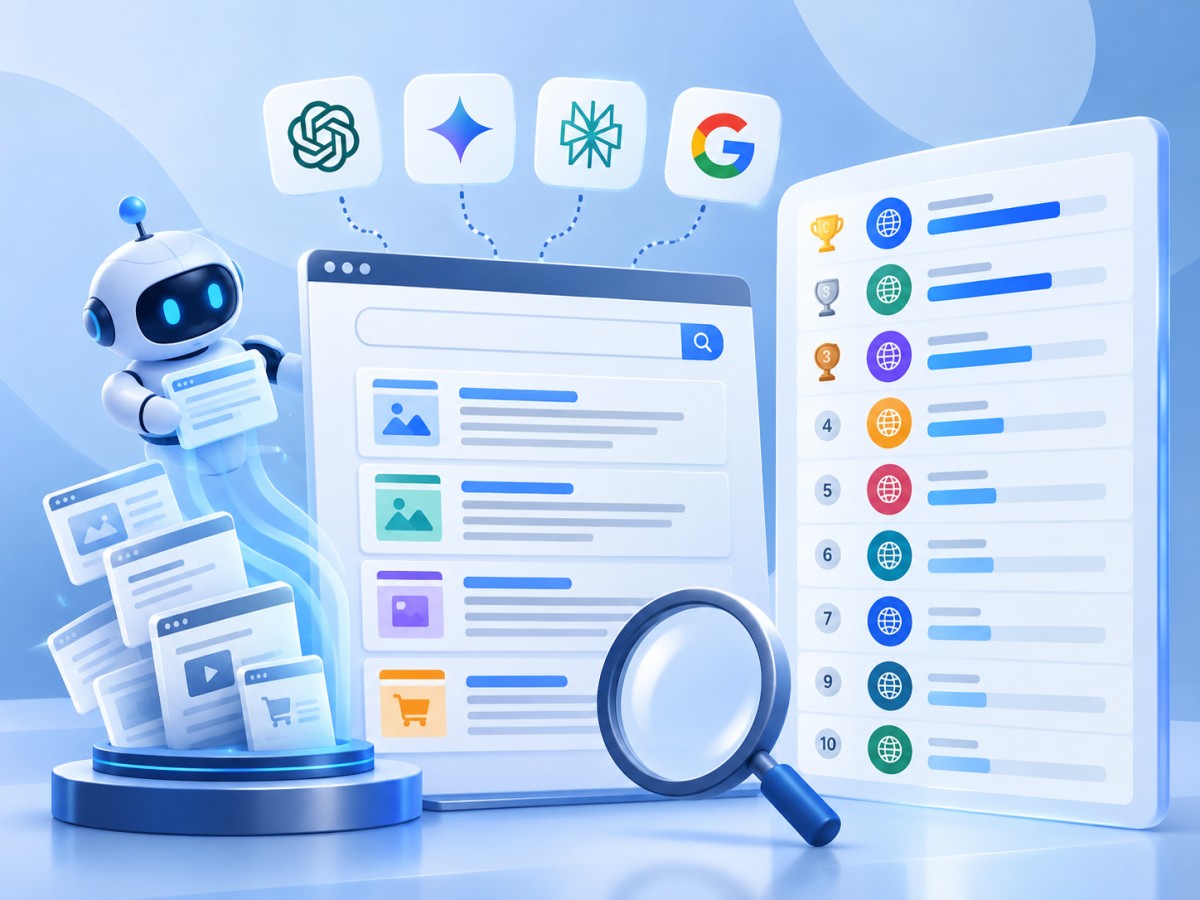
A cited domain is a website that an AI-search interface explicitly uses or presents as a source. Citation frequency can therefore reveal which websites repeatedly supply information for the tested queries.
The final ranking of domains should be based on verified study results rather than assumptions about authority. The analysis should classify each cited source so that frequency can be interpreted in context. Useful source categories include:
- Official company websites
- Government and institutional websites
- Editorial and media publications
- Industry publications and associations
- Directories and comparison resources
- Community or user-generated platforms
Citation frequency alone does not establish why a source was selected. It provides an observable outcome that can then be compared with content quality, topical relevance, organic rankings, links, mentions, and other measurable characteristics.
ChatGPT Findings
ChatGPT visibility should be assessed separately for brand mentions and source citations. A response may identify businesses that are not directly cited, which means brand-level and domain-level visibility can diverge.
For each tested prompt, the study should record whether ChatGPT names a relevant brand, recommends it, provides an attributable source, and selects a specific URL from that domain.
Repeated testing is also important. Generative outputs can change, so a single prompt response should not be treated like a fixed Google ranking position.
The resulting ChatGPT dataset can answer practical questions such as whether certain brands appear across multiple commercial prompts, whether informational resources are cited more often than service pages, and whether third-party sources contribute to brand recognition.
Gemini Findings
Gemini should be measured using the same core query set so that comparisons with other platforms remain meaningful. Changing the questions substantially between platforms would make citation and mention rates difficult to compare.
The analysis should record the source domains and page types Gemini surfaces, along with brand mentions that appear without direct attribution.
Google's own guidance is relevant when interpreting generative search visibility within its ecosystem. Google states that established SEO best practices remain foundational for its generative AI features and emphasises unique, useful content rather than a separate set of supposed AI-only technical tricks.
This reinforces the need to analyse Gemini visibility as part of a wider search strategy rather than as an isolated optimisation discipline.
Perplexity Findings
Perplexity is particularly useful for source analysis because citations are a visible component of its answer experience. The research should record cited domains, individual URLs, citation recurrence, and the type of content used for each query.
A page that appears repeatedly across related prompts may provide stronger evidence of topical source visibility than a page cited once for a highly specific question.
The analysis should also examine whether Perplexity favours different source categories for different types of commercial questions. Comparison prompts, explanatory prompts and provider-discovery prompts may produce materially different source mixes.
The purpose is not to assume that Perplexity's source-selection behaviour applies to every AI platform. It is to understand the platform on its own terms before comparing the results.
Google AI Overviews Findings
Google AI Overviews combine generative answers with Google's broader search ecosystem, making the relationship between conventional SEO and AI visibility particularly important.
The study should record whether an AI Overview appears for each eligible query, which sources are displayed, and how those sources compare with the conventional organic results for the same search.
This comparison can reveal three useful groups: pages that rank organically and receive AI visibility, pages that rank but are not selected for the generated answer, and sources that appear in the AI feature despite not occupying the most prominent conventional position.
Google's 2026 guidance advises publishers to continue following core SEO practices for generative search while creating useful and distinctive content. AI Overview analysis should therefore complement, rather than replace, conventional ranking analysis.
Cross-Platform Citation Overlap
Cross-platform citation overlap measures whether the same domains or pages appear across multiple generative search systems. High overlap would indicate that some sources have relevance beyond one platform, while low overlap would suggest that visibility is more platform-dependent.
The study should calculate overlap at both the domain and URL levels. A company may appear across several systems while each platform chooses a different page from its website.
This distinction is useful for content strategy. Domain-level overlap may indicate broader entity or topical strength, while repeated URL-level overlap may identify individual resources with unusually strong citation potential.
Cross-platform analysis also prevents an AI SEO strategy from becoming dependent on one provider. A business that performs well on one platform but remains absent elsewhere has narrower AI visibility than its headline citation count might suggest.
Singapore vs International Sources
Singapore-related commercial queries can surface both local and international sources. The balance between them helps determine whether geographic relevance is consistently associated with local source selection.
A Singapore business should not assume that using “Singapore” repeatedly throughout a page will automatically make it a preferred local source. Geographic relevance is better established through accurate business context, locally applicable information, relevant examples, and clear alignment between the page and the user's need.
The study should classify cited domains as Singapore-focused, international or mixed-market sources. It should then compare source type by industry and query intent.
This matters in a market where AI adoption is expanding rapidly. Singapore launched the National AI Impact Programme in 2026 with an aim to support 10,000 enterprises over three years in advancing AI adoption.
For businesses, stronger AI usage may increase the importance of understanding how local commercial information is represented and sourced in generated answers.
Types of Pages Most Frequently Cited
Page type analysis identifies the formats that provide information AI systems can use for particular query classes. The goal is not to declare one universal “best” format, but to understand which formats correspond with specific user needs.
The study should classify cited URLs such as service pages, long-form guides, original research, comparison pages, product or category pages, institutional resources, and editorial content.
A commercial service page may be suitable for a provider-selection query, while an evidence-led study may be more useful for a question requiring statistics or comparative findings.
Content format should therefore follow intent. Creating thousands of words simply to increase page length does not guarantee citation value. Information needs to add something useful, specific, and sufficiently clear to extract.
What the Findings Mean for Singapore Businesses
The main implication for Singapore businesses is that search visibility can no longer be evaluated through organic rankings alone. AI-generated answers introduce additional opportunities for brands to be mentioned, cited, and recommended before a user reaches a conventional search result.
This does not make SEO obsolete. Google explicitly continues to position SEO fundamentals as relevant to generative features. A practical AI SEO strategy in Singapore should therefore combine several layers of visibility:
- Maintain technically accessible, indexable, and well-structured web pages.
- Build clear topical relationships between services, expertise and supporting information.
- Publish genuinely useful material that adds original information or clearer evidence.
- Strengthen credible third-party references and brand recognition beyond the company's own website.
- Measure AI mentions and citations alongside rankings, organic traffic and conversions.
The emphasis should remain on useful information rather than attempts to manipulate generative systems.
W360 Recommendations
AI search optimisation should begin with measurement because businesses need to know where they are visible before deciding what to change. An AI SEO programme without a benchmark can generate activity without showing whether brand representation is actually improving.
For Singapore businesses, our recommended framework is built around four connected areas.
Establish a Prompt Benchmark
A prompt benchmark defines the commercial questions for which a brand reasonably expects to be relevant. It should include category discovery, comparison, problem-solving, and recommendation queries. The prompt set should remain sufficiently stable over time to support comparison while allowing new queries to be added when customer behaviour changes.
Separate Mentions From Citations
Brand mentions and website citations should be reported independently. A company may achieve strong entity recognition without being selected as the underlying source. This separation makes the diagnostic process more useful. Low mentions may indicate a broader brand or topical authority problem, while healthy mentions combined with weak owned-site citations may point towards a source-selection or content opportunity.
Strengthen Information Gain
Information gain means providing useful material that adds something beyond generic summaries already available across competing pages. Examples can include original datasets, documented methodologies, expert analysis, proprietary frameworks, first-party case evidence and Singapore-specific observations. Google has specifically emphasised valuable and unique content in its guidance for generative AI features.
Connect AI Visibility With Business Outcomes
AI visibility should not become a vanity metric. Citation counts and mentions are useful diagnostic indicators, but businesses ultimately need to connect visibility with branded demand, qualified traffic, enquiries and other commercial outcomes where attribution is possible. This requires AI SEO reporting to sit alongside GA4, Google Search Console, lead tracking and broader marketing data rather than operating as a disconnected report.
Building an AI Search Benchmark for Singapore
An AI search benchmark provides a repeatable baseline against which future visibility can be measured. The benchmark should document prompts, platforms, test dates, observed responses and classification rules.
Consistency is particularly important because generative systems evolve. If the query set and measurement rules change completely every month, apparent improvements may reflect methodology changes rather than genuine visibility gains.
A practical benchmark can therefore retain a fixed core of high-value prompts while maintaining a smaller exploratory set for emerging topics.
For each brand, the benchmark can report prompt coverage, mention frequency, citation frequency, recommendation frequency and cross-platform presence. These indicators create a more complete view than a single “AI visibility score” without transparent methodology.
Why Traditional SEO Still Matters
Traditional SEO remains foundational because AI-powered discovery still depends on accessible, relevant and useful web information. Generative interfaces change how information is presented, but they do not eliminate the need for strong underlying sources.
Technical accessibility, clear page purpose, internal linking, descriptive titles, useful content and authoritative information continue to matter. Google's own guidance for generative search explicitly reinforces established SEO practices rather than introducing an entirely separate optimisation system.
The more useful strategic question is therefore not whether SEO or AI SEO will “win”. It is how businesses can build web visibility that works across conventional search results, generated answers and emerging discovery environments.
Study Limitations
AI search studies have limitations because generative outputs are dynamic. Results can vary over time, between accounts, by location, with prompt wording and as platforms update their retrieval and response systems.
Citation visibility also does not prove causation. If a cited page has strong backlinks, structured data or a high Google ranking, the citation alone cannot establish which factor caused the platform to select it.
The 500-query study should therefore be treated as an observational benchmark rather than a reverse-engineered ranking formula. Other limitations include differences in citation interfaces between platforms, changing availability of AI features, personalisation and the difficulty of reproducing every user's exact search context.
Transparent limitations make the findings more useful because they prevent correlations from being presented as proven ranking factors.
Methodology Appendix
The methodology appendix exists so the study can be repeated and challenged. Reproducibility is particularly important for AI SEO research because claims about generative search can quickly become outdated.
Each study record should contain the query, commercial intent, industry, platform, test date, brands mentioned, brands recommended, domains cited, URLs cited and page classification.
The final dataset should also preserve clear definitions. A brand mention should not automatically count as a citation. A citation should not automatically count as a recommendation. A source appearing once should not be described as consistently visible.
Where the study compares AI visibility with Google rankings, ranking observations should be recorded separately and within a defined testing period. Future iterations can then use the same core methodology to measure how visibility changes over time rather than comparing incompatible datasets.
Frequently Asked Questions
What is AI SEO in Singapore?
AI SEO in Singapore refers to optimising a brand's digital presence for visibility across traditional search and AI-powered discovery environments. It can include conventional SEO, content structure, entity clarity, generative search monitoring, source citations and brand mentions.
Is AI SEO different from traditional SEO?
AI SEO expands traditional SEO rather than replacing it. Traditional SEO focuses heavily on crawling, indexing, relevance, authority and organic search performance, while AI SEO also examines how brands and sources appear in generated answers.
What is AI search visibility?
AI search visibility measures whether a brand, website or source appears in responses generated by AI-powered search and answer platforms. It can include brand mentions, citations, recommendations, source frequency and visibility across relevant prompts.
Does ranking first on Google guarantee an AI citation?
No. A high organic position does not guarantee that an AI-generated answer will cite the same page. Organic rankings and generative citations should be measured separately. At the same time, conventional SEO remains important because search engines continue to rely on accessible, relevant and high-quality web content.
How can a Singapore business measure ChatGPT visibility?
A business can create a stable set of commercially relevant prompts and record whether ChatGPT mentions the brand, recommends it or cites its website. The same prompts can be tested periodically to identify changes.
Are brand mentions as important as website citations?
Brand mentions and citations measure different outcomes. A mention indicates that the brand is recognised as relevant to the answer, while a citation indicates that a website has been used or presented as an attributable source. Both are useful, but they should be reported separately.
Does schema markup guarantee better AI visibility?
No. Structured data can help machines understand explicit information on a page, but implementing schema does not guarantee inclusion in an AI-generated response. Schema should be accurate and relevant to the content rather than treated as an independent shortcut to AI citations.
How often should AI search visibility be monitored?
Monitoring frequency should reflect the importance of the queries and the rate at which the market changes. A stable monthly or quarterly benchmark may be appropriate for strategic reporting, while priority prompts can be checked more frequently when a campaign is actively being evaluated.
Building Visibility Beyond the Traditional Search Result
AI-powered search is expanding the number of places where a Singapore business can become visible. Rankings remain important, but mentions, citations, recommendations and cross-platform presence now provide additional signals that should be measured separately.
The strongest approach is therefore not to abandon SEO for a new acronym. Businesses should preserve sound technical and content fundamentals while improving the originality, clarity, authority and measurability of the information they publish.
A 500-query benchmark can provide a structured way to evaluate this changing environment, provided the results are recorded transparently and no correlation is presented as a proven ranking factor.
Establish an AI Search Baseline for Your Business
Businesses assessing AI SEO in Singapore performance can begin by identifying the commercial prompts that matter to their customers and measuring how their brand appears across traditional and generative search environments.
W360 Group Pte Ltd approaches AI search visibility alongside established SEO signals so that rankings, brand mentions, citations and commercial outcomes can be evaluated within the same search strategy. Do you want to assess your website’s current visibility? Get a quote to get started on your AI SEO journey.