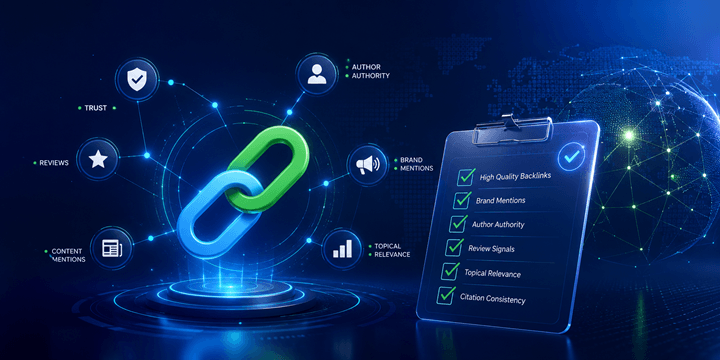
AI SEO refers to the practice of structuring and writing content so it can be accurately interpreted and cited by search engines and AI-generated answer systems. AI (Artificial Intelligence) SEO focuses on clarity, factual completeness, and structured presentation rather than ranking signals alone.
As search engines evolve, information has to be written in a way it directly answers questions or defines concepts when extracted by AI systems. Keep reading to understand what that means when creating content in 2026.
What AI SEO Means in 2026
AI SEO is the alignment of digital content with how modern Large Language Models (LLMs), which are AI systems trained to understand and generate human language, and generative search systems process information.
Unlike earlier optimisation approaches that focused on keyword density (how often specific search terms appear), AI SEO prioritises explicit definitions, self-contained passages, and verifiable statements. In 2026, the primary goal of SEO (Search Engine Optimisation) has shifted from merely winning a “click” to earning a “citation” within an AI-generated overview.
The Shift to Machine-Readable Content
For a page to perform in 2026, it must be “Machine-Readable.” This involves using HTML5 semantic tags (like <article>, <section>, and <aside>) to help AI crawlers identify the most important parts of a page. When content is machine-readable, an AI engine can separate the information into digestible bits, increasing the likelihood that a specific paragraph will be used as the definitive answer for a user’s query.
How AI SEO Differs From Traditional SEO
Traditional SEO focuses on ranking pages for queries, while AI SEO focuses on making content extractable and reusable by AI systems. The difference lies in how information is structured and evaluated. Traditional SEO relies heavily on backlink authority and click-through rates (CTR). In contrast, AI SEO and its subset, Generative Engine Optimisation (GEO), prioritises information gain and citation integrity.
Key Distinctions in Strategy
- Intent vs. Keywords: Traditional SEO targets specific phrases. AI SEO targets intent and the “why” behind a query, providing comprehensive answers that satisfy multi-step conversational prompts.
- Modular vs. Linear: Traditional articles often follow a narrative arc that requires reading from top to bottom. AI SEO content is modular; each section is designed to be complete without relying on page-wide context.
- Answer-First vs. Narrative-First: Definitions and direct answers appear before explanations to support accurate summarisation by AI agents like Google’s Gemini or OpenAI’s SearchGPT.
Feature | Traditional SEO | AI SEO / GEO (2026) |
Primary Metric | Ranking Position | Citation Frequency |
Optimization Unit | The Page (URL) | The Passage (Chunk) |
Content Goal | High CTR (Clicks) | Information Accuracy |
Authority Signal | Backlinks | Brand Mentions & Citations |
The Role of Structure in AI-Readable Content
Clear structure enables AI systems to identify, segment, and reuse information correctly. Headings act as semantic markers, while concise paragraphs ensure ideas are not blended or misinterpreted. In 2026, AI engines use passage indexing to pull specific segments of a page into a search result, even if the rest of the page is less relevant to the specific query.
Best Practices for Structural Clarity
To maximise extractability, content creators should follow these structural rules:
- One Idea Per Section: Use descriptive H2 and H3 headings that mirror common user questions.
- Short Paragraphs: Keep paragraphs under 50 words to avoid “topic bleeding,” where multiple concepts are mixed together, making it hard for an AI to quote one specific fact.
- The “Snippet” Lead: Start every section with a 2-3 sentence summary that contains the most critical information.
Understanding Generative Engine Optimisation (GEO)
Generative Engine Optimisation (GEO) is the process of making content suitable for generative engine outputs, such as AI Overviews and chatbots. While SEO ensures discoverability, GEO ensures that once discovered, AI selects your content as its primary source.

The Components of a GEO Strategy
- Information Gain: AI systems avoid citing content that simply repeats what is already in their training data. You must provide unique data, original research, or expert perspectives.
- Entity Density: Use specific names of people, places, and established concepts. This helps the AI connect your content to the “Knowledge Graph.”
- Technical Schema: Implement JSON-LD schema (specifically FAQPage, HowTo, and Dataset) to provide a “data layer” that AI can read without having to parse natural language.
Content Signals That Support AI Extraction
AI systems rely on explicit signals to determine whether content is safe to quote or summarise. These signals are created through writing choices rather than technical markup alone. In 2026, “citation-safe” content is defined by its neutrality and lack of promotional bias.
Key Signals for AI Trust
- Factual Neutrality: Avoid subjective adjectives (e.g., amazing or unbeatable). AI models are programmed to prefer neutral, encyclopedic tones for their summaries.
- Verifiable Statistics: Include data points from reputable sources. For example, referencing a study from the Journal of Digital Marketing provides a trust anchor that AI systems can verify.
- Internal and External Linking: Contextual internal links help AI understand the topology of your site, while external links to high-authority domains (e.g., .gov or .edu sites) prove you are grounding your claims in reality.
The Importance of E-E-A-T in the AI Era

Experience, Expertise, Authoritativeness, and Trustworthiness (E-E-A-T) are more critical in 2026 than ever before. AI engines are designed to filter out low-quality AI-generated spam.
Demonstrating Authority
To earn citations, content must show it is human written. This is achieved by:
- Detailed Author Bios: Linking to the author’s LinkedIn or professional portfolio.
- First-Hand Experience: Using phrases like “In our testing…” or “Based on our 10 years of experience in…”
- Transparency: Clearly stating if any part of the content was assisted by AI tools, as transparency is a major trust signal for 2026 search algorithms.
Common Mistakes in AI SEO Content
Many articles fail to perform in AI-generated outputs due to structural and language issues rather than a lack of information. These issues often reduce extractability and increase the risk of the AI misinterpreting the content.
Areas to Avoid
- Implicit References: Avoid using words like “it,” “this,” or “as mentioned above” at the start of paragraphs. If an AI extracts that paragraph, it will lose its meaning.
- Gated Content: AI crawlers cannot cite what they cannot see. Important definitions should never be hidden behind pop-ups or login walls.
- Over-Optimisation: Keyword stuffing is obsolete since AI systems now recognise natural language patterns and will penalise content that is solely written for a machine.
FAQ: Frequently Asked Questions about AI SEO
Informational content such as guides, technical explanations, and reference articles benefit from AI SEO because they are designed to answer questions directly. These formats align naturally with AI summarisation and citation logic used by engines like Perplexity and Google.
No. AI SEO complements traditional SEO. While AI SEO helps you get cited in summaries, traditional SEO ensures your site remains technically healthy (fast loading speeds, mobile-friendly) and discoverable by crawlers.
Content should be reviewed whenever facts, definitions, or industry processes change. In 2026, AI systems prefer citing data that has been updated within the last 6 months.
The Zero-Click challenge refers to users getting their answers directly from the AI search interface without clicking through to the website. AI SEO addresses this by ensuring your brand is cited as the source, building brand "mindshare" and authority even when a click does not occur.
Future-Proof Your Business with AI SEO From W360
AI SEO and GEO in 2026 represent a shift toward a more transparent and factual web. By writing self-contained sections with clear definitions, neutral language, and robust technical schema, your content can become a “source of truth” for both traditional search results and AI-generated answers.
Organisations that audit their content for extractability today will dominate the citation-based search landscape of tomorrow. For Singapore organisations looking to review your content strategy, consider a trusted digital marketing agency such as the W360 Group.
We can provide an audit and help you determine whether your existing pages are suitable for AI-driven search environments. Learn more!