AI-driven SEO services should ultimately be measured by whether search visibility contributes to meaningful business outcomes, not simply by whether a website appears in Google, ChatGPT, Gemini, Perplexity or Google AI search experiences.
The difficulty is that the modern search journey is no longer linear. A user can discover a company through a Google ranking, encounter it again in an AI-generated answer, see its website cited as a source, search the brand later and only then submit an enquiry.
Traditional analytics may record only the final website session.
This creates an attribution gap between AI visibility and the eventual lead.
For Singapore businesses, the correct response is not to assign arbitrary revenue to every AI citation. The stronger approach is to measure each stage of the journey separately: Google ranking, AI retrieval, brand mention, website citation, recommendation, website visit, branded search and conversion.
Google’s current guidance confirms that conventional SEO remains relevant to generative search because AI Overviews and AI Mode are rooted in core Search ranking and quality systems. Google also introduced dedicated generative AI visibility reporting in Search Console during 2026, making it increasingly possible to measure some search-side AI exposure before a click occurs.
The objective is therefore not to replace SEO reporting with an AI visibility score. It is to connect search visibility, generative visibility and commercial performance within one measurable framework.
Why AI Visibility Must Connect to Business Outcomes
AI visibility matters commercially only when it contributes to discovery, consideration, demand or conversion.
A citation by itself is not a lead.
A mention by itself is not revenue.
A ranking by itself does not guarantee a conversion.
However, each can influence the customer journey.
The correct measurement question is:
What role did each visibility stage play in moving the user closer to a commercial outcome?
For a Singapore B2B company, this may involve a long research process.
For a local service business, the journey may be shorter.
For ecommerce, the user may move directly from research to product evaluation.
AI SEO measurement therefore needs to reflect the actual buying journey rather than forcing every business into the same attribution model.
The AI SEO Conversion Funnel
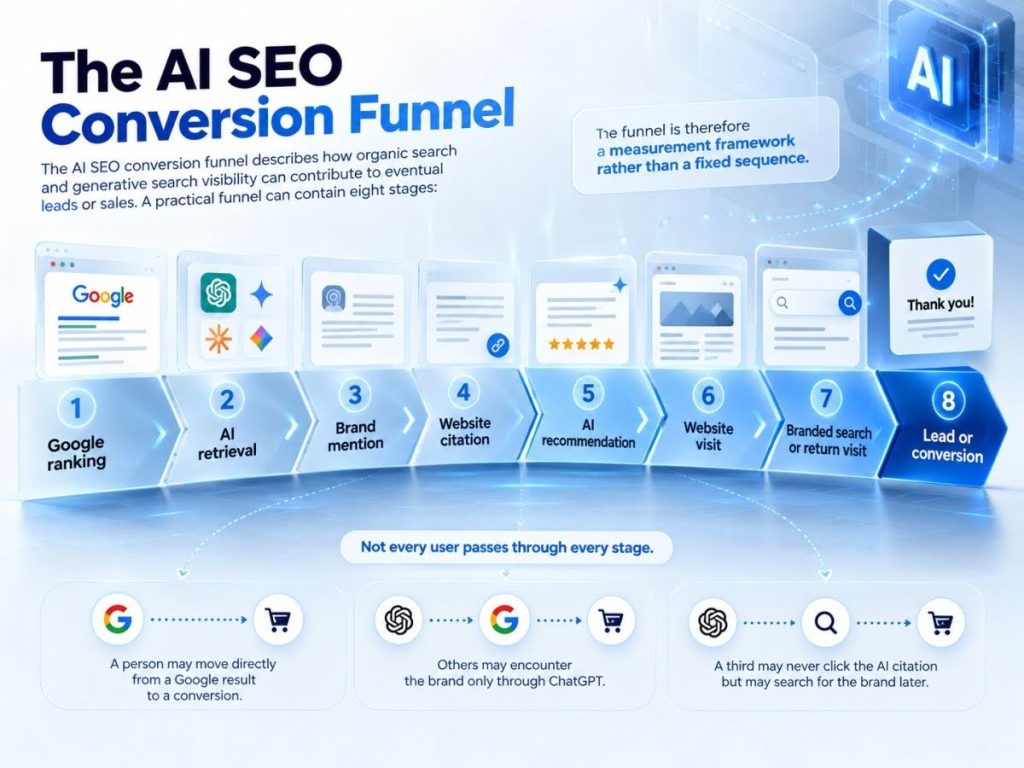
The AI SEO conversion funnel describes how organic search and generative search visibility can contribute to eventual leads or sales.
A practical funnel can contain eight stages:
- Google ranking
- AI retrieval
- Brand mention
- Website citation
- AI recommendation
- Website visit
- Branded search or return visit
- Lead or conversion
Not every user passes through every stage.
A person may move directly from a Google result to a conversion.
Others may encounter the brand only through ChatGPT.
A third may never click the AI citation but may search for the brand later.
The funnel is therefore a measurement framework rather than a fixed sequence.
Stage 1: Google Ranking

Google ranking remains an important foundation because traditional search continues to influence discovery and generative retrieval.
Google states that its generative AI features are rooted in core Search ranking and quality systems. The same technical and content fundamentals that support conventional Search remain relevant for AI Overviews and AI Mode.
A strong ranking can therefore support several outcomes.
It can:
- Generate organic clicks
- Strengthen topical visibility
- Increase opportunities for generative retrieval
- Expose the brand before an AI interaction
- Support repeated discovery across the search journey
However, ranking position should not be treated as the final commercial KPI.
A page can rank strongly while producing weak engagement or low-quality leads.
The ranking is the beginning of the measurement chain.
Measuring Traditional Search Visibility
Traditional search performance should continue to include established SEO metrics.
Useful measurements include:
Metric | What It Shows |
Organic ranking | Search position |
Search impressions | Discovery opportunity |
Organic clicks | Website visits |
Click-through rate | SERP engagement |
Landing-page traffic | Page-level demand |
Organic conversions | Direct commercial outcomes |
These metrics remain essential.
AI SEO extends the framework rather than replacing them.
The key change is that search visibility can now contribute to additional generative experiences before a user visits the website.
Stage 2: AI Retrieval

AI retrieval occurs when a generative search system accesses or selects information relevant to a user’s question.
Retrieval does not necessarily mean the user will see a citation.
It also does not mean the brand itself will appear prominently.
The concept is important because generated answers may use multiple pieces of information to construct one response.
Google describes retrieval-augmented generation, or RAG, as one of the techniques used in its generative Search features. Its guidance explains that relevant and up-to-date webpages can be retrieved from the Search index using core ranking systems.
For businesses, direct retrieval is difficult to measure unless the platform exposes a citation or other source signal.
The practical proxy is therefore visible citation tracking.
Stage 3: Brand Mention

A brand mention occurs when an AI-generated answer names the company, product or organisation.
This can happen without a direct link.
Brand mentions are important because they indicate entity-level visibility.
For example, a user could ask:
“Which AI SEO agencies should a Singapore business consider?”
If a company appears by name, it has entered the user’s consideration environment.
That visibility can be commercially meaningful even if the company website is not cited.
The user may remember the name and search for it later.
Because this journey does not necessarily contain a direct referral click, brand mentions need to be measured separately from GA4 traffic.
Measuring Brand Mention Rate
Brand mention rate can be calculated across a controlled prompt universe.
The basic formula is:
Brand Mention Rate = Relevant Prompts Mentioning the Brand ÷ Total Relevant Prompts Tested × 100
The prompt set should contain realistic customer questions.
It should also remain stable across reporting periods.
Mention rate should be segmented by intent.
A brand mentioned during an educational query has different value from one recommended during a provider-selection prompt.
This makes prompt classification essential.
Stage 4: Website Citation
A website citation occurs when the company’s domain or page appears as a visible supporting source.
This represents source visibility rather than simply brand recognition.
A citation can indicate that the page contains information useful for supporting part of the generated response.
Examples can include:
- Original research
- Definitions
- Service information
- Product specifications
- Comparisons
- Statistics
Citation performance should therefore be measured at both domain and URL level.
The domain shows overall source visibility.
The exact URL reveals which content assets are functioning as sources.
Measuring Citation Rate
Citation rate can be calculated using:
Citation Rate = Relevant Prompts Citing the Website ÷ Total Relevant Prompts Tested × 100
A competitor version can also be calculated.
Citation Share of Voice = Brand-Owned Citations ÷ Total Owned Citations Among Tracked Competitors × 100
These metrics help identify whether the site is becoming more useful as a generative source.
However, citations should not automatically be treated as endorsements.
A technical article may be cited without the company being commercially recommended.
This is why citation rate and recommendation rate should remain separate.
Stage 5: AI Recommendation
AI recommendation occurs when a generative system actively presents the brand, product or provider as an option.
This is generally more commercially significant than a neutral mention.
Examples include prompts such as:
- Which agencies provide AI SEO services in Singapore?
- What are good providers for this service?
- Which company should a business consider?
- What suppliers offer this solution?
Recommendation visibility should be measured only against commercially relevant prompts.
A technical definition should not contribute to provider-recommendation reporting.
This prevents informational authority from being mistaken for commercial consideration.
Recommendation Rate
Recommendation rate can be calculated as:
Recommendation Rate = Commercial Prompts Recommending the Brand ÷ Total Relevant Commercial Prompts × 100
Recommendation shares can then compare competing businesses.
Recommendation Share = Brand Recommendations ÷ Total Tracked Competitor Recommendations × 100
These metrics can be particularly useful for AI-driven SEO services because they show whether visibility has moved beyond informational sourcing into market consideration.
However, recommendation visibility still does not prove a lead occurred.
It represents a stronger position within the discovery funnel.
Stage 6: Website Visit
A website visit creates the first point where conventional analytics can observe user behaviour directly.
If the user clicks from ChatGPT, Perplexity or another AI platform and referral information is preserved, GA4 may record the session.
This creates measurable AI referral traffic.
Useful metrics include:
- Sessions
- Engaged sessions
- Landing pages
- Form starts
- Enquiries
- Purchases
- Qualified leads
Referral traffic provides valuable evidence.
However, it represents only the users who clicked directly.
It does not capture every person who saw a brand or citation within an AI-generated answer.
Direct AI Referral Traffic
Direct AI referral traffic should be reported separately by source where possible.
A useful structure can include:
Source | Sessions | Engagement | Conversions |
ChatGPT | Track | Track | Track |
Perplexity | Track | Track | Track |
Gemini | Track | Track | Track |
Other AI referrals | Track | Track | Track |
The numbers should be interpreted carefully.
A platform generating 500 sessions but no qualified enquiries may be less commercially valuable than one generating 50 highly relevant visits and several leads.
Traffic volume therefore needs conversion context.
Stage 7: Branded Search
Branded search occurs when users later search specifically for the company or a combination of its brand and services.
This can be an important secondary outcome of AI exposure.
For example:
ChatGPT → sees W360 Group Pte Ltd → leaves ChatGPT → searches “W360 AI SEO Singapore” → visits the website
The final session may be recorded as organic search rather than AI referral traffic.
This creates an attribution gap.
Branded search can therefore provide supporting evidence of growing brand demand.
It should not, however, be attributed entirely to AI.
Other channels can also influence it.
Measuring Branded Demand
Branded demand can be tracked using Google Search Console.
Useful measurements include:
- Brand-name impressions
- Brand-name clicks
- Brand-plus-service queries
- Brand-plus-location queries
- Branded query trend
A business can compare these trends with AI visibility growth.
If recommendation visibility, branded search and qualified leads increase during the same period, the relationship deserves further analysis.
The conclusion should remain cautious.
Correlation is not proof that one factor caused the other.
Stage 8: Lead and Conversion
A lead or conversion is the point where visibility produces a measurable commercial action.
For service businesses, this may include:
- Enquiry form submission
- Phone call
- Consultation request
- Qualified sales opportunity
For ecommerce, it may be a purchase.
For B2B companies, the initial lead may still be far from final revenue.
The measurement model should therefore follow the business’s actual sales process.
A lead should not automatically be treated as equal in value to a qualified opportunity.
Why Attribution Is Difficult
AI SEO attribution is difficult because the user journey often contains multiple channels and unmeasured interactions.
A simple journey may look like:
Google → website → enquiry
A generative search journey may look like:
Google → research article → ChatGPT → brand mention → Google branded search → website → LinkedIn → enquiry
Analytics may only record part of this sequence.
Cross-device behaviour creates additional gaps.
A user could research on a mobile phone and convert later on a work computer.
Private browsing, app interfaces and missing referral information can further limit attribution.
No analytics platform can reliably reconstruct every path.
Direct AI Referral Traffic
Direct AI referral traffic is the strongest form of observable AI-originated website activity.
If a user clicks from an identifiable AI platform and then converts, the connection is relatively clear.
The business can analyse:
- Referral source
- Landing page
- Engagement
- Conversion
- Lead quality
This provides useful bottom-funnel evidence.
However, direct referral traffic should not be treated as the full commercial impact of AI SEO.
It excludes zero-click visibility and later branded journeys.
Branded Demand as Supporting Evidence
Branded demand is best treated as supporting evidence rather than direct attribution.
Suppose AI visibility increases substantially after a campaign.
During the same period, branded search impressions also increase.
This may suggest stronger awareness.
However, the business should still review:
- PR activity
- Paid advertising
- Social campaigns
- Offline marketing
- Seasonality
If several channels changed simultaneously, attributing the branded lift to AI SEO alone would be misleading.
The correct report should state what happened without overstating causation.
Assisted Conversions
Assisted conversions occur when a visibility touchpoint contributes to a later conversion without being the final recorded acquisition channel.
AI search can operate in this way.
A user may discover a provider in ChatGPT but submit an enquiry after finding the business through Google several days later.
The final conversion may be attributed to organic search.
The AI exposure still may have influenced the journey.
Because that influence is not always directly measurable, businesses should use multiple evidence sources.
Useful evidence can include:
- Referral traffic
- Branded search
- Lead-source surveys
- CRM notes
- Return visits
- Sales conversations
Lead-Source Questions
Lead-source questions can help fill attribution gaps.
A contact form can ask:
“How did you hear about us?”
Relevant choices may include:
- ChatGPT
- Gemini
- Perplexity
- Social media
- Referral
- Other
This information is imperfect.
Users may not remember the exact source.
Some may choose the platform they used immediately before converting rather than the one that first introduced the brand.
The data should therefore complement analytics rather than replace it.
CRM Attribution
CRM attribution helps connect leads with downstream commercial outcomes.
AI referral traffic may generate an enquiry, but the more important question is whether that enquiry becomes qualified.
The CRM can record:
- Lead source
- Service requested
- Lead status
- Opportunity status
- Revenue outcome
- Sales-cycle duration
This helps distinguish traffic generation from commercial quality.
For a B2B organisation, pipeline contribution can be more useful than raw conversion count.
Lead Quality
Lead quality measures how closely an enquiry matches the business’s target customer profile.
Not all traffic should be valued equally.
For AI-driven SEO services, useful lead-quality criteria can include:
- Relevant market
- Suitable budget category
- Appropriate service needs
- Decision-making authority
- Realistic project timing
The goal is not simply to increase AI referrals.
It is to attract commercially relevant discovery.
A small amount of qualified AI-originated traffic can be more meaningful than a large volume of general informational visits.
AI Visibility Share of Voice
AI visibility share of voice compares the brand’s presence with competitors.
It helps management understand whether visibility gains are competitive or merely absolute.
Useful components can include:
Metric | Purpose |
Mention share | Brand recognition |
Citation share | Source authority |
Recommendation share | Commercial visibility |
Prompt coverage | Visibility breadth |
Platform coverage | Cross-platform strength |
These metrics sit near the top of the conversion funnel.
They should not be presented as direct revenue metrics.
Their purpose is to show whether the brand is gaining or losing generative search presence.
Why Competitive Context Matters
A company may increase its citation rate from 20% to 30%.
That appears positive.
However, if its leading competitor increases from 30% to 60%, the relative gap has widened.
Competitive context therefore matters.
The same applies to recommendations.
A business may receive more mentions while becoming less prominent relative to the market.
AI SEO reporting should therefore include both absolute trend and competitive share.
This makes performance more actionable.
Recommended Commercial KPIs
Commercial KPIs should connect AI visibility to measurable business outcomes without overstating attribution.
A practical KPI stack can include:
- Direct AI-attributed leads
- Qualified AI-attributed leads
- Conversion rate from identifiable AI referrals
- Pipeline associated with AI-originated leads
- Branded search growth
- Assisted-conversion indicators
These should be interpreted alongside visibility metrics.
A content campaign may first improve citation coverage.
Commercial outcomes may appear later.
Different metrics therefore operate on different timelines.
Recommended Visibility KPIs
Visibility KPIs show whether the company is gaining presence before the website visit.
Recommended measures include:
- Prompt coverage
- Mention rate
- Citation rate
- Recommendation rate
- Citation share of voice
- Recommendation share of voice
- Google generative impressions
Google’s dedicated Search Generative AI performance reports provide a direct Google-specific visibility layer for AI Overviews and AI Mode. Google stated that the reporting rollout reached websites worldwide by 31 August 2026.
This data should sit alongside cross-platform prompt tracking.
Recommended Search KPIs
Traditional search KPIs remain part of the framework.
Useful measures include:
- Organic rankings
- Organic impressions
- Organic clicks
- CTR
- Landing-page traffic
- Non-branded conversions
Google’s 2026 optimisation guidance specifically states that SEO best practices remain relevant to generative AI search because the generative features rely on core Search systems.
This means businesses should avoid treating AI SEO as a separate marketing discipline disconnected from organic search.
AI SEO performance builds on strong SEO fundamentals.
Sample AI SEO Reporting Model
A commercial AI SEO report should separate visibility, behaviour and outcomes.
A practical model is:
Funnel Stage | KPI | Data Source |
Google visibility | Rankings, impressions | Search Console / rank tracker |
Google AI visibility | Generative impressions | Search Console |
AI visibility | Mentions, citations | Prompt tracking |
Competitive position | AI Share of Voice | Benchmark dataset |
Website traffic | AI referrals | GA4 |
Demand | Branded search | Search Console |
Lead | Enquiry source | GA4 / CRM |
Pipeline | Qualified opportunities | CRM |
Revenue | Closed business | CRM / finance |
This structure avoids forcing every metric into one tool.
Each system contributes the data it measures most reliably.
Example Funnel Measurement
Consider an illustrative Singapore B2B campaign.
During one reporting period:
- Organic visibility improves.
- AI citation coverage increases.
- The brand begins appearing in more commercial prompts.
- Direct AI referral traffic rises moderately.
- Branded search impressions increase.
- Sales records several enquiries where prospects mention ChatGPT.
The appropriate conclusion is not:
“AI SEO generated all of the new leads.”
A more defensible interpretation is:
“AI visibility increased across several measurable stages and coincided with stronger branded demand and identifiable AI-assisted enquiries.”
This language accurately reflects the evidence.
Measuring Google Ranking to AI Citation
The first analytical relationship is whether stronger Google visibility is associated with stronger AI citation visibility.
The benchmark can compare:
Organic Visibility | AI Citation |
Top 3 | Yes / No |
Positions 4–10 | Yes / No |
Outside Top 10 | Yes / No |
This helps identify citation gaps.
A page ranking strongly but never receiving AI citations may need stronger source value.
A page receiving citations despite weaker rankings may contain information particularly suited to generative retrieval.
Both outcomes can inform content strategy.
Measuring AI Citation to Website Visit
The second relationship is whether cited pages generate referral traffic.
The analysis should compare:
- Citation frequency
- Referral sessions
- Engagement
- Conversion behaviour
A highly cited page may receive a few clicks.
Another may receive fewer citations but stronger referral engagement.
This difference matters.
Citation value therefore has both visibility and traffic dimensions.
The page should not be judged using only one.
Measuring Website Visit to Lead
The third relationship is whether AI-originated visits convert.
Businesses should calculate:
AI Referral Conversion Rate = AI Referral Conversions ÷ AI Referral Sessions × 100
This can then be compared with:
- Organic search conversion rate.
- Paid search conversion rate.
- General referral conversion rate.
The objective is not to prove that AI traffic is universally better or worse.
It is to determine how it behaves for the specific business.
Lead quality should also be reviewed before making investment decisions.
Measuring Brand Mention to Branded Search
Brand mention visibility can be compared with branded search trends.
If AI recommendations become more frequent and branded search rises, the pattern may indicate increasing discovery.
However, the relationship should be reported as correlation unless stronger attribution evidence exists.
A business can improve the analysis by using:
- Lead surveys
- Sales interviews
- CRM notes
- Customer journey research
First-party customer feedback can reveal influences that web analytics alone cannot observe.
Calculating AI SEO ROI
AI SEO ROI should use measurable commercial returns where attribution is sufficiently reliable.
A basic formula is:
ROI = (Commercial Return Attributed to AI SEO − AI SEO Investment) ÷ AI SEO Investment × 100
The difficult part is not the formula.
It is deciding what revenue can legitimately be attributed.
Direct revenue from identifiable AI referral conversions can be relatively clear.
Revenue from a customer who first discovered the company in ChatGPT but converted through Google later may be harder to attribute.
This requires a more cautious model.
Direct ROI
Direct ROI includes outcomes with strong attribution evidence.
Examples can include:
- Identifiable AI referral → conversion
- AI referral → CRM lead → sale
- The user explicitly states the AI platform as a discovery source.
These outcomes can be reported separately.
A report might show:
Directly attributable AI-originated pipeline
rather than treating all AI visibility as revenue-producing.
This makes the reporting more credible.
Assisted ROI
Assisted ROI estimates the contribution of AI visibility to conversions involving multiple channels.
This is harder to calculate.
Businesses should avoid assigning arbitrary monetary values to mentions or citations.
A stronger approach is to report assisted indicators separately.
Examples include:
- AI-referred first visits that later convert.
- Branded searches following AI discovery.
- CRM leads mentioning AI during sales conversations.
- Multi-touch journeys containing identifiable AI referrals.
These provide evidence of contribution without pretending that attribution is perfect.
What Cannot Be Reliably Attributed
Several outcomes cannot be reliably attributed to AI SEO without additional evidence.
These include:
- Every branded search increases.
- Every direct visit.
- Every organic lead after an AI campaign.
- Every increase in brand awareness.
- Every conversion occurs after an AI mention.
The absence of a direct attribution path does not mean AI had no influence.
It means that influence cannot be measured conclusively.
AI SEO reporting should therefore distinguish three evidence levels:
| Evidence Level | Meaning |
| Direct | Observable connection |
| Assisted | Partial measurable connection |
| Correlated | Timing or trend relationship only |
This simple classification improves reporting discipline.
The Attribution Confidence Framework
An attribution confidence framework helps management understand the strength of the evidence.
High Confidence
A user arrives directly from an identifiable AI platform and submits a tracked enquiry.
Medium Confidence
A user first visits through an AI referral, returns through another channel and converts.
Supporting Evidence
Branded search increases while AI visibility improves, but individual journeys cannot be connected.
These categories prevent the organisation from overclaiming performance.
They also give AI SEO teams a clearer way to explain early-stage impact before large amounts of referral traffic exist.
Measuring AI SEO for Long Sales Cycles
Long B2B sales cycles require different commercial measurements.
A lead generated today may not close for several months.
The campaign should therefore track intermediate stages.
Useful B2B KPIs include:
- Qualified leads
- Sales-qualified opportunities
- Opportunity pipeline
- Proposal requests
- Sales-cycle progression
- Closed revenue
The source should be retained in the CRM where possible.
A lead first discovered through an AI platform should not disappear from reporting simply because the eventual sale occurs months later.
Measuring AI SEO for Local Services
Local service businesses may have shorter customer journeys.
Useful outcomes can include:
- Calls
- Contact-form submissions
- Booking requests
- Direction requests
- Brand-plus-location searches
AI visibility may influence local discovery before the user moves into Google Search or Google Business Profile.
This means local SEO and AI SEO should be analysed together.
Generative visibility does not replace local optimisation.
It adds another potential entry point into the customer journey.
Measuring AI SEO for Ecommerce
Ecommerce measurement should connect informational AI visibility with product-level behaviour.
Relevant metrics can include:
- Product referral visits
- Product views
- Add-to-cart events
- Transactions
- Revenue
- Assisted purchases
Informational pages may generate citations while product pages generate transactions.
These roles should not be evaluated using the same KPI.
A buying guide can be commercially valuable even if the final purchase occurs through a product page on a later session.
Content attribution should reflect that relationship.
Google Search Console and AI SEO Measurement
Google’s Search Generative AI performance reporting creates an additional visibility layer between organic ranking and website traffic.
The reports provide dedicated views of impressions within generative features such as AI Overviews and AI Mode. Google announced the feature on 3 June 2026 and stated that worldwide rollout was complete by 31 August 2026.
This is strategically important.
Businesses can now compare:
- Standard search impressions
- Generative search impressions
- Organic clicks
- Website behaviour
This improves Google’s side of the measurement funnel.
Cross-platform systems such as ChatGPT and Perplexity still require separate monitoring.
Why GA4 Alone Cannot Calculate AI SEO ROI
GA4 cannot calculate complete AI SEO ROI because it primarily sees measurable website activity.
It does not observe every:
- Brand mention
- Zero-click citation
- Provider recommendation
- Prompt appearance
- Later branded search was influenced by earlier AI exposure.
GA4 therefore represents one layer of the model.
It is strongest after the website visit begins.
Search Console, AI prompt monitoring and CRM data are needed to measure the earlier and later stages.
The correct system is multi-source.
Combining GA4, Search Console and CRM
GA4, Search Console and CRM data answer different commercial questions.
System | Main Measurement |
GA4 | Website behaviour |
Search Console | Search visibility |
AI prompt tracking | Generative visibility |
CRM | Lead and pipeline outcomes |
The combination creates a stronger measurement chain.
Search Console shows whether the site is visible.
Prompt tracking shows whether the brand appears in AI answers.
GA4 shows what website visitors do.
CRM shows whether those visits become commercial opportunities.
No individual tool can replace the others.
AI SEO Dashboard Structure
An AI SEO dashboard should reflect the customer journey rather than tool availability.
A practical structure is:
Discovery
- Google rankings.
- Search impressions.
- Generative impressions.
AI Visibility
- Brand mentions.
- Citations.
- Recommendations.
- AI Share of Voice.
Website Behaviour
- AI referral sessions.
- Engagement.
- Landing-page performance.
Demand
- Branded search.
- Return visits.
Commercial
- Leads.
- Qualified leads.
- Pipeline.
- Revenue.
This makes it easier for management to understand how upper-funnel visibility connects with commercial results.
Reporting AI SEO to Management
Management reporting should avoid presenting AI SEO as a collection of technical metrics.
The report should answer four commercial questions.
Are We Visible?
Show rankings, prompt coverage and generative impressions.
Are Competitors More Visible?
Show citation and recommendation share of voice.
Is Visibility Producing Behaviour?
Show referral traffic, branded search and return visits.
Is Behaviour Producing Business?
Show leads, qualification and pipeline.
This narrative connects AI visibility with business outcomes while preserving the limits of attribution.
Common ROI Reporting Mistakes
AI SEO ROI becomes unreliable when teams assign commercial value without evidence.
Assigning a Value to Every Citation
A citation does not have a fixed monetary value.
Its commercial effect depends on context.
Treating All Branded Search Growth as AI-Driven
Multiple channels can increase brand demand.
Treating AI Traffic as AI Revenue
Traffic does not equal sales.
Lead quality and conversion need to be measured.
Ignoring Assisted Journeys
A later Google conversion may still have started with AI discovery.
Overlooking Traditional SEO
AI visibility often builds on the same technical and content foundations supporting organic search.
The correct model measures both.
AI SEO Performance Should Be Incremental
AI SEO performance should be evaluated as part of the wider search programme.
Businesses should ask whether generative optimisation creates incremental value beyond existing SEO activity.
This can include:
- New citation visibility
- Additional provider recommendations
- New referral traffic
- Greater branded demand
- Additional qualified leads
The analysis becomes stronger when baseline performance exists before implementation.
Without a baseline, it becomes difficult to determine whether the programme changed anything.
Establishing the Baseline
A baseline records current performance before major AI SEO changes.
Useful baseline metrics include:
- Organic rankings
- Search impressions
- AI prompt coverage
- Mention rate
- Citation rate
- Recommendation rate
- AI referral traffic
- Branded search
- Leads
The same measurements can then be repeated.
This creates trend data.
The objective is not to claim causation after one month.
It is to observe whether changes become consistent across multiple layers.
Setting Commercial Targets
Commercial targets should reflect realistic business outcomes.
Examples can include:
- Increase recommendation coverage among high-value prompts.
- Improve qualified AI referral leads.
- Increase citation share relative to competitors.
- Strengthen branded search for strategic services.
- Grow pipeline from identifiable AI-originated enquiries.
These targets are more useful than vague goals such as:
“Rank in ChatGPT.”
Generative visibility is dynamic.
The more useful target is measurable participation across a controlled set of commercially meaningful prompts.
What AI SEO Success Looks Like
AI SEO success is strongest when several layers improve together.
An ideal pattern may show:
- Stronger Google visibility
- Increasing generative impressions
- Higher AI citation rate
- Higher recommendation share
- Growing branded demand
- Qualified AI referral leads
- Positive pipeline contribution
Not every campaign will show all outcomes at once.
Research content may first improve citations.
Brand-building may first improve mentions.
Service optimisation may influence commercial recommendations.
Each activity should be judged according to its intended role.
Practical Measurement Framework for Singapore Businesses
Singapore businesses can use a seven-step framework to connect AI visibility with business outcomes.
- Define the priority services and commercial topics.
- Build a fixed prompt universe.
- Record current organic and AI visibility.
- Measure referral traffic and branded demand.
- Track leads in the CRM.
- Classify attribution confidence.
- Review competitive and commercial trends together.
This framework can work for B2B, ecommerce and service businesses.
The exact KPIs should still be adapted to the sales model.
AI SEO and Traditional SEO Should Share Commercial Goals
AI SEO and traditional SEO should ultimately support the same business objectives.
They may use different visibility measurements, but both exist to improve how potential customers discover and evaluate the business.
Google’s current generative Search guidance reinforces this integration. It states that established SEO practices remain foundational and advises publishers to focus on useful, distinctive content rather than creating separate pages for every potential AI query variation.
This means businesses do not need one strategy for Google and an entirely unrelated strategy for generative search.
They need one search visibility system capable of measuring several discovery environments.
Frequently Asked Questions
AI-driven SEO services combine traditional organic search optimisation with strategies for improving and measuring visibility across generative search environments. This can include technical SEO, content optimisation, citation analysis, AI visibility tracking and competitor benchmarking.
AI SEO can contribute to leads by increasing brand discovery, source citations, recommendations and referral traffic. The eventual lead may arrive directly from an AI platform or through a later branded or organic search.
Some AI SEO ROI can be measured directly when identifiable AI referral traffic leads to conversions. Other influence is indirect and should be reported as assisted or correlated rather than fully attributed.
Yes. Google states that its generative AI features remain rooted in core Search ranking and quality systems. Traditional SEO therefore remains foundational to Google AI visibility.
No. A citation is a visibility event. A lead occurs when a potential customer takes a measurable commercial action such as submitting an enquiry or contacting the business.
They can contribute to brand discovery that later leads to branded searches. However, branded demand can also be influenced by other channels, so attribution should remain cautious.
Useful metrics include rankings, generative impressions, prompt coverage, mentions, citations, recommendations, AI referral traffic, branded search, qualified leads and pipeline. These metrics should be connected within one reporting framework.
No. GA4 measures identifiable website behaviour after users arrive. It cannot independently measure every AI mention, citation, recommendation or zero-click interaction.
The Real Value of AI SEO Appears Across the Full Journey
AI-driven SEO services should not be judged by one citation, one ranking or one referral source.
The business impact develops across a wider journey.
Google rankings create discovery.
Generative systems can retrieve and cite useful information.
Brand mentions create recognition.
Recommendations create consideration.
Website visits create measurable engagement.
Branded searches can show growing demand.
CRM data finally shows whether those interactions become qualified leads, pipeline and revenue.
The challenge is attribution.
Not every AI influence can be traced to the final sale.
That does not justify ignoring AI visibility, but it also does not justify claiming revenue without evidence.
For Singapore businesses, the strongest measurement model separates direct attribution, assisted influence and correlated performance.
This provides a credible way to connect AI visibility with commercial results while preserving the role of traditional SEO.
Connect AI Search Visibility to Commercial Performance
Businesses should evaluate whether their search strategy is progressing from rankings and AI visibility toward meaningful customer discovery, qualified enquiries and measurable commercial outcomes.
W360 Group Pte Ltd. can help businesses structure AI-driven SEO services around rankings, generative visibility, AI citations, branded demand, referral traffic and commercial measurement. Businesses that want to establish a clearer AI SEO performance and attribution framework can get a quote from W360 Group Pte Ltd.