GEO AI SEO measurement should distinguish between brand mentions and website citations because they represent different types of visibility. A company can appear by name in an AI-generated answer without its website being cited, while another business can have its webpages cited as sources without being prominently recommended as a brand.
Neither signal should automatically be treated as more important in every situation.
Brand mentions measure whether an AI system associates a company with a topic, category or recommendation. Website citations measure whether the company’s owned content is being used as supporting source material.
For Singapore businesses, the distinction matters because the commercial outcome can be very different. A service provider that is repeatedly recommended without receiving many owned-domain citations may already have strong entity recognition. A company with strong citation visibility but few brand mentions may possess useful content without comparable market recognition.
The strongest AI visibility framework therefore measures brand mentions, citations and recommendations separately before evaluating how they interact.
What Is an AI Brand Mention?

An AI brand mention occurs when a generative search platform names a company, product or organisation within its response.
The mention does not need to include a link.
For example, an AI-generated answer to “Which companies provide AI SEO services in Singapore?” could mention several agencies by name.
If a company is included in the answer but its website is not linked or cited, the business has gained a brand mention without an owned-site citation.
This type of appearance reflects brand-level visibility.
It suggests that the brand has entered the information environment used to construct the answer, although the visible response alone does not reveal precisely why it was selected.
What Is an AI Citation?

An AI citation occurs when a webpage, domain or source is visibly attributed as supporting information within an AI-generated answer.
Citations generally operate at source level.
A page may be cited because it contains:
- A factual explanation
- Original data
- A definition
- Product information
- Research
- Supporting evidence
The cited page does not always belong to a brand mentioned prominently in the generated answer.
This creates an important distinction.
Citation visibility measures whether the website functions as a source.
Brand mention visibility measures whether the organisation itself appears in the response.
Why the Difference Matters
The difference matters because AI visibility has both informational and commercial dimensions.
Website citations primarily demonstrate source visibility.
Brand mentions can demonstrate category recognition.
Recommendations represent an even more commercially significant form of visibility because the system is actively presenting the brand as an option.
A complete AI search framework should therefore separate at least three outcomes:
Visibility Type | What It Measures |
Brand mention | Entity recognition |
Website citation | Source visibility |
Recommendation | Commercial inclusion |
These outcomes can overlap.
A brand can be mentioned and cited in the same answer.
However, they should still be counted separately.
Research Methodology
A useful comparison between AI brand mentions and citations should test the same prompts across a fixed set of AI platforms.
The purpose is to determine how often businesses appear in different forms.
For each prompt, the analysis should record:
- Whether the brand is mentioned.
- Whether the owned website is cited.
- Whether a third-party source discusses the brand.
- Whether the brand is actively recommended.
- Which exact URL is cited.
The same competitors should be tracked throughout the study.
Prompt intent should also be classified.
An informational prompt about a technical topic should not be evaluated in exactly the same way as a provider-recommendation prompt.
Brand Mention Frequency
Brand mention frequency measures how often a company appears by name within the tested prompt universe.
The basic formula is:
Brand Mention Rate = Prompts Mentioning the Brand ÷ Relevant Prompts Tested × 100
The denominator must include only relevant prompts.
A Singapore AI SEO agency should not be penalised for failing to appear in a query about ecommerce logistics software.
Mention rate should also be segmented by intent.
A company mentioned in informational answers may have strong topical association.
A company mentioned in provider-selection answers has stronger commercial visibility.
This distinction prevents a large volume of low-value mentions from being mistaken for recommendation strength.
Website Citation Frequency
Website citation frequency measures how often the company’s owned domain appears as a supporting source.
The basic formula is:
Citation Rate = Prompts Citing the Brand’s Website ÷ Relevant Prompts Tested × 100
Citation frequency should be measured at both domain and URL level.
Domain-level data shows overall source visibility.
URL-level data identifies which specific content assets are generating that visibility.
A website may discover that one research article accounts for most of its AI citations.
Another business may have citations spread across service pages, guides and product pages.
These patterns require different strategies.
Recommendation Frequency
Recommendation frequency measures how often a brand is actively presented as an option in commercially relevant prompts.
It is different from general mention frequency.
A sentence explaining that “companies such as Brand A, Brand B and Brand C operate in this market” may count as a mention.
A response stating that “Brand A may be suitable for businesses requiring X” represents a stronger recommendation context.
Recommendation measurement should therefore focus on prompts involving:
- Provider selection.
- Product consideration.
- Supplier discovery.
- Service comparisons.
- Shortlisting.
This metric often has greater commercial relevance than general citation volume.
Owned-Site Citations
Owned-site citations occur when the company’s own domain is used as the source.
These citations are valuable because the business controls the underlying content.
They also reveal which pages AI systems consider useful enough to reference.
Owned citations can come from:
- Service pages
- Research articles
- Guides
- Product pages
- Company information
- Data resources
The page type should be recorded.
A company repeatedly cited for its own market research has a different visibility profile from one cited mainly for basic service information.
Third-Party Citations
Third-party citations occur when another website is used to support information about a brand.
For example, an AI-generated recommendation may mention a Singapore company while citing an industry publication, review platform or news article.
The brand receives visibility even though its own domain receives no citation.
This is strategically important because third-party coverage can influence how generative systems understand and describe companies.
It also demonstrates why GEO AI SEO cannot be managed entirely through on-site optimisation.
The wider information environment matters.
Uncited Brand Mentions
An uncited brand mention occurs when the business appears in an AI-generated response without an accompanying source linking directly to the brand.
This is not necessarily weak visibility.
For commercial queries, an uncited recommendation can be more valuable than a citation to a purely informational article.
The user may learn the brand name and search for it later.
This creates potential downstream effects such as:
- Branded searches
- Direct visits
- Later consideration
- Assisted conversions
These outcomes can be difficult to attribute directly.
For this reason, GA4 referral traffic alone cannot measure the value of uncited AI brand visibility.
Mention Without Citation Does Not Mean No Source Exists
A visible AI response does not necessarily reveal every source involved in retrieval or generation.
The absence of a visible citation beside a brand mention therefore should not be interpreted as proof that no external information influenced the response.
The appropriate SEO interpretation is narrower.
The brand received visible entity exposure, but the owned website did not receive visible source attribution.
This is enough to justify separate measurement.
SEO teams should avoid making assumptions about hidden internal retrieval processes that cannot be independently observed.
Cited Brand Mentions
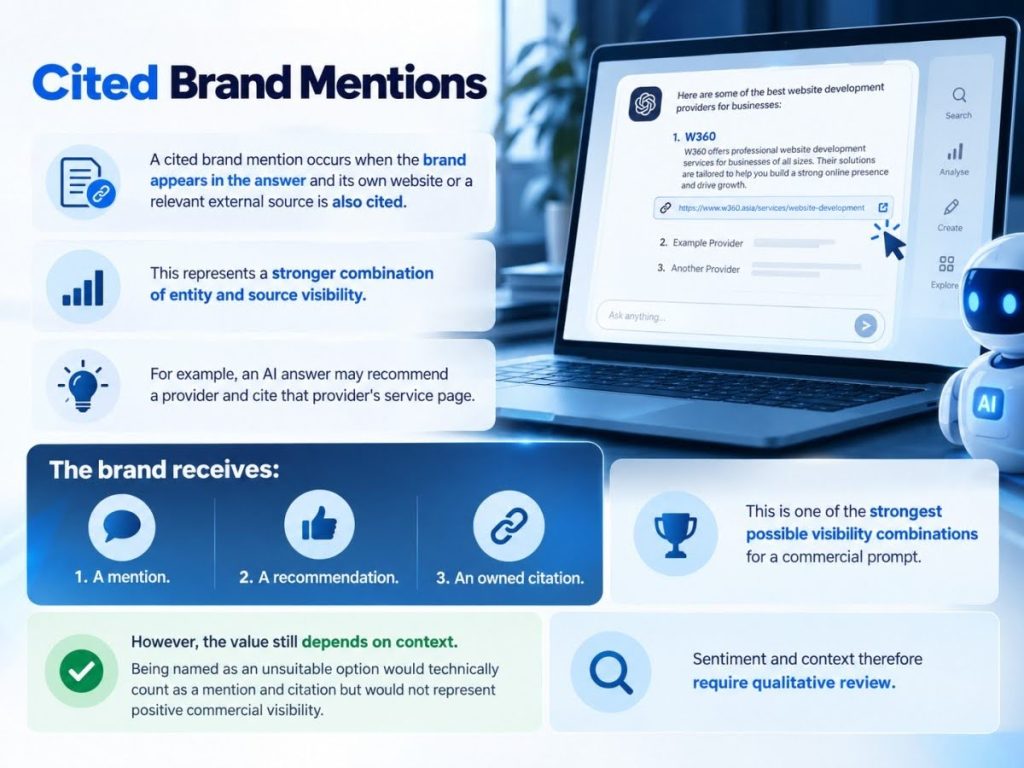
A cited brand mention occurs when the brand appears in the answer and its own website or a relevant external source is also cited.
This represents a stronger combination of entity and source visibility.
For example, an AI answer may recommend a provider and cite that provider’s service page.
The brand receives:
- A mention.
- A recommendation.
- An owned citation.
This is one of the strongest possible visibility combinations for a commercial prompt.
However, the value still depends on context.
Being named as an unsuitable option would technically count as a mention and citation but would not represent positive commercial visibility.
Sentiment and context therefore require qualitative review.
ChatGPT Comparison
ChatGPT analysis should track mentions and citations independently.
A brand may appear in ChatGPT because the system associates it with a relevant category.
The website may also be cited when ChatGPT Search retrieves specific supporting information from the domain.
These outcomes should not be collapsed into one metric.
A useful ChatGPT benchmark can include:
Metric | Measurement |
Mention rate | Brand recognition |
Owned citation rate | Source visibility |
Recommendation rate | Commercial presence |
Third-party citation rate | External corroboration |
Prompt coverage | Breadth of visibility |
This reveals whether the business’s main strength lies in content, entity recognition or recommendation relevance.
Gemini Comparison
Gemini should be evaluated using the same framework.
The analysis should record whether the brand appears by name and whether its owned content is provided as supporting information.
Google’s wider search ecosystem makes the relationship between conventional rankings and Gemini visibility particularly important to monitor.
However, the two should not be assumed to be identical.
A business can rank organically without appearing in a Gemini-generated answer.
Likewise, a brand can appear in a generated response because another source provides information about it.
Repeated prompt testing is therefore more useful than isolated examples.
Perplexity Comparison
Perplexity’s citation-focused interface makes source-level analysis particularly useful.
The study should distinguish between pages cited directly and brands mentioned within the generated answer.
A business can appear in a recommendation while Perplexity cites an external review or comparison source.
Alternatively, the company’s own service or research page may be cited.
These two scenarios represent different authority structures.
The first indicates third-party corroboration.
The second indicates owned-source usefulness.
Both matter to GEO.
Google AI Overview Comparison
Google AI Overview analysis should distinguish source visibility from brand visibility in the same way.
A company website can be cited for factual information without the business being positioned prominently as a provider.
Likewise, a brand may be visible through organic listings elsewhere on the search results page even if its domain is not cited in the AI Overview.
This means Google visibility needs several measurements:
- Organic ranking
- AI Overview citation
- Brand mention
- Local visibility
- Commercial listing visibility
AIO performance should therefore not replace traditional SEO reporting.
It should extend it.
Brand Mentions Are Entity Signals, Not Proof of Authority
Brand mentions can indicate that a business is recognised in relation to a topic, but the presence of a mention alone does not prove authority.
Context matters.
A company can be mentioned because it is:
- Popular
- Frequently discussed
- Relevant
- Controversial
- Recommended
- Criticised
SEO teams should therefore avoid equating raw mention volume with positive authority.
A high-quality benchmark should record mention context.
At minimum, mentions can be classified as neutral, favourable, unfavourable or recommendation-oriented.
This provides a more useful view of brand visibility.
Citations Are Source Signals, Not Automatic Endorsements
A citation indicates that a source supports some part of the generated response.
It should not automatically be interpreted as an endorsement of the company behind the website.
For example, an AI answer might cite a manufacturer’s technical document when explaining a product specification.
The citation indicates information usefulness.
It does not mean the manufacturer is being recommended.
This distinction is critical for commercial AI SEO reporting.
Citation success should therefore be connected to what the source supports.
A citation on a provider recommendation prompt can be commercially stronger than a citation used solely for a technical definition.
Relationship With Brand Authority

Brand authority is broader than citation count.
It reflects how consistently and credibly the organisation is recognised in connection with relevant products, services or expertise.
Brand authority can be influenced by:
- Owned content
- Third-party mentions
- Editorial coverage
- Reviews
- Search demand
- Industry participation
AI brand mentions may reflect this wider information environment.
A company can therefore have strong brand visibility even if its own domain is not the dominant citation source.
This is why AI SEO needs both content optimisation and off-page brand development.
Relationship With Third-Party Coverage
Third-party coverage can influence both mentions and citations.
A credible publication may describe the company, its services or its research.
That page can later function as an external reference source.
For commercial queries, third-party coverage can be particularly important because the source is independent from the company making the claim.
For example, a business stating on its own website that it is a leading provider is self-promotional.
An independent industry source describing the company’s role in the market provides different evidence.
This makes external authority an important component of generative search visibility.
Unlinked Mentions
Unlinked brand mentions are external references that name a company without linking to its website.
Traditional SEO discussions have often focused heavily on backlinks.
AI visibility broadens the importance of unlinked mentions because generative systems can encounter textual references to brands across the web regardless of whether every reference contains a hyperlink.
However, this should not be interpreted as proof that an unlinked mention directly causes AI visibility.
The safer conclusion is that brand information exists beyond link graphs.
For GEO AI SEO, credible mentions, links and citations should therefore be viewed as complementary authority signals rather than substitutes for one another.
Brand Mentions vs Backlinks
Brand mentions and backlinks measure different relationships.
A backlink creates an explicit hyperlink between webpages.
A brand mention creates a textual relationship between a source and an entity.
A strong digital presence can contain both.
For example, an industry publication may mention W360 Group Pte Ltd and link to a relevant research page.
This creates:
- Brand association
- Referral potential
- Link authority
- Source corroboration
The strongest off-page strategy should therefore not ask whether mentions are “better” than backlinks.
It should seek credible contextual references where links are included naturally when appropriate.
Citation Authority
Citation authority refers to the quality and relevance of the source carrying or receiving the citation.
Not all citations have equal strategic value.
A citation from a highly relevant industry publication can have different implications from one on a low-quality syndicated website.
Similarly, an owned-domain citation to a unique research study may be more meaningful than a citation to a generic definition.
Businesses should therefore classify citation quality according to:
- Topic relevance
- Source credibility
- Content quality
- Citation context
- Page purpose
Raw citation count is only the starting point.
Mention Authority
Mention authority evaluates the quality of the source that references the brand.
A mention in a respected industry publication can carry more informational value than dozens of automated directory listings.
This matters for digital PR.
The objective should not be to maximise the number of webpages containing the company name.
The stronger objective is to increase credible references from sources that have a legitimate reason to discuss the business.
For Singapore companies, this may include:
- Industry media
- Trade publications
- Professional associations
- Partners
- Research citations
- Relevant business publications
The context should remain genuine.
Citation Share of Voice
Citation share of voice measures the proportion of owned-domain citations captured by a brand relative to competitors.
The formula is:
Citation Share of Voice = Brand-Owned Citations ÷ Total Owned Citations Across Tracked Competitors × 100
This should be calculated within a defined prompt universe.
A 30% citation share does not mean the website captures 30% of all AI citations in Singapore.
It means the domain captured 30% within the tested competitor and prompt set.
This methodological distinction must always be disclosed.
Mention Share of Voice
Mention share of voice measures the company’s proportion of total brand mentions among tracked competitors.
The formula is:
Mention Share of Voice = Brand Mentions ÷ Total Tracked Brand Mentions × 100
Mention share can be segmented further by intent.
For example:
Intent | Strategic Meaning |
Informational | Topical association |
Comparison | Consideration visibility |
Recommendation | Commercial recognition |
Local | Market association |
A brand can dominate informational mentions while remaining weak in recommendation prompts.
This is why one overall figure is rarely sufficient.
Recommendation Share of Voice
Recommendation share of voice focuses on commercial inclusion.
The formula is:
Recommendation Share = Brand Recommendations ÷ Total Competitor Recommendations × 100
Only relevant recommendation prompts should be included.
A question asking “What is generative engine optimisation?” should not contribute to recommendation share.
A question asking “Which Singapore agencies provide GEO services?” should.
This produces a more commercially meaningful benchmark.
For many service businesses, recommendation share can ultimately matter more than raw citation count.
Which Signal Matters More?
Neither brand mentions nor website citations universally matters more.
The correct priority depends on the business objective.
If the goal is informational authority, citations can be especially important because they show that owned content is being used as a source.
If the goal is provider consideration, brand mentions and recommendations can be more commercially significant.
If the goal is broad market visibility, both should improve together.
A useful priority framework is:
Business Objective | Higher-Priority Signal |
Research authority | Citations |
Brand awareness | Mentions |
Provider discovery | Recommendations |
Content authority | Owned citations |
Category recognition | Mentions |
Balanced AI visibility | All three |
This avoids reducing AI performance to one metric.
When Brand Mentions Matter More
Brand mentions matter more when the user’s question is explicitly about companies, products or providers.
For example:
“Which AI SEO agencies operate in Singapore?”
In this context, a brand that is mentioned has entered the consideration set.
A competing agency may have its research cited elsewhere but fail to appear in the actual provider recommendations.
The mentioned brand has stronger commercial visibility for this prompt.
This demonstrates why marketing teams should not celebrate citations without examining what the generated answer actually says.
When Citations Matter More
Citations matter more when the objective is to establish the company’s website as an information source.
For example:
“What factors influence AI citation visibility?”
A W360 research article cited as evidence would strengthen the site’s informational authority even if the generated answer does not explicitly recommend W360 Group Pte Ltd as an agency.
This visibility can still have strategic value.
Research citations can:
- Earn brand exposure
- Strengthen authority
- Support digital PR
- Drive referral visits
- Reinforce topical association
The commercial effect may be indirect, but the source visibility is valuable.
When Recommendations Matter Most
Recommendations matter most when the prompt reflects a buying decision.
Examples include:
- best provider for a service
- agencies to consider
- companies offering a solution
- suitable suppliers in Singapore
A website citation without a brand recommendation has limited provider-selection value in this context.
The ideal outcome is recommendation plus supporting citation.
The brand appears as an option, and the user can inspect an owned or credible third-party source.
This combination connects entity recognition with verifiable information.
The Strongest Visibility Combination
The strongest visibility combination is usually a relevant brand recommendation supported by credible citations.
This can involve an owned citation, a third-party citation or both.
For example, an answer could recommend a business based on its specialised service while citing the company’s service page and independent industry coverage.
That combination provides:
- Brand recognition
- Commercial relevance
- Source attribution
- External corroboration
However, businesses cannot directly control whether an AI platform produces this outcome.
They can only strengthen the underlying information environment that makes such visibility more plausible.
Brand-First AI Visibility
Brand-first AI visibility occurs when entity recognition is strong but owned source visibility is weaker.
Typical indicators include:
- Frequent brand mentions
- Regular recommendations
- Low owned-domain citation rate
- Heavy third-party citation dependence
The appropriate strategy is often to strengthen owned content assets.
This can include:
- Service pages
- Research
- Expert articles
- Product information
- Structured company information
The objective is to preserve brand recognition while making the company’s own website a stronger source.
Source-First AI Visibility
Source-first AI visibility occurs when the website is cited frequently but the company itself receives limited mention or recommendation visibility.
This can happen when the domain publishes highly useful technical or research content.
The content strategy is working as an information source.
The brand strategy may still be weak.
Useful actions can include:
- Stronger author and organisation attribution
- Clearer service-category positioning
- Better brand consistency
- Third-party coverage
- Expert visibility
The goal is to connect the strong source assets more clearly to the organisation behind them.
Third-Party-First Visibility
Third-party-first visibility occurs when the brand appears mainly through external websites.
For example, AI-generated answers may repeatedly mention a company while citing reviews, news publications or comparison sites.
This can be positive because it demonstrates external recognition.
However, complete dependence on third-party sources creates limitations.
The company has less control over:
- Accuracy
- Updates
- Positioning
- Citation destination
- Conversion journey
A mature strategy should maintain strong external authority while ensuring the owned website contains accurate source-ready information.
Implications for Digital PR
Digital PR can support both AI mentions and citations by increasing credible third-party information about a brand.
The strongest digital PR starts with something worth referencing.
Useful assets can include:
- Original research
- Industry data
- Expert commentary
- Market analysis
- Significant company news
Routine distribution of generic press releases across many syndication websites should not be treated as equivalent to editorial authority.
One legitimate press release can be appropriate when there is genuine news.
Long-term GEO value is more likely to come from relevant third-party coverage that independently connects the brand with its field.
Implications for Off-Page AI SEO
Off-page AI SEO should focus on the wider information environment around a brand.
The objective is broader than backlink acquisition.
A balanced strategy can include:
- Relevant backlinks
- Credible brand mentions
- Expert citations
- Editorial coverage
- Industry participation
These signals reinforce different relationships.
Backlinks connect webpages.
Mentions connect brands with topics.
Editorial citations connect information with authority.
The strongest programmes develop these relationships together.
Implications for On-Page AI SEO
On-page AI SEO should make owned content useful enough to function as a source.
Service pages need factual commercial information.
Research pages need transparent evidence.
Guides need clear explanations.
Comparison pages need fair criteria.
Company pages need consistent entity information.
The objective is not to repeat the brand name excessively.
Strong entity association comes from relevant information and clear attribution rather than keyword or brand-name stuffing.
Entity Recognition and Brand Consistency
Brand consistency helps systems distinguish one organisation from similarly named entities.
Important details should remain consistent where applicable.
These can include:
- Official company name
- Brand name
- Service categories
- Location
- Expert identities
- Website
- Organisation descriptions
For a Singapore company, consistent representation across owned pages and credible external sources can reduce ambiguity.
Structured data may support this representation, but schema alone does not create brand authority.
Entity optimisation should therefore combine technical clarity with real-world evidence.
Brand Mentions and Branded Search
Brand mentions in AI search may contribute to later branded search behaviour, although direct causation can be difficult to establish.
A user may discover a company through a generated answer and later search its name on Google.
The visit may then appear as organic branded traffic rather than AI referral traffic.
This creates an attribution gap.
Businesses should therefore monitor changes in:
- Branded impressions
- Branded clicks
- Direct traffic
- AI referral traffic
- Lead-source information
These metrics cannot prove that an AI mention caused the search.
Together, they provide useful supporting context.
Website Citations and Referral Traffic
Website citations can create direct referral opportunities when users click through to inspect the source.
However, citation value should not be measured only through clicks.
A cited source can influence the user’s understanding without generating a visit.
The business may still benefit from:
- Source recognition
- Brand recall
- Later branded search
- Credibility
- Supporting recommendation visibility
This makes citation reporting different from conventional referral-channel reporting.
Citations should be measured as visibility first and traffic second.
Measuring AI Visibility Correctly
A useful AI visibility framework should report several metrics rather than one aggregated figure.
Recommended measurements include:
KPI | What It Shows |
Mention rate | Brand recognition |
Citation rate | Owned source visibility |
Recommendation rate | Commercial inclusion |
Third-party citation rate | External corroboration |
Prompt coverage | Breadth of visibility |
Citation share of voice | Competitive source strength |
Mention share of voice | Competitive brand strength |
The dashboard should also preserve the actual prompts and cited URLs.
This allows the SEO team to understand why each metric changed.
W360 AI Mention and Citation Framework
W360 Group Pte Ltd.’s AI visibility framework should evaluate mentions and citations as separate but connected signals.
The framework can classify each tested prompt into one of five outcomes:
Outcome | Interpretation |
No mention, no citation | No measurable visibility |
Mention, no owned citation | Entity visibility |
Owned citation, no meaningful mention | Source visibility |
Mention and citation | Combined visibility |
Recommendation and citation | Strong commercial-source visibility |
This structure provides more actionable reporting than a single AI visibility score.
Each outcome leads to a different optimisation priority.
How to Improve Brand Mention Visibility
Brand mention visibility improves when the organisation becomes more strongly associated with relevant topics and categories.
Useful actions can include:
- Clarifying service positioning.
- Improving brand consistency.
- Creating expert-led content.
- Earning credible media coverage.
- Participating in relevant industry conversations.
- Publishing distinctive research.
The emphasis should remain on legitimate brand relationships.
Creating artificial references across unrelated websites can produce noise without meaningful authority.
How to Improve Owned Citation Visibility
Owned citation visibility improves when the website contains information useful enough to support generated answers.
Content can become more source-ready through:
- Original evidence
- Clear factual sections
- Research methodology
- Useful comparisons
- Transparent attribution
- Strong topic relevance
Technical accessibility also matters.
Content cannot become a useful source if retrieval systems cannot access it reliably.
The strongest citation strategy therefore combines technical SEO with information quality.
How to Improve Recommendation Visibility
Recommendation visibility requires more than ranking a service page.
The business needs to be recognised as a relevant option within its market.
Useful supporting signals can include:
- Clear service information
- Local market relevance
- Independent coverage
- Genuine customer feedback
- Expert credibility
- Strong category association
Recommendations cannot be guaranteed.
The practical objective is to build enough consistent evidence that the company is a legitimate candidate when users ask for providers.
Avoid Optimising for Mentions Alone
Optimising only for mentions can create shallow visibility.
A business might be named frequently while users lack a strong source explaining its expertise.
This can limit trust and conversion opportunities.
Mention optimisation should therefore connect to source assets.
For example, third-party coverage of original company research can create both brand association and a reason to cite the underlying study.
This produces a stronger visibility loop than general name recognition alone.
Avoid Optimising for Citations Alone
Citation-only optimisation can also create an incomplete strategy.
A website may publish excellent informational resources without the company becoming strongly associated with its commercial category.
This can produce traffic or citations without meaningful provider recognition.
SEO teams should therefore connect research and informational assets back to relevant commercial pages through contextual internal linking.
Author and organisation attribution should also be clear.
The goal is to ensure useful content strengthens both topical authority and entity understanding.
Common Measurement Mistakes
AI mention and citation analysis can become misleading when metrics are not defined clearly.
One common mistake is counting citations as brand recommendations.
Another is counting every mention as positive.
A third is measuring only owned citations and ignoring third-party coverage.
A fourth is counting repeated citations within one answer as separate prompt victories.
A fifth is comparing different prompt sets over time.
The benchmark should define counting rules before testing begins.
Consistency is more important than maximising the reported number.
Correlation vs Causation
Brand mentions, backlinks, authority and AI citations can be correlated without proving that one directly causes another.
Strong brands often have stronger websites.
They may also have more media coverage, backlinks, search demand and external discussion.
If these brands appear frequently in AI-generated answers, isolating one causal factor becomes difficult.
Businesses should therefore avoid statements such as:
“Unlinked mentions cause ChatGPT rankings.”
The evidence usually supports a narrower conclusion.
Strong web presence and brand recognition often coexist with generative visibility, but the precise causal mechanisms are not fully observable.
Study Limitations
AI mention and citation studies have several limitations.
Generated answers can change between tests.
Platform retrieval systems can also evolve.
Prompt wording, user context, market settings and timing can influence results.
Visible citations may not disclose every source involved in generation.
A finite prompt universe also cannot represent every potential customer question.
These limitations mean the analysis should identify patterns rather than claim a permanent share of all AI search activity.
Any numerical W360 benchmark should be tied explicitly to the exact prompt set, date and platforms used.
Frequently Asked Questions
A brand mention occurs when an AI-generated answer names a company or product. A citation occurs when a webpage or source is visibly referenced to support information in the answer.
Yes. A business can appear by name without its own website receiving a visible citation. This represents entity visibility rather than owned-source visibility.
Yes. A webpage can provide useful information while the company behind it is not positioned as a provider recommendation. This is common with research and informational content.
Not universally. Citations can be more valuable for informational authority, while brand mentions and recommendations can be more important for commercial discovery. The appropriate priority depends on the business objective.
An uncited brand mention occurs when the organisation appears in an AI response without a visible citation to its owned website. The brand still receives visibility even though there is no direct source link.
Credible third-party mentions contribute to the wider information environment around a brand. However, businesses should not assume that one mention directly causes an AI citation or recommendation.
Both can be useful because they represent different relationships. The stronger off-page strategy prioritises relevant links, credible mentions and authoritative editorial coverage rather than choosing one signal exclusively.
Businesses should separately track mention rate, citation rate, recommendation rate, prompt coverage and competitive share of voice. The actual prompts and cited URLs should also be recorded for interpretation.
AI Visibility Is Strongest When Brand Recognition and Source Authority Work Together
GEO AI SEO should not force businesses to choose between brand mentions and website citations.
The two signals measure different dimensions of generative visibility.
Brand mentions show whether a company is recognised within the topic or market.
Website citations show whether its owned content functions as a source.
Recommendations show whether that recognition extends into commercial consideration.
A Singapore business can therefore be strong in one area while remaining weak in another.
The strongest long-term position is where the brand is recognised, its website provides useful source material and credible third parties independently reinforce the organisation’s expertise.
This requires more than on-page optimisation.
Content quality, technical SEO, entity clarity, original information, backlinks, digital PR and independent brand coverage all contribute to the wider search environment.
The practical question is not whether mentions or citations matter more.
It is which type of visibility is missing from the customer journey.
Build Both Brand Recognition and Source Visibility
Businesses should assess whether their AI search weakness comes from limited brand recognition, weak owned-domain citations, insufficient third-party corroboration or poor commercial recommendation visibility.
W360 Group Pte Ltd. can evaluate brand mentions, citations, recommendations and competitor visibility as part of a broader GEO AI SEO strategy. Businesses that want to establish where their generative search visibility is strongest and where competitors hold an advantage can get a quote from W360 Group Pte Ltd.