
AI SEO optimisation increasingly requires businesses to understand why competitors appear in ChatGPT-generated answers while their own brands remain absent. This gap can exist even when both companies offer similar services, compete for the same customers and have comparable visibility in traditional search.
A ChatGPT visibility gap is not always caused by one weak page or one missing technical element. It can reflect a combination of topical authority, entity recognition, third-party mentions, source quality, content structure, backlinks and the amount of useful information available about the brand across the wider web.
For Singapore businesses, this makes AI competitor analysis an important extension of conventional SEO. Traditional competitor benchmarking usually focuses on rankings, content, backlinks and traffic. AI search introduces additional questions: which brands are mentioned, which websites are cited, which pages are used as sources and whether competitors are recommended for commercially relevant prompts.
This 100-query analysis framework examines those differences without assuming that any single factor guarantees a ChatGPT citation. The objective is to identify measurable citation gaps, understand where competitors have stronger signals and create a more focused AI SEO strategy.
100-Query Research Methodology
A 100-query AI search analysis should use a controlled set of commercially relevant prompts that represent how potential customers might research a service, compare providers or evaluate solutions.
Each query should be tested using consistent wording where possible. The purpose is to create a comparable dataset rather than relying on isolated screenshots or one-off ChatGPT responses.
The analysis should record:
- Brands mentioned
- Brands recommended
- Domains cited
- Exact URLs cited
- Page types
- Query intent
- Competitor presence
- Third-party sources used
The 100 queries should then be grouped into categories.
These can include service discovery, comparison, recommendation, problem-solving, informational and commercial evaluation prompts.
This allows the analysis to determine not only whether a competitor appears, but also where in the customer journey that visibility occurs.
Industries and Competitors Analysed
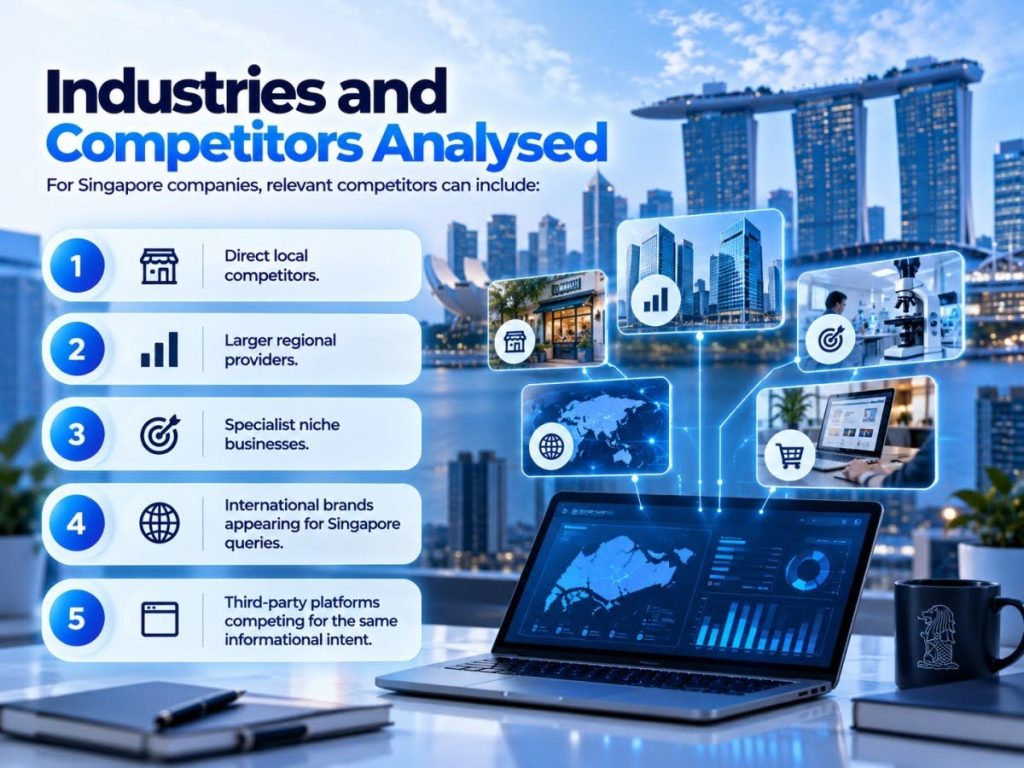
Competitor analysis should focus on companies that genuinely compete for the same topics, services and commercial prompts.
A business should not compare itself against unrelated brands simply because those brands have stronger overall domain authority.
For Singapore companies, relevant competitors can include:
- Direct local competitors.
- Larger regional providers.
- Specialist niche businesses.
- International brands appearing for Singapore queries.
- Third-party platforms competing for the same informational intent.
The analysis should also separate commercial competitors from source competitors.
A commercial competitor sells a similar service.
A source competitor may not sell the same service but repeatedly earns citations because it publishes stronger information.
Both matter in AI search.
What an AI Citation Gap Looks Like

An AI citation gap occurs when a competitor appears as a cited source across relevant prompts while another equally relevant business does not.
This gap can be measured at brand, domain and page level.
A brand-level gap occurs when competitors are mentioned or recommended more frequently.
A domain-level gap occurs when competitors’ websites are cited while the business’s own domain is rarely used.
A page-level gap occurs when a competitor has specific resources repeatedly selected as sources.
These patterns should be examined separately.
For example, a company may have reasonable brand visibility but almost no owned-site citations. This suggests a different problem from a company that is not recognised by ChatGPT at all.
Which Competitors Repeatedly Appeared
Repeated competitor appearance is more meaningful than one isolated citation.
The strongest competitors in an AI search dataset are not necessarily those with the largest websites. They are the brands that appear consistently across relevant prompts.
The analysis should therefore measure:
Competitor Metric | What It Shows |
Mention frequency | How often the brand appears |
Citation frequency | How often the website is sourced |
Recommendation frequency | How often the brand is suggested |
Prompt coverage | Breadth of visibility |
Cross-topic visibility | Strength across related themes |
Source URL count | Depth of useful content |
The final ranking should use validated data from the 100-query test.
Until that data is complete, the framework should avoid inventing percentage differences or claiming that one competitor dominates the dataset.
Content Gap Analysis
A content gap occurs when competitors provide useful information for prompts that a business does not adequately address.
This is not the same as having fewer articles.
A competitor with ten strong resources can have better AI search visibility than a business with fifty repetitive posts.
The analysis should therefore compare content by intent.
Relevant questions include:
- Does the competitor answer the query more directly?
- Does it provide original evidence?
- Does it cover the topic in greater depth?
- Does it address comparison or decision-stage questions?
- Does it publish information missing from the business’s own site?
The goal is to identify missing information, not simply missing keywords.
This distinction is essential for AI SEO optimisation because generative systems require useful source material rather than large volumes of duplicated content.
Topical Authority Gap
A topical authority gap occurs when a competitor demonstrates broader and deeper coverage of a subject.
Topical authority is not created by repeating one keyword across multiple pages.
It is built by covering distinct aspects of a topic in a coherent way.
For an AI SEO agency, for example, topical depth may include:
- AI SEO strategy
- ChatGPT citations
- GEO
- AEO
- Google AI Overviews
- AI visibility measurement
- Entity optimisation
Each page should serve a different purpose.
A competitor that covers these related areas with useful, distinct content may create a stronger topical environment than a site relying on one general service page.
Entity Recognition Gap
An entity recognition gap exists when an AI system appears to understand a competitor’s identity, services and category relationships more clearly.
A business entity is more than a brand name.
It includes information about what the company does, where it operates, which services it provides and how other sources describe it.
Entity clarity can be strengthened through:
- Consistent business naming.
- Clear service descriptions.
- Accurate organisation details.
- Relevant schema markup.
- Strong internal linking.
- Consistent third-party references.
A competitor with stronger entity signals may be easier to associate with a specific category.
This can influence brand mentions even when the company’s own website is not cited directly.
Brand Authority Gap
Brand authority reflects the wider recognition and credibility associated with a company.
It can develop through years of search visibility, media coverage, customer discussion, industry references, backlinks and branded demand.
In AI competitor analysis, brand authority should be examined beyond the website itself.
Useful indicators include:
- Branded search demand
- Editorial coverage
- Relevant directory presence
- Industry citations
- Independent reviews
- Referring domains
A competitor that appears consistently across credible sources creates more corroborating information about its brand.
This can strengthen its wider search presence.
Third-Party Mention Gap
A third-party mention gap occurs when competitors are discussed more frequently by independent sources.
This matters because AI-generated answers can use information from websites beyond the brand’s own domain.
A competitor may therefore gain ChatGPT visibility because it appears in:
- Editorial articles
- Industry publications
- Comparison pages
- Business directories
- Professional associations
- Community discussions
The quality of those mentions matters.
A large volume of low-quality references should not automatically be treated as strong authority.
Relevant, credible mentions are generally more useful than artificial placements created only to increase mention counts.
Backlink and Citation Gap
A backlink gap measures differences in external links pointing to competing websites.
Backlinks remain useful in traditional SEO and can contribute to broader authority signals, but they should not be treated as a direct or guaranteed AI citation factor.
The analysis should compare:
- Referring domains
- Links to cited pages
- Link relevance
- Source quality
- Domain-level link depth
A competitor with stronger backlinks may also have stronger content, brand visibility and authority.
This makes causation difficult to isolate.
The practical value of backlink comparison is therefore diagnostic.
It can show whether a competitor’s broader web authority materially exceeds the business being analysed.
Source-Type Gap
A source-type gap occurs when competitors appear in information environments that the business does not.
For example, one brand may be represented across company websites, editorial publications and industry resources, while another appears only on its own domain.
The first brand has broader source diversity.
This matters because different AI prompts can rely on different source types.
A commercial query may use a company page.
A comparison query may rely on an editorial source.
A recommendation prompt may use a mixture of independent and first-party information.
Source diversity therefore helps explain why a competitor can appear across more query types.
Technical Accessibility
Technical accessibility refers to whether a website can be crawled, indexed and understood reliably.
Strong content cannot contribute to search visibility if important pages are inaccessible or poorly structured.
A technical AI SEO review should examine:
- Crawlability.
- Indexability.
- Canonicalisation.
- Internal linking.
- Mobile accessibility.
- Page rendering.
These remain conventional SEO fundamentals.
AI search does not eliminate the need for technically sound websites.
If competitors have cleaner technical foundations, their content may simply be easier for search and retrieval systems to discover.
Content Characteristics of Winning Pages

Pages that repeatedly appear as AI sources should be analysed for what makes the information useful.
The emphasis should remain on content characteristics rather than assumptions about hidden ranking factors.
Useful characteristics to compare include:
- Clear answer-first sections
- Direct definitions
- Strong topic relevance
- Supporting evidence
- Original data
- Expert attribution
The structure should make the content understandable both to readers and machines.
However, formatting alone is not enough.
A well-structured page with no original value can still be weaker than a less polished page containing unique and authoritative information.
Answer-First Content
Answer-first content begins a section with the clearest factual response before adding detail.
This structure can be useful for AI search because it makes the central information easy to identify.
For example, a section answering whether backlinks matter for AI SEO should begin with a direct explanation rather than several introductory paragraphs.
The supporting context can then explain limitations, evidence and related factors.
This approach improves readability for users as well.
It should therefore be treated as a content-quality principle rather than an AI-specific trick.
Original Information and Evidence
Original information gives a page something distinct to contribute.
This can include:
- First-party research
- Internal data
- Documented experiments
- Expert frameworks
- Case studies
- Local market findings
A competitor publishing original evidence may be more useful as a source than another company repeating publicly available definitions.
For Singapore businesses, local first-party information can be especially valuable when global studies do not accurately reflect the local market.
Original research should still be transparent.
Methods, sample sizes and limitations should be disclosed so the information can be evaluated properly.
Examples From the Dataset
Examples should be used to illustrate repeatable patterns rather than showcase isolated wins.
The most useful examples are those where the competing pages can be compared directly.
For each example, the final study should document:
- Query tested
- Competitor mentioned
- Competitor cited
- Cited URL
- Business visibility
- Key content difference
- Authority difference
This makes the analysis actionable.
A weak example would simply state that a competitor appeared.
A strong example explains how the competitor differed in content, authority, source presence or topical coverage.
No example should be presented as part of the 100-query findings unless it is supported by the completed test dataset.
AI Competitor Diagnostic Framework
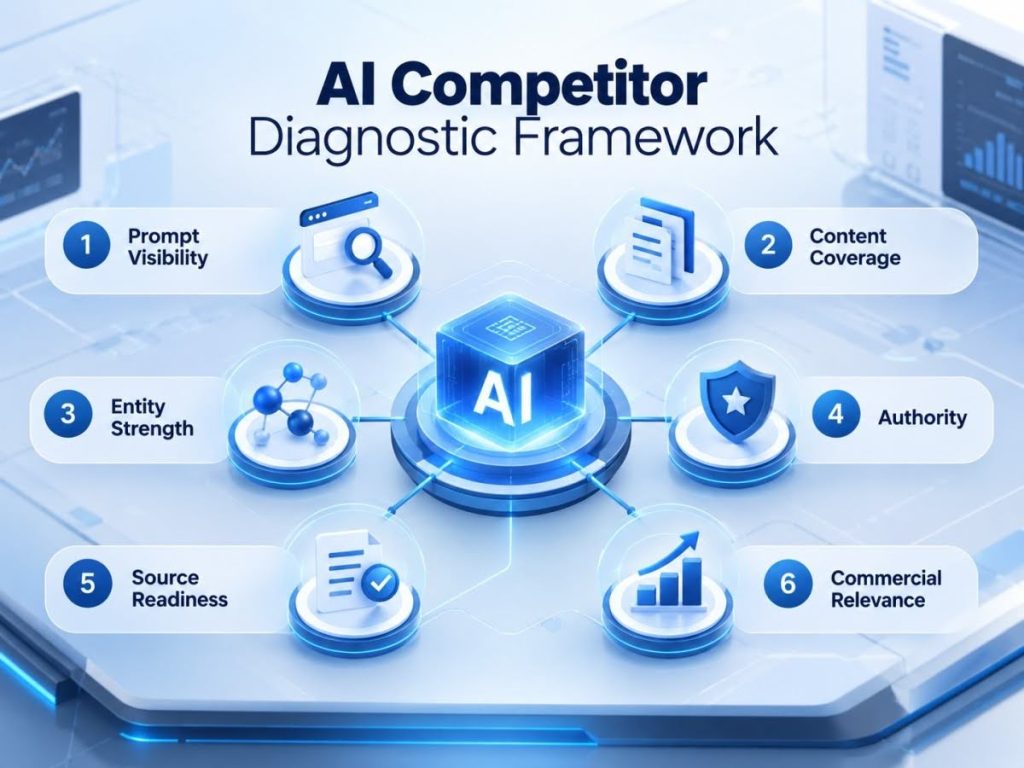
The AI competitor diagnostic framework is designed to identify why one business has stronger generative search visibility than another.
The framework can be organised into six areas.
1. Prompt Visibility
Measure where competitors appear across the priority query set.
This shows the size and location of the visibility gap.
2. Content Coverage
Compare which questions competitors answer that the business does not.
This identifies information gaps.
3. Entity Strength
Review how clearly each brand is associated with its services and topics.
This identifies recognition gaps.
4. Authority
Compare backlinks, editorial references, brand mentions and topical presence.
This identifies authority gaps.
5. Source Readiness
Compare which pages provide concise, useful and attributable information.
This identifies citation opportunities.
6. Commercial Relevance
Measure whether competitors are visible for high-intent queries rather than only informational questions.
This prevents the analysis from overvaluing low-impact mentions.
How to Close the Citation Gap
Closing an AI citation gap requires addressing the underlying weakness rather than copying the competitor’s page.
The first step is to identify whether the problem is visibility, authority, content, entity recognition or technical accessibility.
The second step is to prioritise the highest-value prompts.
A business does not need to win every possible AI query.
It should focus first on the commercial and informational topics most closely related to its actual services.
The third step is to improve source quality.
This may involve adding original research, clearer definitions, stronger evidence, more useful comparisons or better Singapore-specific context.
The fourth step is to strengthen third-party authority.
Relevant editorial mentions and industry citations can improve the broader information environment around the brand.
Strengthening Entity Signals
Entity signals should clearly communicate who the business is and what it does.
This can be improved through consistent naming, organisation information and topic relationships.
The website should make it easy to understand:
- Business name
- Core services
- Geographic market
- Areas of expertise
- Relationships between supporting topics
Structured data can reinforce these relationships where appropriate, but it should accurately reflect visible content.
Entity optimisation should not rely solely on schema.
The wider web should also describe the business consistently.
Improving Topical Coverage
Topical coverage should be expanded according to user intent.
A useful content architecture can include one primary commercial page supported by separate research and informational articles.
For example, an AI SEO service page can be supported by content about:
- ChatGPT citations
- AI visibility metrics
- GEO
- AEO
- AI Overviews
- AI source selection
These pages should complement rather than compete with one another.
This creates broader topical depth while preserving clear keyword mapping.
Increasing Third-Party Visibility
Third-party visibility strengthens the amount of independent information available about a brand.
The most sustainable approach is to earn mentions through useful expertise.
Businesses can contribute:
- Original research.
- Expert commentary.
- Industry insights.
- Case evidence.
- Useful data.
These assets can attract editorial citations naturally.
The objective is not to distribute identical content across low-value sites.
It is to create credible external validation.
Strengthening the Right Pages
Not every page needs to become an AI citation source.
Businesses should identify the pages most likely to provide useful supporting information.
These can include:
- Original studies
- Comprehensive guides
- Comparison resources
- Expert explainers
- Service pages for commercial questions
Each page should have a clear purpose.
The primary commercial page should remain focused on conversion and service relevance.
Supporting content should contribute evidence and topical depth.
Measuring Progress
Progress should be measured using the same query set used to identify the original citation gap.
This creates a controlled baseline.
Useful metrics include:
Metric | What It Measures |
Prompt coverage | Breadth of visibility |
Mention share | Entity recognition |
Citation share | Source visibility |
Recommendation rate | Commercial visibility |
Competitor gap | Relative performance |
Cross-platform presence | Consistency |
These should be monitored over time.
A single citation increase should not be treated as proof that a change caused the improvement.
Patterns across several testing periods are more reliable.
Why More Content Is Not Always the Answer
Publishing more content does not automatically improve AI search visibility.
A site can already have extensive topical coverage but still lack differentiated information or external authority.
Additional generic content may create new problems.
These include:
- Keyword cannibalisation
- Topic duplication
- Thin information gain
- Weak internal linking
- Confused page purpose
Before commissioning new pages, businesses should analyse whether the real gap is content quantity.
In many cases, strengthening existing pages and building better third-party authority may produce a more useful strategy.
Why Brand Building Matters for AI SEO
Brand building matters because generative systems operate within a wider information environment.
A company recognised across multiple reputable sources creates stronger contextual associations than a business visible only on its own website.
This means AI SEO optimisation increasingly overlaps with:
- Digital PR
- Content marketing
- Traditional SEO
- Reputation building
- Entity optimisation
- Thought leadership
These disciplines should support one another.
AI SEO becomes less effective when treated as an isolated technical exercise.
AI Search Visibility vs Google Visibility
AI search visibility and Google visibility should be compared because they can reveal different strengths.
A business can fall into four broad categories.
Google Visibility | ChatGPT Visibility | Interpretation |
Strong | Strong | Broad search authority |
Strong | Weak | AI citation or entity gap |
Weak | Strong | Generative opportunity with SEO weakness |
Weak | Weak | Foundational visibility problem |
This diagnostic helps determine where resources should be focused.
A site strong in Google but weak in ChatGPT requires a different response from one weak across both environments.
Study Limitations
A 100-query AI search analysis provides a useful snapshot but cannot reveal a complete ranking formula.
Generative responses can vary according to:
- Model updates
- Prompt wording
- User context
- Time
- Location
- Retrieval systems
Citation patterns can therefore change.
The study should also avoid assuming that observed website characteristics caused a citation.
A competitor may have stronger backlinks and receive more citations, but both could be related to a third factor such as overall brand authority.
The analysis should therefore identify patterns and gaps rather than claim guaranteed ranking factors.
Frequently Asked Questions
A competitor may have stronger topical authority, brand recognition, third-party mentions, source-ready content or broader online authority. The exact reason cannot usually be reduced to one factor. A structured competitor analysis can identify where the largest gaps exist.
No. Strong Google rankings can support relevance and authority, but they do not guarantee a ChatGPT citation or recommendation. Traditional rankings and generative visibility should be measured separately.
An AI citation gap is the difference between how frequently a competitor's website is cited and how frequently your own website appears as a source. It can be measured across a defined set of commercially relevant prompts.
Backlinks can contribute to broader website authority, but they should not be treated as a guaranteed direct ChatGPT ranking factor. Backlink patterns are better used as one part of competitor authority analysis.
Yes. Brand mentions can help show whether a business is associated with a topic or service across the wider web. Mentions should still be evaluated for relevance and source quality rather than counted mechanically.
Not necessarily. More content helps only when it fills a genuine information or topical gap. Publishing repetitive articles can create cannibalisation without improving authority.
Entity recognition refers to how clearly a search or AI system can identify a business and understand its relationships with services, locations and topics. Consistent owned and third-party information can strengthen this clarity.
Competitors should be monitored using a fixed prompt set that tracks mentions, citations, recommendations and source URLs. The same methodology should be repeated over time so changes can be compared accurately.
Closing the Gap Requires More Than Rankings
AI SEO optimisation requires a broader competitor analysis than conventional rank tracking alone.
When competitors appear repeatedly in ChatGPT, the difference may come from stronger topical coverage, clearer entity signals, better source material, broader brand authority or more credible third-party representation.
The appropriate response is not to imitate every competing article.
Businesses should identify the specific gap, determine whether it affects important commercial prompts and strengthen the areas where competitors have a meaningful advantage.
For Singapore businesses, this means combining traditional SEO with content authority, entity optimisation, original information and credible off-page signals.
The objective is to build enough relevance and authority that the brand becomes a useful part of the information environment rather than simply trying to manipulate individual AI answers.
Identify and Close Your AI Visibility Gaps
Businesses that are consistently absent from ChatGPT while competitors appear should begin with a controlled AI competitor analysis covering the prompts, citations, mentions and recommendation patterns that matter commercially.
W360 Group Pte Ltd. can assess these differences as part of a broader AI SEO optimisation strategy, including traditional rankings, entity strength, content gaps, third-party authority and generative search visibility. Businesses that want to review where their brand is losing visibility can get a quote through W360 Group Pte Ltd’s enquiry page.