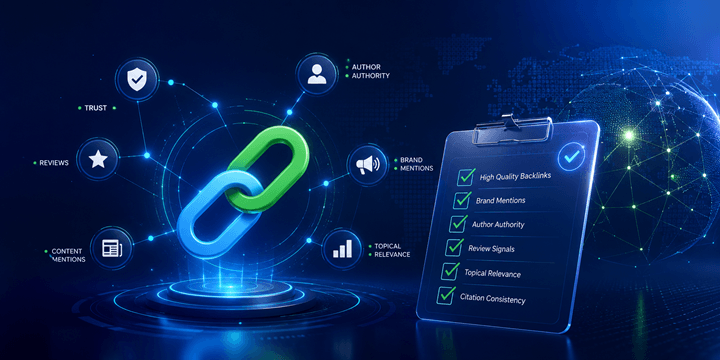
Before utilising AI for SEO it is important to understand not only how webpages rank in conventional search results, but also how websites become sources for AI-generated answers. ChatGPT can mention businesses, describe products or services, recommend organisations and, in search-enabled experiences, provide citations to webpages used to support an answer.
For Singapore businesses, being mentioned by ChatGPT and being cited by ChatGPT are different outcomes. A brand mention indicates that the business has become relevant to the generated response, while a citation provides direct attribution to a website or webpage. A business can therefore have brand visibility without its own domain being selected as a source.
This article examines the characteristics that can be compared across cited and non-cited pages. These include source authority, topical authority, content structure, brand mentions, backlinks, freshness, entity signals, and the type of page being surfaced.
No individual factor should be treated as a guaranteed ChatGPT ranking signal. AI-generated answers are dynamic, retrieval systems can change, and observed correlations do not establish causation. The purpose of this analysis is to identify repeatable characteristics that businesses can evaluate when developing an AI SEO strategy.
Executive Summary
ChatGPT citation visibility is best understood as a source-selection outcome rather than a conventional search ranking. When ChatGPT uses web search or retrieval capabilities, the sources presented can vary according to the question, available information, relevance of retrieved pages, and the way the answer is generated.
A useful citation study therefore needs to examine more than whether a website was cited. It should compare what the cited page contains, how closely it answers the query, what type of source it is, whether the brand has broader authority around the subject, and how the page performs in conventional search.
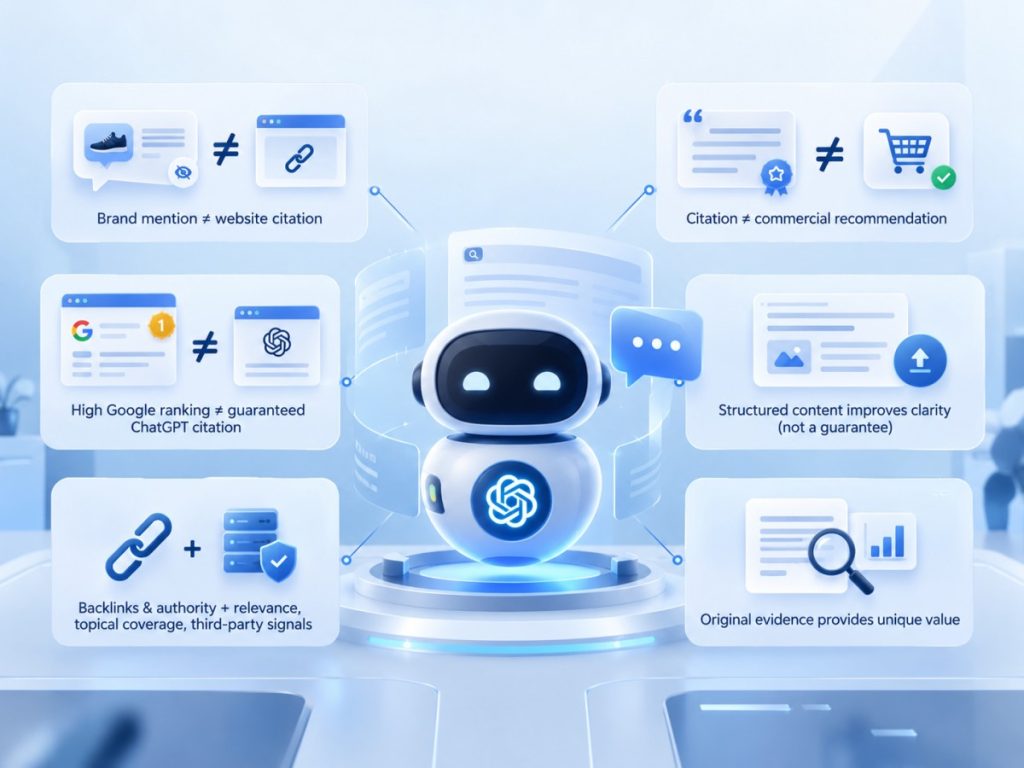
These distinctions should be considered when using AI for SEO:
- A brand mention is not necessarily a website citation.
- A citation is not necessarily a commercial recommendation.
- A high Google ranking does not automatically guarantee a ChatGPT citation.
- Structured content can improve clarity without guaranteeing retrieval.
- Backlinks and authority should be evaluated alongside relevance, topical coverage, and third-party brand signals.
- Original evidence can provide information that generic content cannot.
For Singapore businesses, these distinctions make ChatGPT and SEO a measurement problem as much as a content problem. The objective should be to understand where the business is visible, what sources are being selected instead, and what useful information the website can contribute to the information environment.
What We Wanted to Find Out
A ChatGPT citation study should determine which observable characteristics distinguish cited pages from relevant pages that are not cited. The research question is not simply whether AI SEO works, but what can reasonably be learned from comparing source-selection patterns.
The study focuses on several practical questions.
- Which websites are cited for commercially relevant Singapore queries?
- Are cited pages also prominent in conventional Google results?
- What content formats appear among cited sources?
- Do frequently cited domains demonstrate stronger topical or brand authority?
- How do backlinks and third-party brand mentions differ between cited and non-cited websites?
- Does content freshness appear consistently among cited pages?
These questions provide a framework for analysing ChatGPT visibility without claiming access to the system’s proprietary algorithms. The results should ultimately help businesses distinguish between factors that correlate with citation visibility and factors that can actually be controlled through content, technical SEO, and broader digital authority building.
Study Methodology

A reliable citation analysis requires a consistent query set and a clear definition of what counts as a citation. Without those controls, it becomes easy to treat isolated ChatGPT outputs as evidence of a general ranking rule.
The study methodology records commercially relevant prompts, ChatGPT responses, brands mentioned, cited domains, individual cited URLs, and the type of page selected. The same observations can then be compared with conventional search visibility and measurable characteristics of each source.
A practical classification model includes the following measurements.
Measurement | Definition |
Brand mention | A company or brand is named in the generated answer |
Citation | A webpage or domain is explicitly presented as a supporting source |
Recommendation | A brand is suggested as an option relevant to the user’s request |
Citation frequency | Number of tested queries for which a source appears |
Prompt coverage | Range of relevant queries in which the brand or domain gains visibility |
Page type | Classification of the cited URL, such as service page, guide, or research page |
These categories prevent different forms of AI visibility from being combined into a single figure.
Citation frequency should also be interpreted within the query sample. A domain appearing frequently in one industry does not necessarily have broad ChatGPT authority outside that subject.
Queries Tested

The queries used for ChatGPT citation analysis should represent realistic information needs rather than a list designed only around traditional SEO keywords. Generative search often involves longer, conversational questions containing explicit context.
Commercial query categories can include provider discovery, comparisons, service evaluation, problem-solving, product research, and recommendation requests.
For example, the intent behind a short query such as “AI SEO Singapore” differs from a conversational prompt asking which factors a Singapore company should evaluate when choosing an AI SEO agency. Both relate to the same commercial topic, but the expected answer and suitable sources can differ substantially.
Testing different query formulations also reduces dependence on a single wording. If a brand or source repeatedly appears across multiple prompts representing the same underlying topic, that provides more useful evidence of visibility than one isolated citation.
The final query dataset should document the wording and testing date so future comparisons can use a consistent baseline.
Industries Analysed

Industry segmentation helps determine whether ChatGPT source patterns differ according to the subject and level of commercial or informational complexity. Singapore’s digital economy includes businesses operating across professional services, technology, education, property, ecommerce, hospitality, B2B services and consumer sectors.
The most appropriate source for a query can vary substantially between industries. A regulatory question may require an official source, while a commercial comparison could draw from company websites, specialist publications, editorial resources or other third-party material.
The study should therefore compare citation characteristics within industries before concluding the full dataset.
Which Websites ChatGPT Cited
ChatGPT can cite several types of websites depending on the query and the information required to construct an answer. The important analytical question is not simply which domains appear, but why those sources are relevant to the specific information needed.
A citation dataset should classify the sources before comparing them. Common categories may include official organisations, company websites, specialist publications, editorial media, industry associations, directories, comparison resources and community platforms.
A company website being cited for its own product specification is different from the same website being cited as an independent authority on an industry-wide question. The role played by each source should therefore be recorded alongside citation frequency.
For businesses using AI for SEO, this distinction can reveal whether the website primarily functions as a source about itself or has developed sufficient topical depth to contribute to broader questions within its market.
Most Frequently Cited Domains
Frequently cited domains are sources that recur across multiple relevant prompts within the study dataset. Repetition is more informative than a single citation because it can indicate that a source has relevance across a broader set of questions.
The final study should rank recurring domains only after the dataset has been completed and validated. It should not assume that the largest or highest-authority website will automatically be the most frequently cited.
The analysis should also distinguish between domain-level and page-level recurrence. A domain may be cited repeatedly through many different URLs, while another may rely heavily on one particularly useful research page.
This difference can reveal two forms of strength. Domain-level recurrence can suggest broad topical visibility, while repeated citation of one URL can indicate that a particular resource provides unusually useful information for a defined query set.
Google Ranking vs ChatGPT Citation
Google ranking and ChatGPT citation are separate visibility outcomes, even when the same webpage appears in both environments. A page can rank prominently in Google without appearing as a ChatGPT source, while another source may receive a citation without occupying the highest organic position for the corresponding query.
The appropriate analysis is therefore comparative rather than binary. Pages can be grouped into four useful categories:
- Strong Google ranking with ChatGPT citation.
- Strong Google ranking without ChatGPT citation.
- Lower organic visibility with ChatGPT citation.
- Limited visibility in both environments.
Comparing these groups can help identify whether conventional organic visibility is associated with ChatGPT citation frequency within the dataset. Any relationship found should still be described as correlation rather than causation. ChatGPT’s retrieval and source-selection mechanisms are not identical to Google’s organic ranking system.
For businesses, the practical implication is that conventional SEO should remain part of AI SEO rather than being abandoned in favour of a completely separate optimisation discipline.
Content Characteristics of Cited Pages
Cited pages need to provide information that is relevant enough to support the generated answer. Content characteristics should therefore be assessed in relation to query intent rather than through simplistic measures such as article length alone.
A useful content audit can examine whether cited pages define the subject clearly, answer the central question early, provide supporting detail, and distinguish factual information from promotional language.
Pages can also be assessed for structural characteristics such as descriptive headings, short explanatory paragraphs, useful tables, clear classifications, and source attribution. These features can make information easier for both users and machines to interpret. However, structure alone cannot guarantee retrieval or citation.
For content optimization with generative AI, clarity should support substance rather than replace it. A well-formatted page containing the same generic information as hundreds of competing pages still provides limited information gain.
Authority Characteristics
Source authority describes the credibility and recognition associated with a website or publisher within a subject area. It can be influenced by several observable signals, including expertise, external references, brand recognition, topical depth and the quality of information published.
Authority should not be reduced to a single third-party SEO metric. Metrics such as domain authority or domain rating can be useful for comparison, but they are not direct measurements of ChatGPT’s internal assessment of a source.
A citation study should instead examine authority from multiple perspectives. This can include the domain’s organic search presence, referring domains, independent brand mentions, author or organisational expertise, topical coverage, and whether reputable sources refer to the organisation.
The objective is to determine whether cited domains tend to have stronger authority characteristics than relevant non-cited competitors, without claiming that any one metric causes citation.
Backlink Patterns
Backlinks are links from external websites pointing to a domain or webpage. They remain important in conventional SEO because they can contribute to search engines’ understanding of authority and discovery, but their direct relationship with ChatGPT citations should be tested rather than assumed.
A citation study can compare the backlink profiles of cited and non-cited domains using consistent third-party data.
Relevant measurements may include total referring domains, links to the specific cited URL, quality and relevance of linking websites, and the distribution of links across the broader domain.
A cited website with many backlinks does not prove that those backlinks caused the citation. The same site may also have stronger content, wider brand recognition, and more extensive topical coverage. The useful question is whether backlink patterns consistently differ between the comparison groups after other characteristics are considered.
Brand Mention Patterns
Brand mentions are references to a business or organisation across websites other than its own. They can be linked or unlinked and can occur in news coverage, directories, industry resources, reviews, professional publications and other third-party content.
For AI SEO, brand mention analysis is important because a generative system may encounter information about an organisation from sources beyond the organisation’s own website.
A business repeatedly associated with a specific service or area of expertise across credible independent sources creates a different information environment from a business making the same claims only on its own pages.
The study should therefore compare both the quantity and context of third-party mentions. A high volume of low-quality mentions should not automatically be treated as stronger authority than fewer references from relevant and credible sources.
This is also where digital PR, genuine editorial coverage and industry participation can complement on-site AI SEO.
Content Freshness
Content freshness refers to how recently information has been published or substantively updated. Its importance depends heavily on the query.
A page discussing a stable definition may remain useful for years. A guide covering AI search platforms, regulations, software capabilities, or current market conditions can become outdated much more quickly.
Citation analysis should therefore evaluate freshness relative to the subject rather than assuming that newer content is always superior. Useful indicators include publication dates, meaningful update dates, whether references remain current, and whether the page reflects recent changes to the topic.
Updating a date without improving the information does not create genuine freshness. The page itself should remain accurate and useful.
Entity and Topical Signals
Entity signals help establish what a business, person, organisation or product represents and how it relates to other concepts. Topical signals help establish the subjects for which a website consistently provides relevant information.
For a Singapore AI SEO agency, for example, the desired relationship is not simply between the brand and the phrase “AI SEO”. The broader information environment may connect the business with SEO, GEO, AEO, AI search visibility, content optimisation, technical SEO, citations and related services.
These relationships can be reinforced through consistent website architecture, service descriptions, expert content, structured business information and relevant third-party mentions.
Topical authority similarly requires more than publishing many articles containing related keywords. Supporting pages should address distinct user questions and collectively deepen the site’s coverage without competing for the same intent.
For ChatGPT visibility, clear entity and topical relationships may help make a website easier to understand as a relevant source, but their precise causal effect on citation selection cannot be established through observation alone.
Page Types Most Frequently Cited
Page type analysis helps determine whether particular content formats correspond with specific query intentions. Different questions naturally require different sources.
A service page can be appropriate when a user wants to understand what a provider offers. A research study may be more useful when the answer requires original statistics. A comparison page can support a decision between alternatives, while an explanatory guide may be suitable for defining a technical subject.
Useful page classifications include:
- Service and commercial landing pages
- Informational guides
- Original studies and research
- Comparison resources
- Product or category pages
- Institutional or regulatory resources
The study should report page types by query category rather than presenting one format as universally superior.
Cited vs Non-Cited Page Comparison
A cited-versus-non-cited comparison provides more useful information than analysing cited pages in isolation. Without a comparison group, almost any characteristic found on a cited page can mistakenly be interpreted as important.
The comparison group should consist of pages that are genuinely relevant to the same queries but were not cited during the testing period.
Both groups can then be evaluated using consistent criteria.
Area | Questions to Compare |
Relevance | How directly does the page address the query? |
Organic visibility | Where does the page appear in conventional search? |
Content | Does it provide distinctive or original information? |
Authority | What external evidence supports the source? |
Brand signals | Is the organisation discussed by credible third parties? |
Structure | Is important information clear and extractable? |
Freshness | Is the information current for the subject? |
Topical depth | Does the wider website demonstrate relevant expertise? |
The purpose is to identify combinations of characteristics that deserve further testing, not to manufacture a checklist of supposed ChatGPT ranking factors.
What Appears to Influence ChatGPT Citations
ChatGPT citation visibility appears most useful to analyse through combinations of relevance, source quality, information value and broader authority rather than through one optimisation technique.
A page must first contain information relevant to the question. Technical optimisation cannot compensate for a page that does not adequately address the information needed.
Source credibility also matters when the answer requires dependable information. The appropriate form of credibility depends on the topic: an official institution, recognised specialist, original data source or experienced service provider may each be appropriate in different circumstances.
Information gain is another important consideration. Original research, proprietary datasets, expert analysis, case evidence and detailed comparisons can give a page something distinct to contribute.
Clear structure can then make that information easier to interpret and extract. These observations support a practical principle for AI for SEO: optimise the usefulness and clarity of the source rather than trying to write content specifically for a chatbot.
What the Data Does Not Prove
An observational citation study cannot reveal ChatGPT’s complete source-selection algorithm. It can identify patterns among observed responses, but it cannot prove that one page characteristic directly caused a citation.
This limitation applies to many commonly discussed AI SEO factors. A cited page containing schema markup does not prove that schema caused the citation. A cited domain with thousands of backlinks does not prove that backlinks were the deciding factor. A top-ranking Google page receiving a ChatGPT citation does not prove that its Google position caused ChatGPT to use it.
Generative responses can also vary between tests. A source appearing today may not appear for the same prompt later.
The responsible approach is therefore to use citation research to generate hypotheses, prioritise improvements and monitor changes rather than presenting correlations as guaranteed ranking factors.
W360 ChatGPT Visibility Framework
Our ChatGPT visibility framework separates AI performance into discoverability, entity visibility, source visibility and commercial relevance. Each layer answers a different question about how a brand appears in generative search.
1. Prompt Coverage
Prompt coverage measures how many commercially relevant questions produce some form of visibility for the brand. A business should define a stable prompt universe covering the services, problems, comparisons, and decision-stage questions that matter to its customers.
2. Brand Mention Visibility
Brand mention visibility records whether ChatGPT recognises the organisation as relevant to the topic.
Mentions should be separated from recommendations because appearing in an explanatory answer is different from being suggested as a provider.
3. Citation Visibility
Citation visibility measures how frequently the business’s own website is used as an attributable source.
The analysis should identify not only the domain but also the individual URLs being cited. This helps reveal which resources are functioning as source assets.
4. Third-Party Representation
Third-party representation evaluates how the brand is described by independent websites. This layer is important because AI-generated answers can draw on an information environment extending beyond the company’s owned website.
5. Commercial Relevance
Commercial relevance measures whether visibility occurs for prompts that could realistically influence awareness, evaluation, or provider selection.
A large number of mentions for unrelated informational queries may have less business value than consistent visibility across a smaller set of high-relevance questions. Together, these measurements create a more transparent view of AI SEO than a single unexplained AI visibility score.
Recommendations for Singapore Businesses
Singapore businesses seeking stronger ChatGPT visibility should begin with the information needs of their market rather than trying to optimise directly for an unknown algorithm.
The first priority is to identify the questions potential customers ask during discovery and evaluation. These questions form the basis for both content planning and AI visibility measurement.
The website should then provide clear pages for distinct intents. Commercial pages should explain services accurately, while informational resources should answer supporting questions without duplicating the same target intent.
Original evidence can strengthen this ecosystem. Businesses with access to internal expertise can publish research, benchmarks, documented processes, case evidence, and practical insights that are difficult for competitors to reproduce.
Third-party authority should also be developed naturally. Relevant editorial mentions, industry citations, partnerships, and expert contributions can reinforce the relationship between the brand and its subject area.
Finally, AI visibility should be monitored alongside traditional SEO. Google rankings, organic traffic, ChatGPT citations, brand mentions, and commercial outcomes provide different pieces of the overall search-performance picture.
Building Citation-Ready Content Without Writing for Robots
Citation-ready content is information that is clear, useful, specific, and sufficiently trustworthy to support an answer. It should still be written primarily for people rather than formatted around assumptions about how an AI system might parse a page.
Each section should answer a defined question and provide enough context to stand independently. Definitions should be clear, factual claims should be supportable, and tables or lists should be used only when they genuinely improve comprehension.
Original information is particularly valuable because it creates a reason for another source to refer to the page. A company publishing its own verified study contributes something materially different from another article summarising existing articles.
For Singapore businesses, local relevance should work the same way. Local examples, regulations, datasets, or market observations are useful when they genuinely change the answer. Repeating “Singapore” throughout generic content does not create meaningful local expertise.
Why AI SEO Requires More Than Content Production
AI SEO is not simply a requirement to publish more articles. Content volume without clear intent, original information or authority can create duplication and dilute the purpose of important pages. A strong website architecture assigns different roles to different assets.
The commercial service page should own the primary transactional intent. Supporting articles should deepen the subject through research, definitions, comparisons, methodology, and practical guidance. Internal links should make the relationship between those resources clear.
This model also reduces keyword cannibalisation. Multiple articles do not need to compete for “AI SEO Singapore” when one primary service page is intended to rank for that commercial term.
Supporting research can instead strengthen the site’s overall relationship with AI SEO while addressing narrower questions such as ChatGPT citations, AI search measurement, source selection, and generative search visibility.
Frequently Asked Questions
A ChatGPT citation is an attributable source presented with an AI-generated response when the relevant ChatGPT experience uses web information. It normally identifies a webpage or domain supporting information included in the answer.
A citation should not be confused with a brand mention, because a company can be named without its own website being cited.
There is no guaranteed method for earning a ChatGPT citation. A practical approach is to publish accessible, relevant, and trustworthy information that directly addresses real user questions while strengthening broader topical and brand authority.
Citation performance should then be monitored through a consistent set of relevant prompts rather than assumed from conventional rankings alone.
AI SEO overlaps with traditional SEO but measures additional outcomes. Traditional SEO focuses on organic search visibility, while AI visibility can include mentions, recommendations, and source citations within generated answers.
Strong SEO fundamentals remain useful because clear, accessible and authoritative web information supports visibility across multiple discovery environments.
Backlinks can contribute to conventional search authority and broader website discovery, but their direct effect on ChatGPT citations should not be treated as proven. A citation study can compare backlink patterns between cited and non-cited websites, but correlation does not establish causation.
Businesses should focus on earning relevant links because their information is useful rather than building links solely for AI citations.
Schema markup can help describe entities and page information in a machine-readable format, but it does not guarantee a ChatGPT citation. Structured data should accurately represent visible page content and be implemented for appropriate technical and search purposes.
Schema is best treated as one component of a well-structured website rather than an AI citation shortcut.
Yes. ChatGPT can name a brand without presenting the brand's website as the supporting source. This is why brand mentions and citations should be measured independently.
A business can therefore have strong entity visibility but comparatively weak owned-domain citation visibility.
Google rankings and ChatGPT citations can overlap, but they are not the same result. A webpage ranking prominently in Google is not guaranteed to appear as a ChatGPT citation.
Comparing the two datasets can help identify patterns, but describe the relationship carefully rather than presenting it as direct causation.
Singapore businesses can create a fixed set of prompts covering their services, commercial categories, comparisons, and customer problems. Tests can then record brand mentions, recommendations, citations, and cited URLs at regular intervals.
Using the same core prompts and classification rules makes changes over time easier to interpret.
From Search Visibility to Source Authority
AI for SEO expands the definition of search performance beyond rankings and website visits. ChatGPT can introduce a business through a brand mention, use its website as a source, recommend it within a commercial answer or rely on third-party information describing the organisation.
These outcomes need to be measured separately. Citation research can help identify patterns in relevance, source authority, topical coverage, content structure, backlinks, brand mentions and freshness. It cannot reveal a guaranteed formula for ChatGPT citations, and correlations should not be presented as direct ranking factors.
For Singapore businesses, the most sustainable approach is to create accurate and genuinely useful resources, establish clear relationships between the brand and its expertise, strengthen credible third-party representation and measure AI visibility alongside conventional SEO.
Assess How Your Brand Appears in AI Search
Understanding ChatGPT visibility starts with identifying the commercial questions relevant to a business and examining whether the brand is mentioned, recommended, or cited when those questions are asked.
At W360 Group Pte Ltd, we assess these signals as part of our AI SEO approach that considers traditional search visibility, generative search, content authority and brand representation. If you are a business owner who wants to evaluate your current AI search presence, contact us to learn more about our services.