Technical SEO optimisation is the process of improving a website’s technical infrastructure so search engines and AI-driven systems can crawl, render, understand, index, and summarise its content accurately. It focuses on the foundations that allow website content to be discovered and interpreted, including site architecture, structured data, page speed, internal linking, mobile usability, crawl directives, and rendering accessibility.
AI search has increased the importance of technical SEO because search systems no longer rely only on traditional blue-link rankings. AI-generated answers, search summaries, and answer engines need clear, accessible, and well-structured information before they can extract content confidently.
For businesses in Singapore, technical SEO optimisation is especially relevant for websites that depend on organic visibility, lead generation, ecommerce transactions, educational resources, service pages, and local search performance. Discover how to create a technically sound website that gives both search engines and AI systems a clearer path to understand each page and raise the likelihood of your content being summarised or cited in searches.
What Technical SEO Optimisation Means in AI Search
Technical SEO optimisation means improving the technical conditions that help search and AI systems access, process, and classify website content. In AI search, the goal is not only to rank pages but also to make content machine-readable, contextually clear, and easy to extract.
Traditional SEO focuses heavily on crawling, indexing, ranking, and user experience. AI search adds another layer because generative systems may summarise content, compare sources, identify entities, and surface answers without sending users to a standard search result page immediately.
A website with poor technical foundations may still contain useful information, but AI systems may struggle to interpret it. Technical SEO optimisation helps reduce that risk by making website structure, content hierarchy, and metadata more consistent.
Why Website Infrastructure Matters More in AI Search
Website infrastructure matters more in AI search because AI systems rely on accessible, structured, and context-rich content to generate reliable answers. Infrastructure includes the technical setup behind a website, such as URLs, server responses, JavaScript rendering, internal links, schema markup, and content templates.
AI systems need clean technical signals to understand what a page is about, how it relates to other pages, and whether the information is suitable for extraction. If pages are slow, blocked, duplicated, poorly structured, or difficult to render, their visibility in both traditional and AI-led search environments may be limited.
The following table shows how infrastructure affects AI search interpretation:
Technical Area | How It Supports AI Search |
Crawlability | Allows search systems to access important pages |
Rendering | Ensures visible content can be processed |
Structured data | Clarifies entities, page types, and relationships |
Internal linking | Shows topical relationships across pages |
Site speed | Supports usability and efficient page processing |
Canonicalisation | Identifies the preferred version of content |
Technical infrastructure gives search systems the foundation required to interpret content at scale.
AI Crawlability and Website Access
AI crawlability refers to the ability of search and AI systems to access website content without technical barriers. Crawlability is a core requirement because content cannot be indexed, summarised, or cited if crawlers cannot reach it.
Technical SEO optimisation improves crawlability by ensuring important pages are not blocked, hidden, redirected incorrectly, or isolated from the website structure. Crawlability issues often occur when websites use complex navigation systems, excessive parameters, JavaScript-heavy content, or incorrect robots.txt directives.

Common crawlability checks include:
- Reviewing robots.txt rules
- Checking XML sitemap accuracy
- Identifying broken internal links
- Testing server response codes
- Finding orphan pages
These checks help confirm whether search systems can reach and evaluate the website’s most important pages.
Crawl Budget and AI Content Discovery
Crawl budget refers to the amount of crawling activity search engines allocate to a website within a given period. Large websites can waste crawl budget if crawlers spend too much time on duplicate, low-value, or parameter-based URLs.
Technical SEO optimisation helps direct crawlers towards valuable content. This is important for AI search because generative systems often depend on indexed and retrievable information from reliable pages.
Websites with inefficient crawl paths may experience slower discovery of new or updated content. Businesses with large service directories, ecommerce catalogues, blogs, or resource hubs should manage crawl budget carefully to keep priority content accessible.
Crawl budget optimisation may involve:
- Removing low-value pages from indexation pathways
- Consolidating duplicate URLs
- Improving internal linking to important pages
- Cleaning redirect chains
- Keeping XML sitemaps focused on canonical URLs
Efficient crawling improves the likelihood that relevant content is found, refreshed, and evaluated correctly.
Structured Data and Machine Understanding
Structured data is a standardised format that helps search engines understand the meaning and context of website content. It provides additional information about entities, page types, products, articles, services, organisations, FAQs, breadcrumbs, and other content elements.
Technical SEO optimisation uses structured data to make information easier for machines to classify. This matters in AI search because answer engines and generative systems often rely on clear contextual signals when deciding how to interpret content.

The table below shows common structured data types and their purpose:
Structured Data Type | Purpose |
Organisation schema | Clarifies business identity |
Article schema | Defines editorial content |
FAQ schema | Supports question-and-answer interpretation |
Breadcrumb schema | Shows page hierarchy |
Product schema | Describes product-related details |
LocalBusiness schema | Provides local business context |
Structured data does not guarantee visibility, but it improves content clarity and reduces ambiguity for search systems.
Semantic Indexing and Content Context
Semantic indexing refers to how search systems understand meaning, entities, topics, and relationships within content. It goes beyond matching exact keywords and focuses on the broader context of a page.
Technical SEO optimisation supports semantic indexing by creating clear page structures, consistent headings, descriptive metadata, and logical internal links. These elements help search engines understand whether a page is about a service, a guide, a product category, a location, or an informational topic.
Semantic clarity is important for AI-generated answers because AI systems need to identify precise explanations, definitions, comparisons, and supporting details. A technically disorganised page may make it harder for systems to extract accurate information.
Strong semantic signals typically include:
- Clear heading hierarchy
- Descriptive title tags
- Accurate meta descriptions
- Relevant internal links
- Structured content sections
- Consistent terminology
These signals help search systems connect a page to the correct search intent and topic cluster.
Website Architecture and Topic Relationships
Website architecture refers to how pages are organised and connected within a website. A clear architecture helps search engines and AI systems understand which pages are most important and how different topics relate to one another.
Technical SEO optimisation improves architecture by reducing unnecessary depth, strengthening internal pathways, and grouping related pages into logical clusters. This is useful for businesses in Singapore that publish multiple service pages, blog articles, guides, and location-specific resources.
A clear structure usually follows a logical hierarchy:
- Main service page
- Supporting service subpages
- Informational blog articles
- FAQs or resource pages
- Conversion or contact pages
This structure helps search systems identify main topics, supporting content, and user pathways.
Internal Linking for AI Search Visibility
Internal linking is the practice of connecting related pages within the same website. It helps users navigate the website and helps search systems discover relationships between pages.
Technical SEO optimisation uses internal linking to support topic clusters and improve content discoverability. In AI search, internal links can help clarify how a supporting article relates to a main service page or broader subject area.
Internal links should be contextually relevant and useful. Links placed within meaningful paragraphs provide stronger context than links added without explanation. A scalable internal linking strategy may include:
- Links from blog articles to relevant service pages
- Breadcrumb links to clarify hierarchy
- Related content modules
- Links between supporting articles within the same topic cluster
- Descriptive anchor text that explains the destination page
Internal linking helps distribute authority, guide crawlers, and strengthen topical relevance.
JavaScript Rendering and AI Accessibility
JavaScript rendering refers to how search systems process content generated or modified by JavaScript. Many modern websites use JavaScript frameworks to create dynamic layouts, interactive features, and application-like browsing experiences.
Technical SEO optimisation ensures that important content, links, metadata, and structured data remain accessible even when JavaScript is involved. If essential content appears only after delayed rendering, search engines may process it inconsistently.
Common rendering issues include:
Rendering Issue | Possible SEO Impact |
Content loaded only after user interaction | Important information may be missed |
Internal links hidden in scripts | Crawl discovery may weaken |
Blocked JavaScript files | Rendering may fail |
Delayed content loading | Indexing may be incomplete |
Client-side rendering only | Search processing may slow down |
Rendering checks are important for AI search because inaccessible content cannot be reliably summarised or cited.
Server-Side Rendering and Pre-Rendering
Server-side rendering is a method where content is generated on the server before being delivered to the browser. Pre-rendering creates static versions of pages so crawlers can access content more easily.
Technical SEO optimisation may use server-side rendering or pre-rendering to improve content accessibility for search systems. These methods are especially useful for websites that rely heavily on JavaScript frameworks.

Server-side rendering can help ensure that important page elements are available in the initial HTML. This includes headings, main content, internal links, metadata, and structured data.
Pre-rendering can be useful for selected pages where full server-side rendering is not practical. The goal is to make important information accessible without relying entirely on client-side processing.
Indexation Control and AI Retrieval
Indexation control refers to managing which pages search engines are allowed to store and show in search results. Technical SEO optimisation uses indexation controls to help search systems focus on useful, canonical, and search-relevant pages.
AI search depends heavily on retrievable content. If important pages are unintentionally noindexed, canonicalised incorrectly, or excluded from sitemaps, they may not be available for AI-generated answers.
Problems often occur in large websites because of duplicated templates, CMS rules, filter pages, or migration errors. A technical review can identify whether important URLs are eligible for indexing. Indexation controls commonly include:
- Meta robots tags
- Canonical tags
- Robots.txt directives
- XML sitemap inclusion
- Redirect rules
Correct indexation management helps ensure that the right pages are available for search and AI systems.
Canonicalisation and Duplicate Content
Canonicalisation is the process of identifying the preferred version of a page when multiple similar URLs exist. It helps search engines consolidate ranking signals and avoid confusion caused by duplicate content.
Technical SEO optimisation uses canonical tags, redirects, and consistent internal links to manage duplicate content. This is important for AI search because duplicate pages can create conflicting signals and reduce confidence in source selection.
Duplicate content may come from:
- URL parameters
- Tracking tags
- Category filters
- HTTP and HTTPS versions
- WWW and non-WWW versions
- Printer-friendly pages
A clear canonical strategy helps search systems understand which URL should represent the main version of the content.
Mobile-First Technical Optimisation
Mobile-first technical optimisation ensures that the mobile version of a website is accessible, usable, and complete. Search engines primarily evaluate mobile versions of pages for indexing and ranking.
Technical SEO optimisation reviews mobile layout, navigation, content parity, performance, and rendering stability. This is particularly important in Singapore, where users frequently browse business websites, service pages, ecommerce platforms, and educational resources on mobile devices.
Mobile technical issues can affect both users and search systems. A page that works well on desktop but poorly on mobile may experience reduced visibility and weaker engagement. This is where mobile optimisation checks come in, they involve:
- Responsive design validation
- Mobile page speed testing
- Font and tap target review
- Mobile content parity checks
- Layout stability evaluation
Mobile-first optimisation helps ensure that users and search systems access the same meaningful content across devices.
Page Speed and AI Search Readiness
Page speed refers to how quickly a page loads and becomes usable. Technical SEO optimisation improves page speed by reducing unnecessary resources, optimising assets, and improving server response times.
Fast websites provide better user experience and support more efficient crawling. Slow websites may discourage users, delay rendering, and create processing inefficiencies for search systems.
These are the key performance factors to consider:
Performance Factor | Why It Matters |
Image size | Large images slow page loading |
JavaScript weight | Excessive scripts delay interactivity |
Server response time | Slow servers delay content delivery |
CSS efficiency | Unoptimised stylesheets block rendering |
Third-party scripts | External tools may increase load time |
Page speed is not only a ranking consideration. It also affects how easily users and systems can access content.
Core Web Vitals and Search Experience
Core Web Vitals are performance metrics that measure loading speed, responsiveness, and visual stability. These metrics help evaluate how users experience a webpage.
Technical SEO optimisation uses Core Web Vitals to identify issues that may affect both search visibility and usability. Poor performance can make a website harder to use, especially on mobile connections.
The three primary Core Web Vitals are:
Metric | Meaning |
Largest Contentful Paint | Measures loading performance |
Interaction to Next Paint | Measures responsiveness |
Cumulative Layout Shift | Measures visual stability |
Improving these metrics supports a more stable browsing experience and reduces technical friction.
Structured Headings and Extractable Content
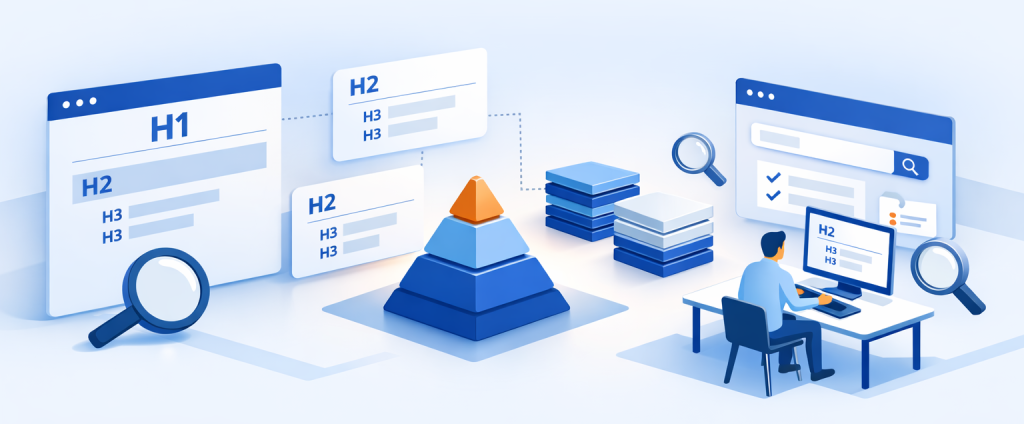
Structured headings are organised headings that define the hierarchy and meaning of content sections. They help users scan a page and help search systems interpret the relationship between sections.
Technical SEO optimisation ensures that each page uses one clear H1, followed by logical H2 and H3 headings. This structure is important for AI-generated answers because systems often extract definitions and direct answers from well-organised sections. A good heading structure should:
- Identify the main page topic clearly
- Divide content into self-contained sections
- Avoid using headings for styling only
- Support logical reading order
- Match the intent of the content
Structured headings improve content readability and machine interpretation.
Metadata and AI Search Interpretation
Metadata refers to information that describes a webpage, including title tags, meta descriptions, canonical tags, and structured markup. Technical SEO optimisation ensures metadata is accurate, unique, and aligned with the page’s actual content.
Metadata helps search engines and AI systems understand the purpose of a page before processing the full content. Poor metadata can create confusion, especially when multiple pages cover similar topics.
Important metadata elements include:
Metadata Element | Function |
Title tag | Defines the page’s main topic |
Meta description | Summarises page value |
Canonical tag | Identifies the preferred URL |
Open Graph data | Supports social sharing context |
Schema markup | Adds machine-readable meaning |
Accurate metadata supports clearer search interpretation and more consistent page classification.
Image and Media Optimisation
Image and media optimisation means improving files so they load quickly and provide useful context. Technical SEO optimisation includes compressing images, using descriptive alt text, selecting proper formats, and avoiding unnecessary media weight.
Search and AI systems may use image context to understand page relevance. Descriptive alt text can support accessibility and help clarify what an image represents.
Other vital media optimisation practices include:
- Compressing large image files
- Using descriptive filenames
- Adding accurate alt text
- Serving modern image formats
- Lazy loading non-critical images
Media optimisation supports page speed, accessibility, and content interpretation.
Log File Analysis for Search Behaviour
Log file analysis is the process of reviewing server records to understand how crawlers access a website. It shows which pages are frequently crawled, ignored, blocked, or returning errors.
Technical SEO optimisation uses log file analysis to identify crawler behaviour that standard analytics tools may not show. This is useful for large websites where search engines may not crawl all pages equally. Log files can reveal:
- Crawl frequency by page type
- Wasted crawling on low-value URLs
- Important pages with low crawl activity
- Server errors affecting crawlers
- Bot access patterns over time
Log analysis also helps businesses make evidence-based decisions about crawl management.
Technical SEO and Entity Understanding
Entity understanding refers to how search systems identify people, organisations, places, products, services, and concepts within content. AI search depends heavily on entity recognition to connect information accurately.
Technical SEO optimisation supports entity understanding through structured data, consistent naming, clear page context, and internal links between related topics. For Singapore businesses, this may include clarifying business identity, service categories, locations, and topical expertise.
Entity clarity helps search systems distinguish a business, service, or concept from similar terms. It also improves the likelihood that content is interpreted in the correct context.
Practical entity signals include:
- Organisation schema
- Consistent brand and service naming
- Author or publisher information
- Relevant internal links
- Clear service descriptions
These signals help reduce ambiguity in search interpretation.
Technical SEO for AI-Generated Answer Visibility
AI-generated answer visibility refers to the possibility of website content being used, cited, or summarised in AI search experiences. Technical SEO optimisation supports this by making content accessible, well-structured, and contextually clear.
AI systems are more likely to use content that provides direct answers, verifiable context, and clean formatting. Technical issues such as blocked pages, poor rendering, missing structured data, and weak headings can reduce content usefulness.
Businesses can improve AI-answer readiness through:
- Clear definitions at the start of sections
- Structured data implementation
- Strong internal linking
- Fast and accessible pages
- Consistent content hierarchy
These practices support both traditional SEO and generative search retrieval.
Common Technical Issues That Limit AI Search Compatibility
Technical issues limit AI search compatibility when they prevent systems from accessing, interpreting, or trusting website content. Many of these issues are invisible to users but visible to crawlers and search systems.
Common problems include:
Technical Issue | Search Impact |
Blocked resources | Content may not render correctly |
Duplicate pages | Source selection becomes unclear |
Missing schema | Machine context is weaker |
Poor internal linking | Topic relationships are harder to identify |
Slow performance | User experience and crawl efficiency decline |
Incorrect canonicals | Important pages may be ignored |
Fixing these issues improves the technical quality of a website’s search foundation.
How Technical SEO Optimisation Supports Business Websites in Singapore
Technical SEO optimisation supports business websites in Singapore by improving search access, user experience, and content interpretation. Businesses that depend on enquiries, bookings, ecommerce sales, or informational visibility need websites that are technically accessible and easy to understand.
Singapore businesses often compete in dense search results across sectors such as finance, education, healthcare, professional services, ecommerce, construction, and technology. A technically optimised website helps ensure that content quality is not weakened by infrastructure problems.
Technical SEO supports business outcomes by improving:
- Organic discoverability
- Website usability
- Mobile performance
- Search engine understanding
- AI-search compatibility
These improvements help create a stronger digital foundation for long-term visibility.
Measuring Technical SEO Optimisation Results
Technical SEO optimisation results are measured through crawl, indexation, performance, visibility, and user engagement indicators. These measurements help businesses determine whether technical improvements are producing practical outcomes.
Measurement Area | Example Metric |
Crawl health | Reduction in crawl errors |
Indexation | Increase in valid indexed pages |
Performance | Improved Core Web Vitals |
Visibility | Growth in impressions and rankings |
Engagement | Lower bounce rate or better session quality |
Conversions | Improved enquiry or transaction completion |
Frequently Asked Questions
Technical SEO optimisation is the process of improving a website’s technical structure so search engines and AI systems can crawl, render, index, and understand its content. It includes areas such as site speed, structured data, mobile usability, internal linking, canonicalisation, and crawl management. The goal is to make website content easier to access and interpret.
Technical SEO matters for AI search because AI systems need accessible, structured, and well-organised content to generate accurate summaries or answers. If a page is blocked, slow, duplicated, or difficult to render, AI systems may not process it correctly. Technical optimisation improves the conditions needed for content retrieval and interpretation.
Structured data helps AI search visibility by giving search systems explicit information about page content, entities, relationships, and page types. It can clarify whether a page is an article, FAQ, product, service, organisation profile, or local business page. This makes the content easier for machines to classify and understand.
Technical SEO optimisation can support rankings by removing barriers that prevent search engines from accessing, indexing, or evaluating pages properly. It does not replace content quality or relevance, but it strengthens the foundation that allows content to perform. Improvements in speed, crawlability, mobile usability, and site architecture can contribute to better organic visibility.
AI crawlability refers to how easily AI-related search systems and crawlers can access website content for processing, indexing, or summarisation. It depends on factors such as robots.txt rules, internal linking, server responses, rendering accessibility, and sitemap accuracy. If important content is not crawlable, it is less likely to appear in AI-generated search experiences.
Technical SEO optimisation should be reviewed regularly, especially after website redesigns, CMS updates, migrations, new template launches, or major content expansions. Large websites may require ongoing monitoring because small technical issues can affect many pages at once. Periodic audits help detect problems before they reduce search visibility.
Technical SEO remains important even when a website has strong content because search systems must be able to access and interpret that content. Good content may underperform if pages load slowly, use weak internal linking, contain duplicate versions, or rely on inaccessible JavaScript. Technical optimisation helps ensure that content quality is not limited by infrastructure problems.
Stronger Infrastructure for Search and AI Discovery
With search engines and AI systems depending on technically accessible and context-rich websites, technical SEO is an increasingly important part of optimisation. A strong infrastructure helps content become easier to crawl, render, index, summarise, and connect with relevant search intent.
For businesses in Singapore, technical SEO optimisation supports both traditional organic visibility and AI-search readiness by ensuring their websites have a clear architecture, reliable indexation, and accessible content. These factors raise the chances of increasing your search ranking or your content being used for AI generated answers.
Consider partnering with a trusted digital marketing agency in Singapore such as W360 Asia to review your website infrastructure and AI-search compatibility. Get in touch today for a technical SEO assessment.