Answer Engine Optimisation (AEO) focuses on structuring content so it can be selected and delivered as a direct answer by search engines, AI systems, and voice assistants. In Singapore, where digital adoption is high and users increasingly rely on AI-assisted search, AEO enables businesses to appear in featured snippets, People Also Ask results, and AI-generated summaries.
Unlike traditional optimisation methods that prioritise rankings, AEO aims at extractability. Content must be structured in a way that search engines and AI models can interpret, verify, and present clearly. Businesses that adopt AEO gain visibility at the decision-making stage, where users are actively seeking immediate answers rather than browsing multiple sources.
What Is Answer Engine Optimisation (AEO)?
Answer Engine Optimisation (AEO) is the process of structuring and refining content so it can be identified, extracted, and delivered as a direct response by search engines and AI systems. While traditional Search Engine Optimisation focuses on improving rankings in a list of search results, AEO focuses on whether content can function as a standalone answer.
This distinction is important because search behaviour is changing. Users increasingly expect search engines and AI tools to give them the best answer immediately, rather than simply showing a list of pages to explore. As a result, businesses need content that is not only searchable but also directly usable by modern answer engines.
Why Does AEO Matter in Singapore
AEO is especially relevant in Singapore due to the country’s high digital literacy, strong mobile usage, and growing adoption of AI-assisted tools such as Google Gemini, ChatGPT Search, and Perplexity. Users often want fast, direct, and reliable information without having to compare multiple pages manually.
This shift means businesses are no longer competing only for rankings, but for answer visibility. Content that cannot be extracted and presented directly may be excluded from featured answers and AI-generated summaries, even if it performs reasonably well in traditional organic search. In a market like Singapore, where users value speed and convenience, this makes AEO a practical visibility strategy rather than just a technical trend.
The Shift from Browsing to Retrieval
Search behaviour in Singapore has evolved from discovery-based browsing to direct retrieval. Users no longer want to click through several websites just to find a basic explanation, comparison, or recommendation. Instead, they expect search engines and AI systems to synthesise information and provide immediate answers.
Most businesses fail at AEO because they continue to optimise for rankings rather than extractability. In AI-driven search, visibility is no longer determined only by position, but by whether content can be directly used as an answer. Pages that are not structured for extraction are often ignored by AI systems, regardless of how well they rank in traditional search results.
AEO vs SEO vs GEO: Key differences for Singapore businesses
Although AEO, SEO, and GEO are related, they are not the same. Each serves a different purpose in modern digital visibility, and businesses that understand the distinction are better positioned to build content that performs across both traditional and AI-driven search environments.
SEO focuses on ranking webpages in standard search results. AEO focuses on becoming the direct answer selected by search engines or assistants. GEO focuses on making content citable and reusable within AI-generated outputs. Together, they create a more complete search visibility strategy.
| Strategy | Primary Goal | Primary Output | Key Optimisation Metric |
|---|---|---|---|
| SEO | Rank #1—10 in SERPs | Blue hyperlinks | Organic Traffic, CTR |
| AEO | Be the "Answer" | Featured Snippets, Voice | Answer Accuracy, Precision |
| GEO | Be cited by AI models | AI Summaries, Footnotes | Citation Frequency, Authority |
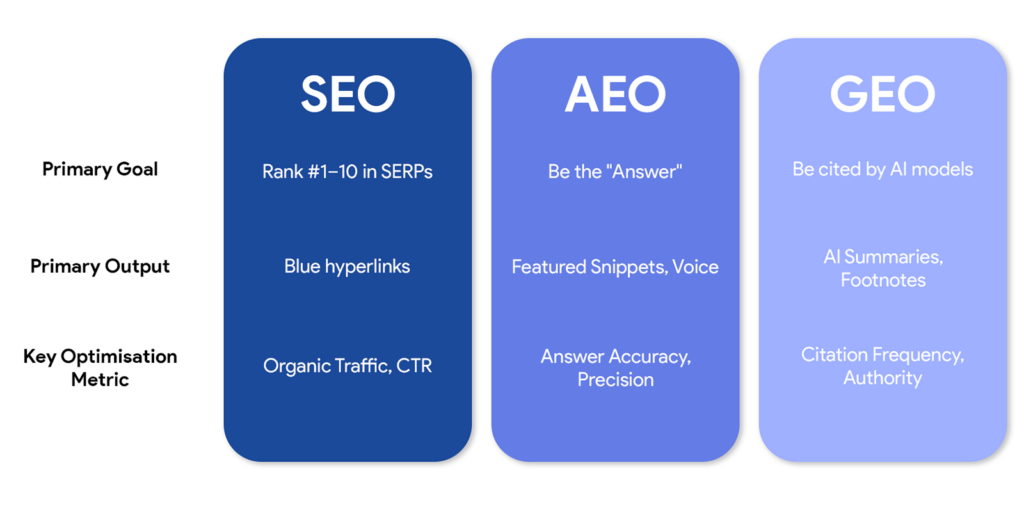
For businesses operating in competitive markets, relying on only one of these approaches is limiting. SEO helps pages get discovered, AEO helps content get extracted, and GEO helps brands get cited in AI-generated responses. A combined strategy creates stronger long-term visibility.
How Answer Engines Process Information
o optimise effectively for AEO, it is useful to understand how answer engines evaluate and transform content into direct responses. Search engines do not simply read a page the way a human does. They process content through a sequence of classification, extraction, and validation steps to determine whether it is clear enough to serve as an answer.
This means content needs to be structured not just for readability, but also for interpretation. If the page is vague, poorly organised, or overloaded with filler, it becomes harder for search engines to identify the exact answer.

1. Intent Classification
The engine first determines if a query is “Informational,” “Navigational,” or “Transactional.” AEO focuses almost exclusively on informational intent, where the user asks “How,” “Why,” “What,” or “Where.”
2. Entity Recognition and Extraction
Search engines use Natural Language Processing (NLP) to identify “Entities” (e.g., “Singapore,” “GST Rate,” “Central Business District”). AEO-ready content clearly defines these entities using simple subject-verb-object sentence structures.
3. Verification through Knowledge Graphs
Google compares the information found on a page against its Knowledge Graph, a massive database of verified facts. If your content contradicts facts without providing significant evidence, it is unlikely to be chosen as a featured answer.
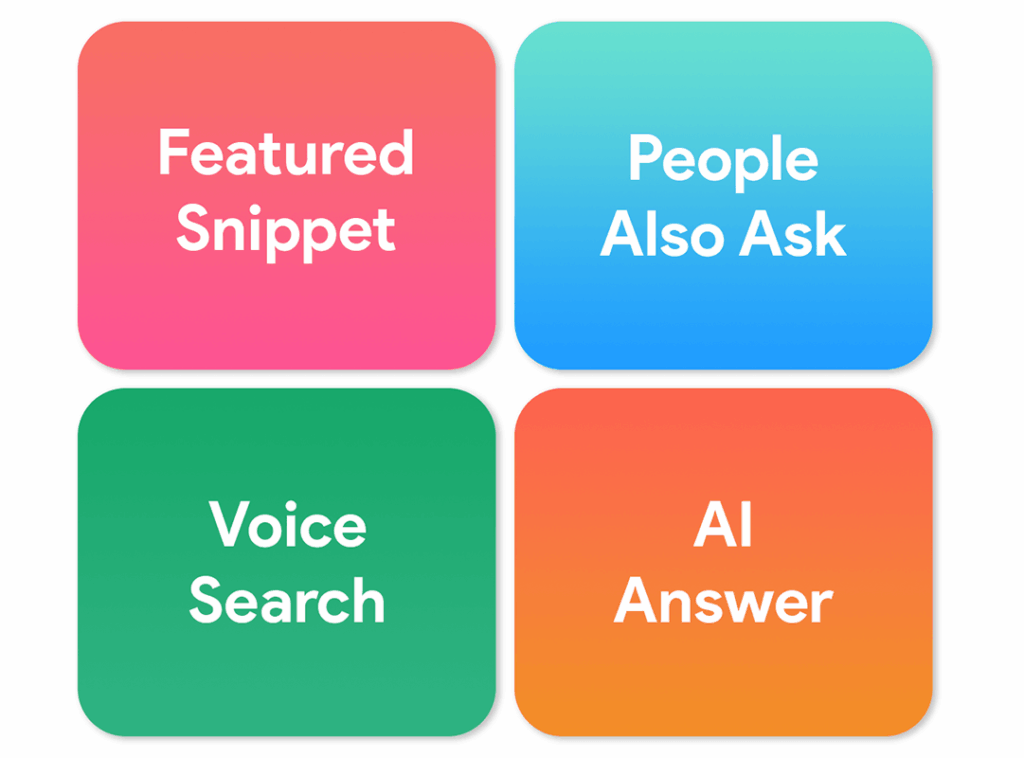
Answer engines surface information through different search features and response formats. Understanding these formats helps businesses structure content more intentionally so it can match the way answers are displayed.
Google Featured Snippets
Google featured snippets extract a concise answer from a webpage and display it at the top of search results. These snippets typically appear for question-based queries
and provide immediate information without requiring a click.
Content that ranks in snippets is usually structured clearly, includes direct answers, and uses headings that match user intent.
People Also Ask (PAA)
People Also Ask sections display related questions and expandable answers. These questions are dynamically generated based on user behaviour and search patterns.
Content that performs well in PAA is typically structured in a question-and-answer format, with concise and relevant responses.
Voice search
Voice search delivers spoken answers using digital assistants that often pull answers from featured snippets or structured content. On the other hand, voice queries tend to be longer and more conversational, requiring content that reflects natural language patterns.
AI-Generated Answers
AI-generated answers summarise multiple sources into a single response. These answers prioritise content that is factual and well-structured.
Content selected for AI answers often includes definitions, step-by-step explanations, and clearly segmented sections.
Core AEO Strategies
Strong AEO performance does not happen by accident. It requires deliberate content structuring so that important information is easy to identify, extract, and present. Businesses that want to rank within answer formats need to focus less on padding and more on precision.
The following strategies improve the chances of content being selected in featured snippets, People Also Ask results, voice search, and AI-generated summaries.
How To Rank In Featured Snippets And Ai Answers In Singapore
The "Definition-First" Content Model
The Definition-First model is a content structure where the direct answer to a query is placed in the first 50–60 words of a section. This allows AI crawlers to immediately identify the “Value Proposition” of the text.
- Example: If the heading is “What is the corporate tax rate in Singapore?”, the first sentence should be “The corporate tax rate in Singapore is a flat 17%.” Avoid introductory fluff like “In the bustling economic landscape of Singapore, many business owners often wonder about the tax implications…”
Optimising for featured snippets involves structuring content in a way that is easy to extract.
Google featured snippets (Position Zero) are the most prominent form of AEO. To capture these:
Effective approaches include:
- Paragraph Snippets: Use a clear heading and a 40–50 word summary.
- List Snippets: Use H2 or H3 tags for the steps in a process (e.g., “How to Register a Business in Singapore”).
- Table Snippets: Use standard HTML <table> tags for data comparisons. AI engines prefer HTML tables over images or PDF downloads because the data is machine-readable.
These formats align with how Google selects and displays snippet content.
How To Rank In “People Also Ask” Using AEO Strategies
- Including question-based headings
- Providing concise answers immediately after each question
- Expanding with supporting details
How To Optimise Content For Voice Search
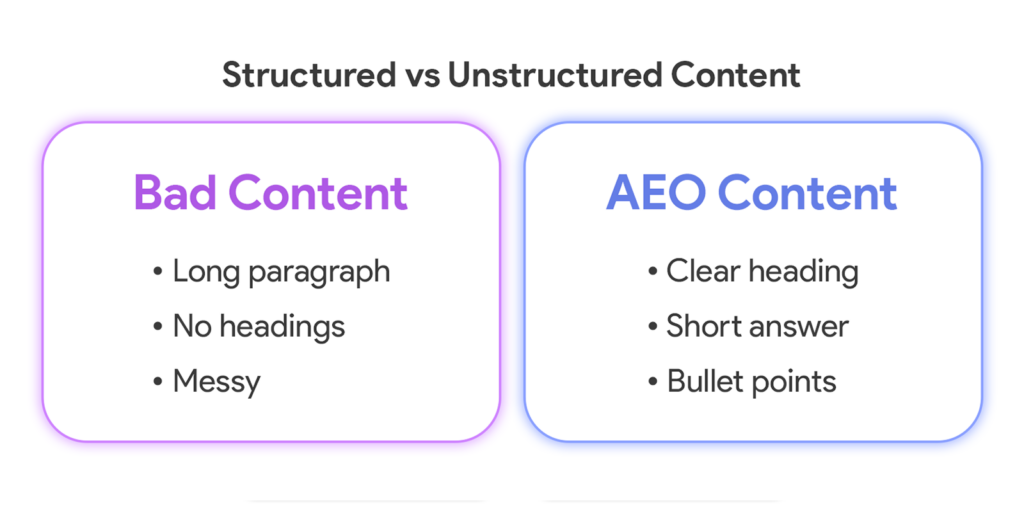
Content structure plays a central role in AEO because answer engines rely heavily on layout, hierarchy, and clarity to interpret meaning. Even accurate content can be overlooked if the answer is unclear or mixed into unrelated text. Therefore, ensure your content:
- Reflects how people speak, not just how they type
- Answers the questions clearly
- Uses simple and direct language
A strong structure makes each section self-contained, readable, and extractable. It also helps the page support multiple related questions without becoming disorganised.
How to structure FAQ content for maximum AEO performance
FAQ content supports AEO by directly answering common questions. Each question should be clearly stated and followed by a concise answer while aligning with both PAA and voice search requirements.
A useful FAQ section should use real query phrasing, keep answers direct, and avoid turning every answer into a long paragraph unless further explanation is needed.
AEO Content Framework: How To Write Content That Gets Picked As Answers
AEO keyword targeting should focus on question-based and intent-driven queries rather than only short commercial phrases. The recommended structure includes:
- Clear heading that matches the query
- Direct answer in the first paragraph
- Supporting explanation with examples
This does not replace traditional keyword research, but it expands it. Businesses should identify the exact questions users ask before making decisions and build content around those questions.
AEO Keyword Strategy: Targeting Question-Based Queries
Queries beginning with “what,” “how,” “why,” and “when” often have stronger answer potential. Common formats include:
- What is
- How to
- Why does
- When should
Advanced GEO: Citation and Authority Building
AEO helps content become the answer, while GEO helps content become a source. In AI-generated search environments, that distinction matters because not every extractable answer becomes a cited reference. Citation usually depends on clarity, depth, trust, and authority.
Content structure plays a critical role in GEO because AI systems rely on hierarchy and organisation to interpret information. Poorly structured content increases the risk of misinterpretation, reducing the likelihood of being selected in AI-generated answers.
To improve citation potential, businesses should strengthen the overall information value of the page. This includes:
1. Inclusion of Unique Data and Statistics
AI models are trained to prioritise high-information density content. Including original research, local Singaporean market surveys, or government-sourced statistics (e.g., from SingStat) increases the probability of an AI engine citing your page as a reference.
2. Quotation of Industry Experts
Including direct quotes from verified experts in your field allows AI to attribute specific viewpoints to your brand. This “Attributional Authority” is a core pillar of GEO.
3. Neutrality and Objectivity
AI engines are programmed to avoid biased or overly promotional content. To be citation-safe, avoid using superlative language such as “The best service in Singapore” or “Unmatched quality.” Instead, use factual descriptors like “Awarded the Singapore Quality Class certification” or “Providing 24/7 customer support.”
Voice Search Optimisation in the AEO Framework
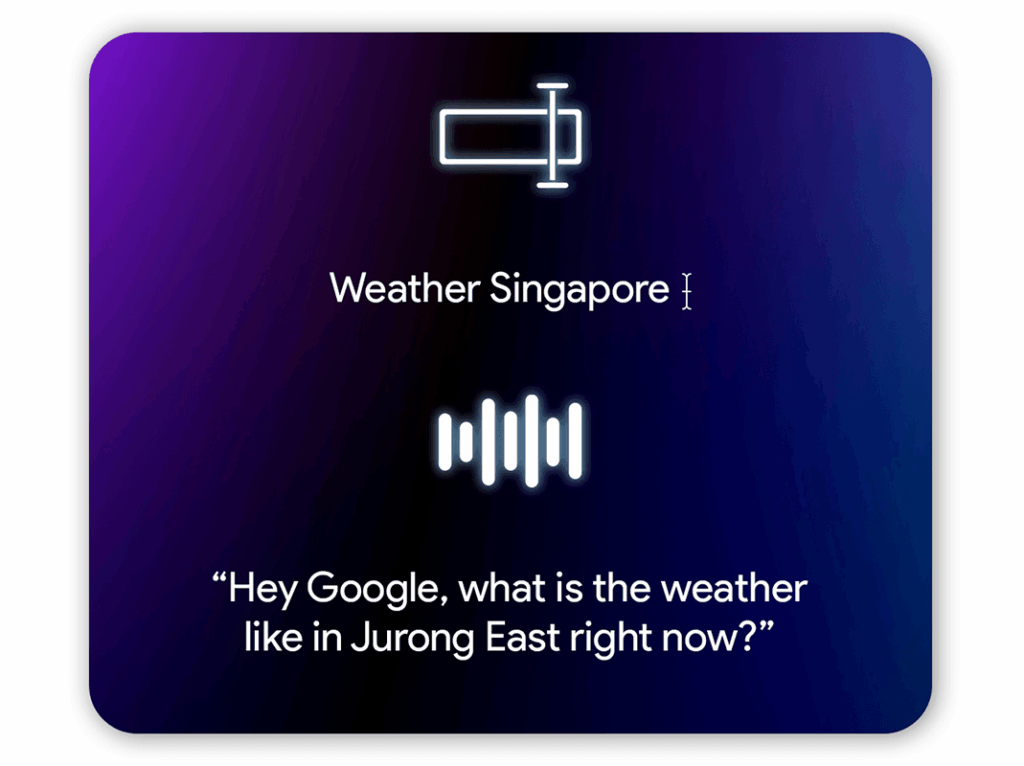
Voice search should not be treated as a separate topic from AEO. It is part of the same answer-delivery ecosystem, but with a stronger emphasis on conversational phrasing and spoken usability. As more users rely on assistants to ask natural-language questions, pages need to reflect that behaviour more closely.
Conversational Long-Tail Keywords
Voice queries are often longer and more specific than typed searches. They also frequently contain local intent, such as availability, proximity, or immediate need. This makes content structure, natural language, and local relevance especially important.
- Typed: “Weather Singapore”
- Voice: “Hey Google, what is the weather like in Jurong East right now?”
The Importance of "Near Me" Optimisation
For local businesses in Singapore, such as clinics in Novena or cafes in Tiong Bahru, AEO involves optimising for near me queries. This requires a perfectly optimised Google Business Profile (GBP) and the inclusion of local landmarks and neighbourhood names in the website’s text to provide the AI with geographic context.
AEO for Specific Singapore Industries
AEO does not apply in the same way across all sectors. Different industries have different query patterns, trust requirements, and information needs. In Singapore, this is particularly important because users often search for practical answers related to finance, property, healthcare, education, and services.
Businesses should adapt AEO implementation according to the type of decisions users are trying to make and the level of compliance expected in that industry.
AEO for Financial Services
In the highly regulated Singaporean finance sector, AEO content must adhere to E-E-A-T (Experience, Expertise, Authoritativeness, and Trustworthiness).
- Strategy: Create “What is” guides for complex financial instruments like SRS accounts or CPF top-ups. But ensure every claim is backed by a link to an official MAS (Monetary Authority of Singapore) document.
AEO for Real Estate
With the complexity of HDB BTO applications and private property cooling measures, Singaporean users have endless questions.
- Strategy: Use AEO to answer specific eligibility questions (e.g., “Can a PR buy an HDB flat alone?”) and include tables to compare different stamp duty rates.
AEO for E-commerce and Retail
Modern shoppers use AI to compare products.
- Strategy: Optimise product description pages with pros and cons lists. AI engines love to extract these lists for “Which [Product] should I buy?” queries.
AEO for Singapore Businesses
For businesses in Singapore, AEO should be treated as part of a broader digital visibility strategy rather than a standalone tactic. It works best when content, technical setup, and search intent are aligned with one another.
AEO is especially useful for businesses that rely on trust, education, or high-intent search behaviour. When users are actively looking for answers before making a decision, being the source of that answer can improve both visibility and conversion potential. Ensure to consider:
- The type of queries being targeted
- Whether the content is structured clearly enough for extraction
- How AEO integrates with existing SEO efforts
- Whether related pages are internally connected properly
- If the page gives direct answers before expanding into detail
How AEO can increase leads and conversions
AEO increases visibility at the moment users are seeking answers. This positions businesses as a source of immediate value.
When users find clear answers, they are more likely to trust the source and take action, which ultimately leads to higher engagement and improved conversion potential.
AEO for local SEO in Singapore
Local AEO focuses on answering location-specific queries. This includes searches related to services, directions, and availability.
Content should include relevant local context where appropriate, such as neighbourhoods or service areas, without overuse.
Best AEO strategies for service-based businesses
Service-based businesses benefit from AEO by addressing common customer questions. Effective strategies include:
- Creating detailed service pages with FAQs
- Explaining processes clearly
- Addressing common concerns
This helps users make informed decisions and improves visibility in answer-based search features.
Measuring AEO and GEO Success
Traditional SEO metrics alone are no longer enough to evaluate answer visibility. A page may rank reasonably well and still fail to appear in snippets, AI summaries, or voice responses. That is why performance measurement needs to go beyond keyword ranking alone.
Traditional SEO metrics like keyword rankings are insufficient for measuring AEO success. Instead, businesses should track:
1. Share of Model (SoM)
SoM is a new metric that measures how often your brand is mentioned by a Generative AI for queries related to your industry. This is typically tracked through manual testing or specialised AI-tracking tools.
2. Impression Share in Featured Snippets
Use tools like Google Search Console to monitor the appearance filter. If your impressions are deep but clicks are moderate, you are likely appearing in Featured Snippets or AI Overviews.
3. Natural Language Queries
Analyse your search term report for queries that start with “How,” “Can,” or “Should.” Growth in these specific types of queries indicates successful AEO.
Technical AEO Optimisation
Technical optimisation supports AEO by making content easier for search engines to interpret and trust. Even strong content can underperform if the page structure, markup, or presentation creates confusion.
A technical foundation does not replace content quality, but it improves the chances that well-structured content can be processed accurately and surfaced correctly.
The Role of FAQ Schema for AEO in Singapore
FAQ Schema (Frequently Asked Questions Structured Data) is a specific type of code added to a webpage that tells search engines exactly which text is a question and which is the answer. By using JSON-LD (JavaScript Object Notation for Linked Data), Singaporean businesses can increase the likelihood of their content appearing in “People Also Ask” (PAA) boxes.
Implementing Schema for AI Extraction
- Ensure the question in the code matches the H2 heading on the page exactly.
- Keep answers concise (under 100 words).
- Include a link within the answer to a deeper resource, which encourages the AI to cite that specific URL.
AEO Content Framework: The Step-by-Step Template
A repeatable framework helps businesses create answer-ready content consistently across multiple pages. Without a framework, content often becomes uneven, repetitive, or too dependent on individual writing style.
To ensure every piece of content published is AEO-ready, follow this 5-step framework:
- The Query Heading: Use an H2 that is a full question (e.g., “How do I claim a GST refund at Changi Airport?”).
- The Direct Answer: The first paragraph (40–60 words) must provide the answer without jargon.
- The Visual Aid: Include a bulleted list, numbered list, or table to break down the answer visually.
- The Deep Dive: Provide 200–300 words of additional context, including why this answer is correct.
- The Internal Link: Link to a related “Cluster” topic to help the AI map your site’s architecture.
Why Most AEO Strategies Fail in Singapore

Many businesses struggle with AEO not because they lack content, but because they apply the wrong optimisation priorities. They continue to produce pages designed mainly for rankings, while answer engines increasingly reward clarity and direct usability.
As a result, some businesses publish long-form content that looks comprehensive but still fails to appear in answer-based search environments.
Common reasons include:
- focusing on rankings instead of extraction
- writing lengthy content without clear answer blocks
- failing to define entities and context properly
- weak internal linking between related topics
- using generic language that adds little unique value
When these issues are present, content may still exist online, but it becomes harder for AI systems and answer engines to use confidently.
Common Mistakes in AEO and GEO
AEO and GEO usually fail because the content is either too vague, too thin, or too difficult for machines to interpret quickly. In many cases, the problem is not a lack of effort, but the wrong content structure.
Avoiding a few common mistakes can significantly improve answer visibility.
1. Burying the Lead
Many writers save the conclusion for the end of the article. In AEO, the conclusion (the answer) must come first. If an AI crawler has to read 500 words to find the answer, it will likely skip your page and cite a competitor.
2. Over-reliance on Thin Content
While AEO requires conciseness, it does not mean “thin” content. An answer must be comprehensive. An AI will not cite a source that only provides a superficial answer without supporting data.
3. Neglecting Mobile Load Speed
In Singapore, most AI-assisted searches occur on mobile devices. If your page takes more than 2.5 seconds to load (the Core Web Vitals threshold for LCP), the search engine may prioritise a faster-loading page for the featured snippet to ensure a good user experience.
The best-performing pages are usually those that deliver the answer early, support it clearly, and remain easy to interpret throughout.
The Future of AEO in Singapore: 2026 and Beyond
AEO will continue evolving as search becomes more multimodal and AI-assisted. In the future, answer visibility may increasingly depend not only on text, but also on how well supporting content formats such as video, audio, and visual summaries are structured.
For businesses in Singapore, this means preparing content not just for ranking, but for reuse across multiple answer interfaces. Search engines and AI tools are becoming more context-aware, more localised, and more selective about the quality of the sources they rely on.
This makes content clarity, local relevance, and structured presentation even more important moving forward. Businesses that adapt early will be better positioned to maintain visibility as search behaviour continues shifting toward direct-answer experiences.
FAQs
AEO (Answer Engine Optimisation) is the process of optimising content so it can be selected as a direct answer by search engines and AI systems. It focuses on structure and relevance to user queries.
AEO focuses on providing direct answers, while SEO focuses on improving rankings in search results. Both strategies work together but target different outcomes.
AEO is important because users in Singapore rely heavily on mobile search, AI tools, and quick answers. Optimising for AEO improves visibility in these formats.
Yes, AEO can improve conversions by positioning content at the moment users are seeking answers. This builds trust and encourages action.
Content that answers specific questions, uses a clear structure, and provides concise explanations performs best for AEO.
AEO as a Visibility Framework
Answer Engine Optimisation provides a structured approach to digital visibility by aligning content with how users search for answers. It ensures content can be extracted and presented across multiple search formats.
By combining AEO with SEO and GEO, businesses can achieve broader visibility across traditional search results, AI-generated answers, and voice search. This integrated approach supports long-term digital presence in an evolving search landscape.
Next Step: Apply AEO to Your Content Strategy
Businesses that want to improve visibility in answer-based search formats can begin by structuring content around user questions and clear answers. This includes reviewing existing pages, identifying opportunities for improvement, and aligning content with AEO principles.
For organisations looking to implement structured optimisation strategies, the next step is to evaluate your current content and identify gaps. Get a quote and request an assessment.