
When it comes to AI SEO strategy in Singapore, measurement needs a competitive benchmark because absolute visibility figures can be misleading without context. A brand may appear in 30% of tested prompts and seem highly visible, but that result becomes less impressive if its closest competitor appears in 70% of the same prompts.
AI search share of voice measures how much visibility a brand receives relative to competing brands across a defined set of prompts and AI platforms. It can include brand mentions, website citations, recommendations and prompt coverage across ChatGPT, Gemini, Perplexity and Google AI search experiences.
This metric extends the traditional concept of search share of voice. Conventional SEO share of voice generally compares ranking visibility across tracked keywords. AI search requires a broader model because there is no single fixed ranking position in a generated answer.
For Singapore businesses, the most useful approach is to define a controlled prompt universe, track the same competitors consistently and calculate separate mention, citation and recommendation shares before combining them into any summary score.
What AI Search Share of Voice Means

AI search share of voice is the proportion of generative search visibility captured by one brand compared with a defined group of competitors.
The measurement is relative rather than absolute.
If five tracked brands collectively receive 100 relevant mentions and one business receives 25 of them, that business has a 25% mention share of voice within the defined dataset.
The same approach can be applied separately to:
- Brand mentions
- Website citations
- Recommendations
- Prompt coverage
- Cross-platform appearances
The scope of the dataset must always be disclosed.
A share of voice calculated from 100 commercial Singapore prompts does not represent all AI searches in Singapore. It represents visibility within that controlled test environment.
Why Traditional Search Share of Voice Is Insufficient

Traditional search share of voice is insufficient for AI search because generated answers do not operate as a simple list of fixed ranking positions.
Conventional SEO measurement can assign weighted values to positions one through ten.
AI search introduces several different outcomes.
A company can be:
- Mentioned by name.
- Recommended as a provider.
- Cited through its website.
- Discussed through a third-party source.
- Absent even when its organic page ranks strongly.
These outcomes should not be treated as identical.
A business ranked third organically but never mentioned in AI-generated commercial answers has a different competitive position from a company that is repeatedly recommended but rarely cited from its own domain.
AI share of voice therefore expands competitive visibility measurement beyond rankings.
The W360 AI Share of Voice Framework
The W360 AI Share of Voice Framework separates AI visibility into measurable components before producing any combined score.
The framework contains five core layers.
Layer | Measurement |
Prompt presence | Whether the brand appears |
Mention share | Relative brand recognition |
Citation share | Relative source visibility |
Recommendation share | Relative commercial inclusion |
Cross-platform coverage | Breadth across AI platforms |
Each layer answers a different strategic question.
Prompt presence shows whether the business participates in relevant AI-search conversations.
Mention share shows how visible the brand is relative to competitors.
Citation share shows whether the company’s website is being used as a source.
Recommendation share focuses specifically on commercial decision-making.
Cross-platform coverage shows whether visibility depends on one platform or is broader.
Building a Prompt Universe

A prompt universe is the complete set of questions used to calculate AI search share of voice.
It should reflect realistic customer needs rather than random prompt variations.
For Singapore businesses, the prompt universe should combine several intent categories.
Useful categories include:
- Service discovery
- Provider recommendation
- Product or service comparison
- Problem-solving
- Educational research
- Local Singapore queries
The prompt set should remain stable enough to support repeated measurement.
New questions can be introduced over time, but the benchmark group should be preserved so changes can be compared meaningfully.
Why Prompt Selection Matters
Prompt selection determines what the final share-of-voice score actually represents.
A company can look very strong if the test consists mainly of questions closely aligned with its existing content.
The same company may appear much weaker when commercial recommendation prompts are included.
A balanced prompt dataset should therefore represent the whole relevant customer journey.
For example, an AI SEO agency could be measured against prompts such as:
- What is AI SEO?
- How does GEO differ from SEO?
- Which AI SEO agencies operate in Singapore?
- How can a company measure ChatGPT visibility?
- What should businesses look for in an AI SEO provider?
These prompts measure different forms of authority.
The final benchmark becomes more useful because it does not overvalue one type of visibility.
Brand Mention Share
Brand mention share measures how much of the total brand visibility within the competitive set belongs to one company.
The basic calculation is:
Brand Mention Share = Brand Mentions ÷ Total Competitor Mentions × 100
The calculation should count only eligible prompts.
If a prompt concerns a completely different service category, an absent brand should not be penalised.
Mentions should also be classified by context.
A company appearing once in a long list is different from a company being positioned as a leading recommendation.
This is why mention share should be reported alongside recommendation share.
Citation Share
Citation share measures how often one company’s owned website is cited relative to competing domains.
The basic formula is:
Citation Share = Brand-Owned Citations ÷ Total Owned Citations Across Tracked Brands × 100
Citation share should usually be calculated at domain level first.
URL-level analysis can then show which specific pages contribute most to that visibility.
This distinction is useful because one company may achieve strong citation share through a single research page.
Another may receive citations across multiple service and informational pages.
Both can have the same percentage while demonstrating different content strengths.
Recommendation Share
Recommendation share measures the proportion of relevant commercial prompts in which a brand is actively suggested.
It should not be calculated across purely informational questions.
The basic formula is:
Recommendation Share = Brand Recommendations ÷ Total Competitor Recommendations × 100
Recommendation prompts can include questions such as:
- Which provider should I consider?
- What are good options for this service?
- Which companies offer this solution in Singapore?
- Which provider suits a specific requirement?
These queries are commercially meaningful because the user is evaluating options.
Recommendation share can therefore be one of the most useful AI SEO metrics for service businesses.
Prompt Coverage
Prompt coverage measures the breadth of a brand’s visibility across the tested query set.
The formula is:
Prompt Coverage = Prompts Where Brand Appears ÷ Total Relevant Prompts × 100
Prompt coverage differs from total mention count.
A brand could appear several times within a small number of prompts but still have weak overall coverage.
Another brand might appear once across a much larger portion of the query universe.
The second business has broader visibility.
For AI competitor benchmarking, coverage should therefore be reported separately from frequency.
Cross-Platform Prompt Coverage
Cross-platform prompt coverage measures whether the same brand remains visible across multiple AI environments.
A company can perform strongly in ChatGPT but weakly in Gemini.
Another may be frequently cited in Perplexity while barely appearing in Google AI Overviews.
The benchmark should therefore track each platform separately before calculating a combined metric.
A useful classification can include:
Coverage Pattern | Interpretation |
One platform only | Concentrated visibility |
Two platforms | Partial cross-platform presence |
Three platforms | Broad visibility |
Four platforms | Strong cross-platform consistency |
The classification should be based on meaningful prompt coverage rather than a single appearance.
Platform Weighting
Platform weighting determines how much each AI platform contributes to a combined share-of-voice score.
Equal weighting is simple but may not reflect real business value.
A company could assign more weight to platforms that are more relevant to its audience or measurable customer journey.
For example, an internal reporting model could assign:
- ChatGPT: 30%
- Google AI: 30%
- Gemini: 20%
- Perplexity: 20%
These figures are only an example.
They should not be presented as universal best-practice weights.
The appropriate model depends on business priorities, audience behaviour and available data.
The important requirement is transparency.
Competitor Weighting
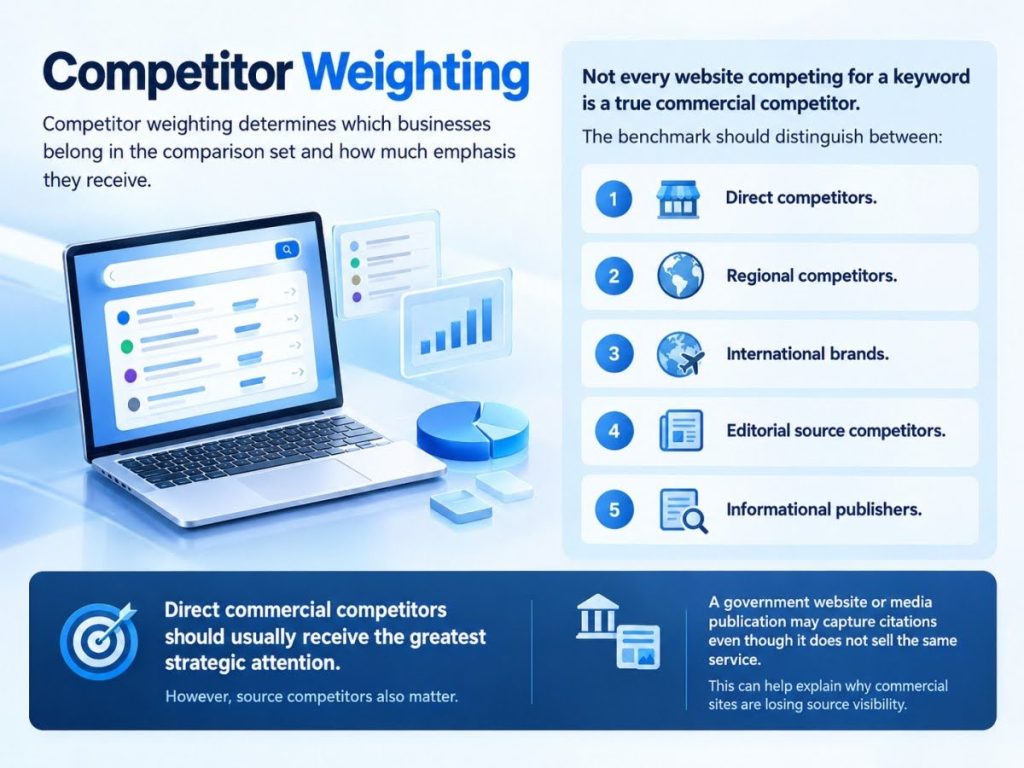
Competitor weighting determines which businesses belong in the comparison set and how much emphasis they receive.
Not every website competing for a keyword is a true commercial competitor.
The benchmark should distinguish between:
- Direct competitors
- Regional competitors
- International brands
- Editorial source competitors
- Informational publishers
Direct commercial competitors should usually receive the greatest strategic attention.
However, source competitors also matter.
A government website or media publication may capture citations even though it does not sell the same service.
This can help explain why commercial sites are losing source visibility.
Direct Competitors vs Source Competitors
Direct competitors compete for customers.
Source competitors compete for citations.
These categories can overlap but should not be assumed to be identical.
For example, a Singapore digital marketing agency may compete commercially with other agencies.
However, an AI search answer explaining a technical topic may cite Google, an academic study or an industry publication instead.
Those websites are not commercial competitors, but they compete for informational visibility.
A mature AI SEO benchmark should therefore maintain two views:
- Commercial share of voice
- Source share of voice
This distinction can reveal whether the main opportunity lies in brand recommendations or informational authority.
W360 AI Share of Voice Formula
A combined AI Share of Voice formula should summarise several metrics while keeping the calculation transparent.
One possible model is:
AI Share of Voice Score = (Mention Share × Weight) + (Citation Share × Weight) + (Recommendation Share × Weight) + (Prompt Coverage × Weight) + (Cross-Platform Coverage × Weight)
The weights should total 100%.
For example:
Component | Example Weight |
Mention Share | 20% |
Citation Share | 25% |
Recommendation Share | 25% |
Prompt Coverage | 20% |
Cross-Platform Coverage | 10% |
This example is not a universal formula.
A commercial lead-generation campaign may assign greater weight to recommendations.
A publisher may assign more weight to citations.
The model should reflect business objectives.
Why the Formula Must Remain Transparent
A proprietary AI visibility score becomes difficult to trust if users cannot see what drives the result.
A single number can hide important differences.
For example, two brands may both receive a score of 60.
Brand A may have strong citation visibility but weak recommendations.
Brand B may have high recommendation visibility but almost no owned-site citations.
The strategic responses are completely different.
The dashboard should therefore display the underlying components alongside the composite score.
The combined number is a summary, not the analysis itself.
Worked Example
A worked example demonstrates how the framework can be applied without representing actual W360 study findings.
Assume four Singapore businesses are tested across 100 relevant prompts.
The example dataset produces the following results:
Metric | Brand A | Brand B | Brand C | Brand D |
Prompt coverage | 55% | 42% | 30% | 18% |
Mention share | 38% | 31% | 20% | 11% |
Citation share | 25% | 40% | 22% | 13% |
Recommendation share | 46% | 29% | 17% | 8% |
These numbers are illustrative only.
Brand A has the strongest overall prompt coverage and recommendation visibility.
Brand B has the strongest citation share.
This shows why one metric should not define the winner.
Brand A may be better recognised commercially, while Brand B may have stronger source assets.
Competitor Benchmarking
Competitor benchmarking identifies where visibility gaps exist and whether those gaps are meaningful.
A useful competitive report should compare brands by platform and intent.
For example:
Area | Key Question |
Informational visibility | Who is cited for educational prompts? |
Commercial visibility | Who is recommended? |
Brand recognition | Who is mentioned most? |
Source strength | Whose website receives citations? |
Platform breadth | Who appears consistently across engines? |
This produces a more actionable comparison.
A business can then determine whether it needs stronger content, better authority, clearer entity signals or improved commercial relevance.
Mention Gap Analysis
A mention gap exists when competitors appear frequently for relevant prompts while the target brand is absent.
This usually indicates a broader entity or brand-recognition issue.
Possible causes can include:
- Limited third-party discussion
- Weak association with the service category
- Inconsistent brand information
- Low branded search demand
- Narrow online presence
The correct response is not always to publish more website content.
Brand visibility can require stronger off-page activity, digital PR, credible references and broader category association.
Citation Gap Analysis
A citation gap occurs when competing websites are frequently used as sources but the target domain is rarely cited.
This can suggest weaknesses in owned content.
Possible causes include:
- Generic information
- Weak source-ready evidence
- Limited topical depth
- Poorly structured pages
- Technical accessibility problems
- Stronger competing sources
Citation gaps should be analysed at URL level.
This reveals whether the problem affects the whole site or only certain content types.
Recommendation Gap Analysis
A recommendation gap exists when competitors are repeatedly suggested for provider-selection prompts while the target business is not.
This is a commercially significant problem.
The gap can reflect:
- Weak brand recognition
- Limited independent coverage
- Incomplete service information
- Poor market association
- Stronger competitor reputation
Recommendation visibility should therefore be evaluated alongside third-party sources.
An AI platform may rely on independent coverage rather than a company’s own claims when presenting provider options.
How to Interpret the Score
An AI share-of-voice score should be interpreted relative to competitors and historical performance.
A score of 40 has little meaning by itself.
It becomes useful when compared against:
- Competitor scores
- Previous reporting periods
- Platform-specific visibility
- Commercial prompt performance
The direction of travel can be more important than the absolute value.
A business moving from 15% to 25% citation share over several reporting periods may be strengthening its source visibility even if a leading competitor remains significantly ahead.
The benchmark should therefore show both current position and trend.
High Mention Share, Low Citation Share
High mention share combined with low citation share indicates strong brand recognition but weak owned-source visibility.
The business is being discussed, but its website is not frequently used as supporting evidence.
This can occur when third-party websites provide most of the information about the brand.
The appropriate strategy can involve strengthening owned research, service information, guides and reference pages.
The goal is not to reduce third-party mentions.
It is to complement brand recognition with stronger source authority.
Low Mention Share, High Citation Share
Low mention share with high citation share indicates that the website is useful as a source even though the brand itself has limited recognition.
This can happen when one or more content assets provide strong factual information.
The business should preserve those source strengths while improving entity association.
Useful actions can include:
- Clear organisation attribution
- Stronger author identification
- Better brand consistency
- Third-party brand coverage
The objective is to ensure the information contributes to both source visibility and brand recognition.
High Information Visibility, Low Commercial Visibility
A business may receive many citations for educational prompts but almost no recommendations for commercial queries.
This indicates strong informational authority but weak provider visibility.
The content strategy may already be effective.
The commercial weakness may instead involve entity positioning, service-page clarity or third-party validation.
This is another reason why citation share alone cannot be treated as the final AI SEO KPI.
The customer journey needs to be measured across several prompt types.
Recommended Reporting Cadence
AI search share of voice should be tracked consistently rather than continuously reacting to individual output changes.
Monthly measurement is suitable for many campaigns.
A practical reporting structure can include:
- Monthly prompt testing
- Monthly competitor comparison
- Quarterly strategic analysis
- Annual prompt-universe review
The core benchmark prompts should remain unchanged during regular reporting.
New prompts can be added as supplemental measures.
This maintains historical comparability.
Why Consistency Matters
Consistency is essential because AI responses can vary.
If the team changes prompts, competitors and measurement rules every month, it becomes impossible to determine whether visibility genuinely changed.
The benchmark should therefore document:
- Prompt wording
- Platform
- Date
- Market
- Competitor set
- Scoring rules
Testing conditions should remain as stable as reasonably possible.
Variation cannot be eliminated completely, but consistent methodology makes trends more meaningful.
Common Measurement Errors
AI share-of-voice reporting can become misleading when different visibility types are combined incorrectly.
Counting Every Brand Mention Equally
A passing mention should not necessarily carry the same commercial value as a primary recommendation.
Context should be classified.
Counting Citations and Mentions as the Same Thing
A citation measures source visibility.
A mention measures brand visibility.
Combining them without distinction hides useful information.
Using Irrelevant Competitors
A large global publisher may dominate informational citations without competing for customers.
Commercial and source competitors should therefore be separated.
Changing the Prompt Set
Changing the benchmark repeatedly destroys trend comparability.
The core prompt universe should remain stable.
Treating One Response as Stable Visibility
One citation does not establish lasting visibility.
Repeated measurement is more reliable.
Common Formula Errors
Formula design can also distort AI visibility.
One mistake is weighting every platform equally without business justification.
Another is allowing large volumes of low-value informational mentions to overwhelm commercially important recommendations.
A third is calculating percentages from different denominator sizes without clearly explaining them.
Every metric should therefore document:
- Numerator
- Denominator
- Eligibility rules
- Weight
- Platform scope
This makes the model auditable.
AI Share of Voice and Traditional SEO
AI share of voice should be compared with traditional organic search visibility.
This reveals whether the brand’s strengths are consistent across both environments.
A useful matrix is:
Traditional SEO | AI Share of Voice | Interpretation |
Strong | Strong | Broad market visibility |
Strong | Weak | Generative visibility gap |
Weak | Strong | AI recognition with SEO weakness |
Weak | Weak | Foundational authority gap |
Each situation requires different priorities.
A company ranking strongly in Google but rarely appearing in AI-generated recommendations may need stronger entity and third-party authority rather than more traditional keyword optimization.
AI Share of Voice and Brand Search
Branded search can provide useful supporting context for AI share-of-voice trends.
If brand visibility rises across AI prompts and branded search impressions also increase, the pattern may indicate stronger brand discovery.
However, direct causation should not be assumed.
Branded demand can also be influenced by:
- Advertising
- Social media
- PR
- Events
- Offline marketing
- Seasonality
The strongest reporting approach therefore combines several datasets.
AI share of voice provides visibility information.
Search and analytics data provide behavioural evidence.
AI Share of Voice and Referral Traffic
AI referral traffic measures direct visits from generative platforms.
This metric should be monitored but not used as the denominator for visibility share.
Many AI interactions can produce exposure without a direct visit.
A user may see a recommendation, remember the brand and later search for it manually.
Citation visibility can also occur without a click.
This means referral traffic represents one downstream outcome rather than the total value of AI visibility.
For reporting, traffic should sit alongside share-of-voice metrics.
Benchmarking by Industry
Industry-level benchmarking improves interpretation because AI source behaviour can vary by sector.
Healthcare, finance, education, B2B services, ecommerce and property can all produce different source patterns.
For example, regulated topics may rely more heavily on official sources.
Consumer recommendations may incorporate reviews and community content.
B2B queries may surface provider websites, industry publications and specialist explainers.
A Singapore AI SEO benchmark should therefore compare businesses with relevant sector peers.
Cross-industry comparisons are useful for market research but less useful for direct performance evaluation.
Benchmarking by Search Intent
Search-intent benchmarking helps identify where a brand is strongest in the customer journey.
Prompt share of voice can be calculated separately for:
Intent | Measurement Focus |
Informational | Source authority |
Discovery | Category recognition |
Comparison | Consideration visibility |
Recommendation | Commercial inclusion |
Local | Singapore market relevance |
This creates a more useful diagnostic.
A brand with 60% informational share but 5% recommendation share has a very different problem from one that performs consistently across the funnel.
Benchmarking Singapore vs International Sources
Singapore businesses often compete with international sources in AI-generated answers.
The benchmark should therefore classify cited domains by market.
Possible classifications include:
- Singapore domain
- Singapore-focused international domain
- Global source
- Government or institutional source
This helps determine whether local websites have sufficient source representation.
If international sites dominate a Singapore-specific query, there may be an opportunity for local businesses to contribute stronger market-specific information.
Localisation should still be meaningful.
Simply adding “Singapore” to generic content does not create stronger source relevance.
Improving Mention Share
Mention share improves when the brand becomes more strongly associated with relevant topics across the wider web.
Useful activities can include:
- Stronger service positioning
- Consistent entity information
- Expert commentary
- Credible third-party coverage
- Original market research
The objective is to create a legitimate category association.
Artificial mentions placed across unrelated websites may increase raw counts without creating meaningful authority.
Quality and context remain more important than mention volume.
Improving Citation Share
Citation share improves when a website contains useful information that can function as evidence.
This may involve strengthening:
- Original studies
- Comprehensive guides
- Technical explainers
- Comparison resources
- First-party data
The pages should also be technically accessible.
Strong source content should be connected to the wider site through internal links and clear topical architecture.
Businesses should monitor which competitors receive citations and identify what those pages contribute that their own content does not.
Improving Recommendation Share
Recommendation share is influenced by more than owned content.
Commercial recommendations can depend on brand recognition, reputation, category association and third-party information.
Businesses should therefore review both their websites and external presence.
Useful actions can include:
- Clarifying service scope
- Strengthening local relevance
- Building credible independent coverage
- Maintaining genuine reviews
- Establishing expert authority
Recommendation visibility should be measured over time.
No single change can guarantee that an AI platform will suggest a specific business.
The Role of Original Research
Original research can support several share-of-voice components simultaneously.
A strong study can earn citations.
It can create third-party mentions.
It can strengthen topical authority.
It can also increase brand recognition if external publishers reference the company behind the research.
For Singapore businesses, local research can be especially useful where market-specific data is limited.
A transparent study should explain its sample, methodology and limitations.
Unsupported numbers should never be presented as first-party findings simply to create apparent authority.
The Role of Digital PR
Digital PR can increase brand and source visibility when it creates credible third-party coverage.
The best campaigns begin with information worth covering.
Examples include:
- Original datasets
- Industry benchmarks
- Expert analysis
- Significant company developments
- Market research
Generic press release distribution should not be confused with strong digital PR.
A single legitimate press release may be appropriate for genuine news.
Long-term AI visibility is more likely to benefit from meaningful editorial coverage and authoritative brand references than repeated low-value syndication.
AI Share of Voice as a Management KPI
AI share of voice can be useful for management reporting because it converts scattered AI-search observations into a competitive framework.
However, management should still see the underlying metrics.
The KPI should answer:
- Are we more visible than last quarter?
- Which competitors are gaining?
- Where are we losing citations?
- Are we being recommended commercially?
- Which platforms remain weak?
This makes the metric strategic rather than cosmetic.
The score should eventually be connected to branded demand, referral traffic, leads and assisted conversions where possible.
Framework Limitations
AI share-of-voice measurement has limitations because generative responses are dynamic.
Results can vary according to:
- Prompt wording
- Model updates
- User context
- Platform behaviour
- Time
- Retrieval availability
A 100-prompt benchmark also cannot represent every possible customer question.
The methodology therefore provides a controlled sample rather than a complete census of AI behaviour.
Combined scores introduce another limitation.
Weighting decisions can influence the result significantly.
For this reason, all formulas and weights should remain transparent.
The framework is best used to track patterns, competitive gaps and direction of travel rather than claim a permanent market share.
Frequently Asked Questions
AI search share of voice measures how much generative search visibility a brand receives relative to selected competitors. It can include mentions, citations, recommendations and prompt coverage across platforms such as ChatGPT, Gemini, Perplexity and Google AI.
AI share of voice can be calculated separately for brand mentions, website citations and recommendations. A combined score can then weight these metrics according to business priorities, provided the formula is transparent.
No. Traditional SEO share of voice usually measures visibility based on search ranking positions. AI share of voice also includes generated mentions, citations, recommendations and prompt-level visibility.
Citation share measures how much of the total owned-domain citation visibility among tracked competitors belongs to one brand. It should be calculated across a clearly defined prompt and competitor set.
Mention share measures the proportion of total brand mentions captured by one company among tracked competitors. It reflects brand recognition rather than website source visibility.
There is no universal minimum that guarantees accuracy. The prompt universe should be large enough to represent important topics and intents while remaining stable enough for repeatable testing.
Not necessarily. Platform weighting should reflect business relevance, audience behaviour and available evidence. The calculation should always disclose the weights used.
Monthly measurement is suitable for many campaigns, with quarterly strategic reviews providing broader trend analysis. The core prompt set should remain consistent across reporting periods.
Competitive AI Visibility Needs More Than One Score
For AI SEO strategy in Singapore, measurement becomes more useful when businesses compare themselves against competitors rather than viewing isolated citations or mentions.
AI search share of voice provides that competitive context.
Mention share measures brand recognition.
Citation share measures owned-source visibility.
Recommendation share measures commercial inclusion.
Prompt coverage measures breadth.
Cross-platform coverage measures consistency.
Together, these metrics provide a more complete picture than one ranking position or one AI visibility score.
For Singapore businesses, the strongest benchmark is transparent, repeatable and connected to the actual prompts customers use.
The objective is not to dominate every generative answer.
It is to improve visibility for the topics, services and commercial decisions that matter most.
Benchmark Your AI Visibility Against the Market
A useful AI search benchmark should show not only whether a brand appears, but how its mentions, citations and recommendations compare with direct competitors across commercially relevant prompts.
W360 Group Pte Ltd. can help businesses build an AI SEO strategy in Singapore framework covering AI search share of voice, competitor benchmarking, prompt visibility, citations and traditional search performance. Businesses that want to establish a measurable competitive baseline can get a quote from W360 Group Pte Ltd.