AI for SEO requires businesses to understand that generative search does not work exactly like a conventional list of ranked webpages. ChatGPT, Gemini, Perplexity and Google AI search experiences can retrieve information from multiple sources, combine evidence and present a synthesised response with citations or supporting links.
This changes the source-selection question. A webpage does not simply need to rank for one keyword; it needs to contain information that is relevant and useful for the specific part of a question being answered.
Current public documentation also shows that AI search systems can use search and retrieval processes rather than relying only on information contained within a language model. OpenAI states that ChatGPT Search can search the web, select relevant results and provide cited sources, while Google explains that its AI search features remain rooted in core Search ranking and quality systems.
For Singapore businesses, this means AI SEO optimisation should focus on discoverability, relevance, authority, entity clarity, information gain and extractable answers rather than attempting to identify one hidden “AI ranking factor”.
How AI Search Differs From Traditional Search

AI search differs from traditional search because the final user experience can synthesise information instead of displaying only a sequence of webpages.
Traditional search generally presents ranked results that users evaluate individually.
Generative search can perform additional steps.
It may interpret the question, search for supporting information, retrieve several sources, extract relevant passages and synthesise an answer.
This process is often described using concepts such as information retrieval and retrieval-augmented generation, or RAG.
The practical consequence is that a webpage can contribute to an AI answer without necessarily being treated as the single best page for the entire original query.
A source may instead support one fact, comparison, definition or sub-question within the generated response.
How We Conducted the Testing
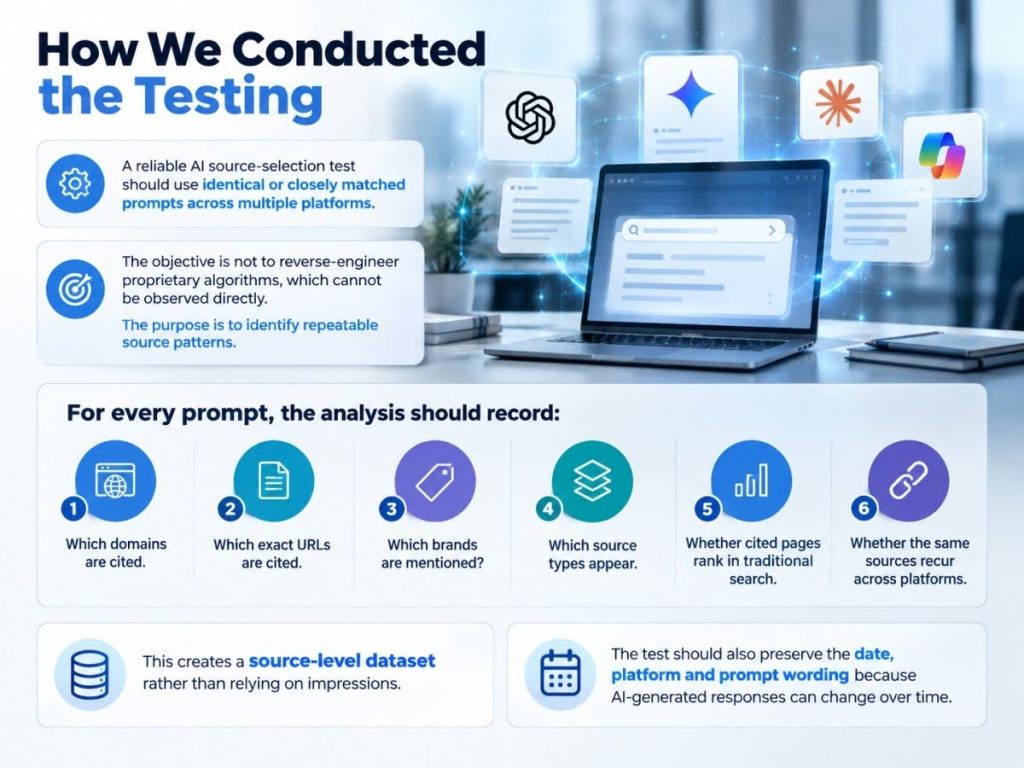
A reliable AI source-selection test should use identical or closely matched prompts across multiple platforms.
The objective is not to reverse-engineer proprietary algorithms, which cannot be observed directly.
The purpose is to identify repeatable source patterns.
For every prompt, the analysis should record:
- Which domains are cited.
- Which exact URLs are cited.
- Which brands are mentioned?
- Which source types appear.
- Whether cited pages rank in traditional search.
- Whether the same sources recur across platforms.
This creates a source-level dataset rather than relying on impressions.
The test should also preserve the date, platform and prompt wording because AI-generated responses can change over time.
Understanding Retrieval and Citation

Retrieval is the process of finding information relevant to a question, while citation is the visible attribution of a source used to support an answer.
The two concepts are related but not identical.
A system can retrieve information without displaying every underlying source to the user.
Similarly, a cited source may support only part of the final response.
OpenAI’s current documentation states that ChatGPT Search can automatically search the web when current information would improve the answer and that search responses may include citations users can open to inspect the supporting source.
Perplexity similarly describes its search experience as searching the web, synthesising information from multiple sources and presenting citations to the original material.
For SEO, this means source visibility should be measured at both domain and URL level.
Relevance Signals

Relevance is the degree to which a source addresses the specific information needed contained in a prompt.
This is one of the most fundamental requirements for any retrieval system.
A highly authoritative webpage can still be a poor source if it does not answer the relevant question.
For example, a Singapore AI SEO service page may be highly relevant to a query about agencies offering AI SEO services.
It may be less suitable for a prompt asking for empirical evidence about whether schema markup increases ChatGPT citations.
A research article examining schema would be more directly relevant to that question.
This illustrates why topical relevance should be evaluated at page level rather than only at domain level.
Query-Level Relevance
Query-level relevance means matching the actual question rather than only the broad topic.
A page about digital marketing can be topically related to AI SEO but still provide little useful information about AI citation measurement.
AI source analysis should therefore compare the exact information contained on cited and non-cited pages.
Useful questions include:
- Does the page answer the specific query?
- Is the answer easy to locate?
- Does the page provide supporting evidence?
- Does it cover the necessary subtopic?
- Is the information sufficiently precise?
This approach is more useful than simply counting keyword occurrences.
Source Authority
Source authority refers to the credibility and established standing of a source within the relevant subject.
Authority can come from several places.
Government agencies can be authoritative for official policy.
Academic journals can be authoritative for peer-reviewed research.
Industry specialists can be authoritative for practical professional information.
Established businesses can be authoritative about their own products and services.
Perplexity’s 2026 source-labelling system illustrates this distinction by identifying certain domains as Government, Academic or Trusted based on source-level review criteria such as authorship, corrections and editorial separation. Perplexity also makes clear that these labels apply at domain level and are not guarantees that every individual page is accurate.
For AI SEO, authority therefore needs to be interpreted in context.
Authority Is Topic-Dependent
Authority is not universal.
A global newspaper may be highly authoritative for a reported event but not necessarily the best source for technical implementation advice on Singapore employment compliance.
Likewise, a software company may be authoritative about how its own platform works but less suitable for an independent comparison claiming that it outperforms competitors.
AI source analysis should therefore ask whether the source has a credible relationship with the claim being supported.
This is important for content strategy.
Businesses should not attempt to become the primary source for every type of information.
They should focus on topics where they can provide legitimate expertise or first-party evidence.
Content Freshness
Content freshness matters when the underlying information can change.
AI search platforms dealing with current topics need access to recently updated or recently published material.
OpenAI explicitly describes ChatGPT Search as a way to answer questions using current information from the web.
Perplexity similarly describes its search system as sourcing current web information when users ask questions.
This makes freshness particularly important for:
- Software features
- Regulations
- Prices
- Market developments
- Search platform behaviour
- Current statistics
However, freshness should not be confused with changing the publication date.
A page is genuinely fresh when its underlying information has been reviewed and updated.
When Evergreen Content Can Still Be Strong
Evergreen content can remain useful when the underlying facts do not change frequently.
A clear explanation of canonical tags does not need a weekly update.
A methodology for calculating citation share of voice may remain valid for an extended period if the formula itself has not changed.
The source-selection question is therefore not simply “How new is this page?”
It is “Is this information current enough for this question?”
This distinction prevents unnecessary content refreshing.
For Singapore businesses, editorial calendars should prioritise updates where stale information could materially affect accuracy.
Entity Recognition
Entity recognition refers to whether a system can identify a business, person, organisation, place or concept and understand its relationships with other entities.
For a company, useful relationships can include:
- Brand name
- Services
- Industry
- Location
- Founders or experts
- Related products
- Authoritative third-party references
Entity recognition matters because AI systems frequently need to determine which real-world organisation is relevant to a question.
A company whose identity and services are represented consistently across its website and credible external sources creates clearer entity relationships than one with inconsistent descriptions.
Structured data can help describe these relationships, but entity recognition should not be reduced to schema markup alone.
Entity Signals Across the Web
Entity signals can come from both owned and third-party sources.
Owned signals include the company’s website, service pages, author profiles and organisation information.
External signals can include industry publications, trusted directories, media coverage, partnerships and independent reviews.
The consistency of these references matters.
If a company is described as an SEO agency on one source, a software company on another and a general consulting business elsewhere, the entity relationship becomes less clear.
For AI for SEO strategies, brand consistency should therefore be part of technical, content and off-page optimisation.
Topical Authority
Topical authority refers to the depth and coherence of a website’s coverage within a defined subject.
A business does not establish topical authority by publishing many pages that repeat the same keyword.
The stronger pattern is a set of distinct resources covering related but separate information needs.
For an AI SEO website, this can include:
- AI search visibility measurement
- ChatGPT citation analysis
- GEO and AEO
- Google AI Overview visibility
- Schema testing
- AI citation attribution
These topics strengthen the broader AI SEO theme while serving different search intents.
Internal linking can then establish relationships between the resources and the main commercial service page.
Content Extractability
Content extractability describes how easily a relevant answer can be isolated from a webpage without losing necessary context.
Extractable content is not necessarily short content.
A long article can be highly extractable if each section begins with a clear factual statement and then provides supporting detail.
Useful characteristics include:
- Descriptive headings
- Direct definitions
- Short paragraphs
- Clear tables
- Self-contained sections
- Explicit source attribution
This structure benefits users as well.
A reader can scan the page and locate the required information quickly.
For GEO, extractability should therefore be treated as a readability principle rather than an artificial AI formatting trick.
Answer-First Structure
Answer-first structure places the direct factual response at the beginning of a section.
For example, a section titled “Do Backlinks Matter for AI Citations?” should begin by answering that question rather than delaying the response through several paragraphs of background.
The supporting evidence can then explain uncertainty and limitations.
This structure can make content easier to retrieve and summarise.
However, concise wording should not remove important qualifications.
An answer that is technically short but misleading is less useful than a slightly longer answer that defines the conditions correctly.
AI-ready content therefore needs both clarity and accuracy.
Information Gain
Information gain is the useful contribution a page makes beyond information already widely available.
A page that simply rewrites existing definitions creates limited information gain.
A page containing original testing, proprietary statistics, expert observations or Singapore-specific evidence provides more distinct value.
Information gain can come from:
- Original research
- First-party data
- Expert analysis
- Local market findings
- New comparisons
- Practical implementation evidence
For AI source selection, distinctive information gives the webpage a clear reason to be retrieved.
The page is not merely another version of what dozens of existing sources already say.
Why Generic Content Is a Weak Source Strategy
Generic content has limited source value because it does not contribute anything distinctive.
Generative AI has made it easier to produce large volumes of competent but repetitive articles.
This increases the amount of commodity information available online.
For businesses, responding by producing even more generic material creates diminishing value.
A better approach is to identify questions where the company can contribute something specific.
For example, a Singapore agency may have unique information about local search behaviour, campaign testing, AI citation patterns or client-side implementation challenges.
That evidence creates a stronger source asset than another article defining AI SEO.
Source Diversity
Source diversity means that generated answers can use different categories of evidence rather than relying on one type of website.
A question about a Singapore regulation may appropriately use an official government source.
A question about user experience may use community discussions.
A product comparison may use first-party pages together with independent editorial sources.
Perplexity’s own product documentation describes its search process as drawing from articles, academic papers, forums, videos and other source types depending on the user’s query and selected search mode.
This illustrates why businesses should not expect company websites to dominate every type of AI response.
The source needs to fit the function.
Third-Party Corroboration
Third-party corroboration occurs when independent sources confirm information about a brand, service or claim.
This is particularly important for commercial recommendations.
A company’s own website can accurately state what services it provides.
It is less independent when claiming that the company is one of the best providers in its market.
Independent media, industry sources, customer reviews or external research can provide additional evidence.
For AI SEO, this means owned content and off-page authority should work together.
Businesses need accurate first-party information as well as credible external references.
This broader information environment can strengthen both brand recognition and recommendation visibility.
Government and Institutional Sources
Government and institutional sources are particularly relevant when questions concern official requirements, statistics, regulation or public programmes.
For Singapore-specific topics, primary government sources often provide the strongest basis for factual claims.
Commercial publishers should usually cite and interpret official information rather than reproduce it without attribution.
This creates a clearer information hierarchy.
The government source establishes the official fact.
The specialist business can then provide operational interpretation, implementation guidance or industry context.
This approach increases information gain while respecting source authority.
Media and Editorial Sources
Editorial sources can provide independent reporting, context and comparison.
They can be particularly useful for recent developments and third-party brand validation.
However, editorial authority varies significantly.
A recognised publication with transparent authorship and fact-checking processes provides different evidential value from a low-quality syndication website.
AI source analysis should therefore classify both source type and source quality.
For businesses, the objective should be credible coverage rather than sheer mention volume.
This strengthens both traditional digital PR and generative search visibility.
Forums and Community Sources
Forums and community platforms provide first-hand discussion, opinions and practical experiences.
These sources can be useful for questions that cannot be answered fully through official or corporate documentation.
Examples include:
- Real-world product experiences
- Common frustrations
- User preferences
- Implementation problems
- Community recommendations
However, forum content can be anecdotal or inaccurate.
It should not automatically be treated as equivalent to official evidence.
AI search may still use community material when the question itself seeks personal experience or sentiment.
Business Websites
Business websites are strongest as sources for first-party information.
A company is usually the most direct source for its own services, product specifications, locations, policies and published research.
This creates clear opportunities for commercial AI visibility.
Service pages should therefore contain accurate, detailed information rather than relying almost entirely on promotional copy.
A business website can also become a stronger informational source by publishing first-party research, case evidence and specialist explanations.
The distinction is important.
Commercial pages explain the offering.
Research and informational pages establish wider source usefulness.
ChatGPT Source Patterns
ChatGPT Search can use current web information and provide citations to supporting webpages.
OpenAI states that ChatGPT ranks search results using multiple factors intended to help users find relevant and reliable information, while also making clear that inclusion is not guaranteed.
OpenAI also advises publishers that public websites can appear in ChatGPT search when accessible to OAI-SearchBot and eligible for discovery.
This provides two practical SEO implications.
First, technical accessibility matters.
Second, content still needs to compete on relevance and reliability.
Crawler access alone does not create citation visibility.
What ChatGPT Testing Should Measure
ChatGPT testing should distinguish source citation from brand mention visibility.
A company can appear by name even when its website is not cited.
The analysis should therefore record:
Metric | Purpose |
Brand mention | Entity visibility |
Owned citation | Website source visibility |
Third-party citation | External corroboration |
Recommendation | Commercial inclusion |
Prompt coverage | Breadth of visibility |
This distinction reveals whether the primary weakness is source authority or brand recognition.
A business frequently mentioned but rarely cited requires a different strategy from one that is absent entirely.
Gemini Source Patterns
Gemini source analysis should focus on relevance, grounding and the relationship between generated answers and Google Search.
Google’s Gemini Deep Research documentation states that Google Search is included as a source by default for its research mode.
This does not mean every Gemini response uses identical retrieval behaviour.
It does show that current Gemini research experiences can actively ground responses in external information.
For SEO analysis, this reinforces the need to monitor exact citations instead of assuming that Gemini simply reproduces the conventional top-ranking results.
The same prompt should be tested repeatedly and compared with traditional search visibility.
Perplexity Source Patterns
Perplexity is particularly transparent about source use because citations are central to its interface.
Its documentation states that it searches the web, synthesises information and provides links to original sources.
Perplexity Pro Search can conduct multiple searches and draw from articles, academic papers, forums, videos and other source categories.
As of August 2026, Perplexity also introduced domain-level labels for selected Government, Academic and Trusted sources based on criteria including authorship, correction practices and separation between editorial and advertising content.
For businesses, these features make Perplexity useful for analysing which page types repeatedly function as attributable sources.
Google AI Overview Source Patterns
Google AI Overviews operate within the wider Google Search ecosystem rather than as a completely independent search engine.
Google states that AI Overviews and AI Mode remain rooted in its core ranking and quality systems and that established SEO best practices continue to apply.
Google has also described AI Mode as using a “query fan-out” approach, where related searches can be issued across subtopics and data sources to develop a more comprehensive response.
This means a page does not always need to be the strongest result for the user’s exact original phrasing.
It may instead provide the best information for one sub-question generated during the retrieval process.
For Singapore businesses, broader topical depth can therefore create opportunities beyond a single target keyword.
Query Fan-Out and Supporting Sources
Query fan-out expands one complex question into several related information needs.
Consider a prompt asking:
“What should a Singapore company look for when choosing an AI SEO agency?”
The generated answer may require information about:
- What AI SEO includes.
- How performance is measured.
- Whether traditional SEO remains necessary.
- What GEO means.
- Which agencies offer the service?
Different sources can support each part.
A research article about AI measurement may therefore contribute even though it is not a provider-list page.
This demonstrates why content clusters can support generative visibility when each page contributes distinct information.
Cross-Platform Source Overlap
Cross-platform source overlap measures whether the same domains or URLs appear across several AI search systems.
High overlap can indicate that a source has broad usefulness.
Low overlap can indicate that platforms use different retrieval environments, ranking processes or source preferences.
The benchmark should measure:
- Domains cited by one platform only
- Domains cited by two platforms
- Domains cited across three or more platforms
- Exact URLs repeatedly cited
Repeated URL-level visibility is especially useful.
It can identify pages that consistently function as source assets rather than appearing once through chance variation.
Relationship With Google Rankings
Google rankings and AI citations should be analysed together but not treated as identical.
Strong organic rankings can indicate relevance, authority and accessibility.
These characteristics may also support generative retrieval.
However, AI systems can cite sources outside the top organic positions.
This can occur because the generated response requires specific information found on another page or because retrieval follows a different process.
A useful analysis therefore creates four categories:
Organic Visibility | AI Citation Visibility | Interpretation |
Strong | Strong | Broad search strength |
Strong | Weak | Generative visibility gap |
Weak | Strong | Citation opportunity with SEO weakness |
Weak | Weak | Foundational visibility gap |
Each category requires a different optimisation response.
Content Freshness by Platform
Freshness requirements can differ according to both query and platform.
A breaking-news prompt requires recently published information.
A technical definition may rely on older but still accurate material.
AI search analysis should therefore avoid assuming that newer content always wins.
The better question is whether the source reflects the latest valid state of the subject.
Singapore businesses operating in fast-changing sectors should maintain update schedules for content involving:
- Technology platforms
- Government rules
- Statistics
- AI tools
- Industry standards
- Search features
Freshness should be meaningful rather than cosmetic.
Page-Level Authority vs Domain-Level Authority
Page-level authority refers to the strength and usefulness of an individual URL.
Domain-level authority reflects the broader reputation and search strength of the website.
Both can matter.
A strong domain can help content become discoverable.
However, an individual research page may be cited because it contains a specific statistic or study unavailable elsewhere.
This means businesses should not rely only on building homepage authority.
Strategically important research, comparison and reference pages should also attract internal links, editorial mentions and relevant backlinks.
These individual source assets can become important components of AI visibility.
Technical Accessibility
Technical accessibility determines whether retrieval systems can reach and process content.
For ChatGPT Search, OpenAI explicitly advises publishers to allow OAI-SearchBot if they want public content to be discoverable for search summaries and cited results.
Conventional search accessibility remains equally important.
Pages should be:
- Crawlable
- Indexable
- Properly canonicalised
- Rendered reliably
- Connected through internal links
Technical accessibility is a prerequisite rather than a guarantee.
A perfectly crawlable page with weak content is still unlikely to become a strong source.
Content Structure and Source Selection
Content structure supports source usefulness when it makes relevant information easy to identify.
A practical page should use a logical heading hierarchy.
Each section should address one specific idea.
Tables should organise genuinely comparable information.
Definitions should precede interpretation.
Supporting evidence should appear near the claim it supports.
This allows sections to remain meaningful when extracted from the larger article.
The result is content that works well for both human scanning and generative retrieval.
What the Testing Suggests
Cross-platform testing suggests that AI source selection is better understood as a combination of relevance, authority, accessibility, topical context and information usefulness than as one isolated ranking factor.
A page needs to be available for retrieval.
It needs to match the question.
It needs to contribute information worth using.
The wider brand and domain also benefit from credible authority and consistent entity relationships.
Different platforms may weigh these factors differently, and proprietary systems do not disclose a complete source-selection formula.
The safest conclusion is therefore pattern-based rather than absolute.
What the Testing Cannot Prove
Observational testing cannot prove exactly why an AI platform selected one webpage over another.
Several factors can occur together.
A cited page may have:
- Strong rankings
- Many backlinks
- High brand authority
- Original information
- Clear content structure
If the page is cited, the experiment cannot automatically determine which factor caused selection.
AI responses can also vary by time, model version, retrieval environment and prompt wording.
Testing should therefore identify repeatable associations and competitive gaps rather than claim access to proprietary ranking algorithms.
Practical AI SEO Recommendations
AI SEO should begin with traditional search fundamentals and then extend into generative visibility measurement.
The first priority is technical accessibility.
The second is clear intent alignment.
The third is useful, distinctive information.
The fourth is topical depth.
The fifth is credible third-party authority.
The sixth is direct AI visibility monitoring.
A practical workflow is:
- Build a fixed prompt universe.
- Track mentions and citations separately.
- Identify repeatedly cited competitors.
- Compare cited and non-cited pages.
- Strengthen information gaps.
- Re-test using the same methodology.
This creates a measurable AI SEO process rather than relying on assumptions.
Create Distinct Source Assets
Distinct source assets give a website information that can support specific generated answers.
Useful examples include:
- Original studies
- Industry benchmarks
- Expert frameworks
- Comparison tables
- Local datasets
- Technical explainers
These resources should support the main commercial pages through internal linking.
They should not duplicate the same commercial intent.
For W360 Group Pte Ltd, an AI citation study should strengthen the main AI SEO service page rather than compete with it for the same purpose.
This approach combines topical authority with clear page mapping.
Strengthen Third-Party Corroboration
Third-party corroboration should focus on sources relevant to the business’s expertise.
Useful activities can include:
- Digital PR based on genuine research
- Expert commentary
- Industry contributions
- Partnerships
- Credible editorial mentions
The objective is not simply to create more mentions.
It is to create independent information that consistently connects the brand with the subject.
This can strengthen both conventional brand authority and generative recognition.
Measure Source Visibility Separately From Traffic
AI citation visibility should not be judged only through referral traffic.
A source can be cited without receiving a click.
A brand can also be mentioned without its website appearing as a source.
Businesses should therefore track:
Metric | Meaning |
Brand mentions | Entity recognition |
Website citations | Owned-source visibility |
Recommendations | Commercial visibility |
Referral traffic | Direct visits |
Branded search | Potential downstream demand |
Assisted conversions | Wider commercial contribution |
This gives management a clearer picture of how AI search contributes to discovery.
Common AI Source Optimisation Mistakes
AI source optimisation becomes ineffective when businesses chase individual tactics without evidence.
One mistake is creating separate generic pages for every AI acronym.
Another is adding schema and assuming citations will increase.
A third is acquiring low-quality backlinks or mentions solely to manipulate perceived authority.
A fourth is rewriting competitors without adding original information.
A fifth is tracking ChatGPT alone and assuming the findings apply to Gemini, Perplexity and Google AI.
The better approach is integrated.
SEO, content, entity optimisation, technical accessibility and brand authority should support one another.
Frequently Asked Questions
AI search systems can use retrieval and search technologies to find information relevant to a user's question before generating an answer. Source selection can involve relevance, authority, freshness, accessibility and the usefulness of specific information. The exact proprietary weighting used by each platform is not publicly disclosed.
ChatGPT Search uses web search and ranks results using multiple factors intended to identify relevant and reliable information, according to OpenAI. That does not mean ChatGPT simply reproduces Google's organic rankings.
Perplexity states that it searches web sources and provides conversational answers supported by citations. Its Pro Search can perform multiple web searches across different source categories. The exact sources vary according to the query and search mode.
Query fan-out is a retrieval approach in which a broader question is broken into related searches or subtopics. This allows a generative search system to gather supporting information from several relevant sources rather than relying on one webpage for the entire answer.
No. Strong organic rankings can support discoverability and relevance, but AI systems can use different sources for specific parts of an answer. Organic rankings and AI citation visibility should therefore be measured separately.
Freshness can matter when the query concerns information that changes over time. Evergreen content can remain useful when its underlying facts are still accurate.
Content extractability is the ease with which a specific factual answer can be identified and understood within a page. Clear headings, answer-first sections, concise paragraphs and supporting evidence can improve extractability.
No. Inclusion and citation are controlled by the respective platforms. Businesses can improve accessibility, relevance, content quality and authority, but they cannot guarantee source selection.
AI Source Selection Rewards Useful Information, Not One Formula
AI for SEO should not be approached as a search for one hidden generative ranking factor.
ChatGPT, Gemini, Perplexity and Google AI experiences can retrieve, evaluate and synthesise information differently, but the strongest practical requirements remain familiar.
The source needs to be accessible.
It needs to answer the question.
It needs credible context.
It should contribute useful information.
The brand and website should also demonstrate clear topical and entity relationships across the wider web.
For Singapore businesses, this means AI SEO is best treated as an extension of high-quality SEO rather than a replacement for it.
Traditional rankings, content authority, original information, digital PR, technical SEO and AI citation measurement should operate within one strategy.
Improve How Your Website Functions as an AI Source
Businesses that want stronger generative visibility should examine not only whether they rank, but whether their pages provide information that ChatGPT, Gemini, Perplexity and Google AI can use for specific questions.
W360 Group Pte Ltd. can help businesses review source accessibility, topical authority, citation gaps, entity signals and content quality as part of an AI SEO strategy. Businesses that want to assess how their website currently performs across AI search platforms can get a quote from W360 Group Pte Ltd.