
AI SEO optimisation increasingly includes questions about schema markup because structured data helps search engines identify specific information about webpages, organisations, products, articles and other entities. The more difficult question is whether adding schema directly increases the likelihood that a page will be cited by ChatGPT, Gemini, Google AI Overviews or other generative search systems.
Current evidence does not support treating schema markup as a direct AI citation lever. A 2026 Ahrefs study tracked 1,885 pages that added JSON-LD and compared them with 4,000 control pages. It found no meaningful citation increase in Google AI Mode or ChatGPT after schema implementation, while Google AI Overviews showed a small decline relative to matched controls.
A separate 2026 empirical study examining 730 AI citations across 75 commercial queries and 1,006 unique pages found that schema presence, entity richness and schema-to-query alignment did not independently predict citation once confounding factors were controlled. Google organic ranking position was substantially more predictive in that dataset.
This does not mean structured data is useless. Schema still has established roles in search understanding, rich-result eligibility and the explicit description of entities and page content. The evidence simply suggests that businesses should not expect adding JSON-LD by itself to generate more AI citations.
For Singapore businesses, the practical approach is to use schema correctly as part of technical SEO while measuring AI search visibility separately through citations, mentions and prompt-level testing.
Research Question and Hypothesis
The central research question is whether implementing structured data causes measurable improvements in AI citations.
The common hypothesis is straightforward: if schema makes content easier for machines to understand, adding it should make webpages more likely to appear in AI-generated answers.
That hypothesis is plausible, but plausibility is not proof.
A page containing structured data often differs from a page without schema in several other ways. Websites implementing JSON-LD may also have stronger technical SEO, better editorial processes, greater authority, more backlinks and better organic rankings.
These differences can create misleading correlations.
A useful schema experiment therefore needs to separate the effect of structured data from the wider quality of the website.
What Schema Can and Cannot Do
Schema markup is structured information added to webpages using recognised vocabularies such as Schema.org. JSON-LD is one of the most common formats used to implement this information.
Schema can describe concepts such as:
- Organisations
- Articles
- Products
- People
- Events
- Breadcrumbs
This can make important relationships more explicit to systems processing the page.
However, schema cannot compensate for weak underlying content.
Adding Article schema to a generic article does not make the article more authoritative. Organisation schema does not automatically establish brand authority. FAQ markup does not turn weak answers into useful information.
The distinction is fundamental for AI SEO optimisation.
Structured data describes information. It does not create information gain.
Study Methodology

A proper before-and-after schema test should compare treated pages against similar control pages.
The treated pages are those where structured data is added.
Control pages should remain unchanged during the same testing period.
Before implementation, both groups should have baseline measurements for:
- Traditional organic visibility
- AI citation frequency
- Brand mentions visibility
- Search impressions
- Page indexing and crawlability
The same metrics should be collected again after implementation.
The objective is to determine whether treated pages improve more than control pages.
A simple before-and-after comparison is not enough because AI citations can fluctuate across an entire platform during the testing period.
Pages Included in the Test
Pages selected for schema testing should be comparable in topic, authority and visibility.
A mixed dataset containing completely different page types can make conclusions unreliable.
For example, a homepage, research study and ecommerce product page naturally have different search functions.
A more useful experiment would group similar pages.
Possible test groups include:
Test Group | Suitable Comparison |
Articles | Similar informational articles |
Service pages | Similar commercial landing pages |
Product pages | Similar products or categories |
Research pages | Similar studies or datasets |
Pages should also have enough baseline visibility to make movement measurable.
If a page receives no citations before or after implementation, it can be difficult to determine whether the schema had no effect or whether the page was never competitive enough to be retrieved.
Schema Types Tested

Different schema types serve different purposes, so they should not automatically be combined into one conclusion.
Common implementations relevant to business websites include Organisation, Article, Product, BreadcrumbList and other page-specific structured data.
FAQ structured data may also be implemented where the page genuinely contains qualifying question-and-answer content, although search feature eligibility should be treated separately from AI citation potential.
A rigorous test should record exactly which schema types were added.
It should also verify whether the markup accurately represents visible page content.
Incorrect or misleading structured data is not useful simply because it increases the amount of JSON-LD on the page.
Baseline Search Visibility
Baseline search visibility provides a control point before schema changes are introduced.
This should include organic ranking positions, impressions and relevant search queries.
Traditional search visibility matters because AI citation behaviour can overlap substantially with organic performance.
The 2026 cross-platform schema study found that Google organic rank position was the dominant predictor of citation probability in its dataset. Position-one pages were cited much more frequently than pages appearing further down the ranking set.
This finding is important because it shows how easily schema correlations can be misinterpreted.
Pages with schema may appear more frequently in AI results simply because they belong to well-optimised websites that already rank strongly.
Baseline ranking data is therefore essential.
Baseline AI Visibility
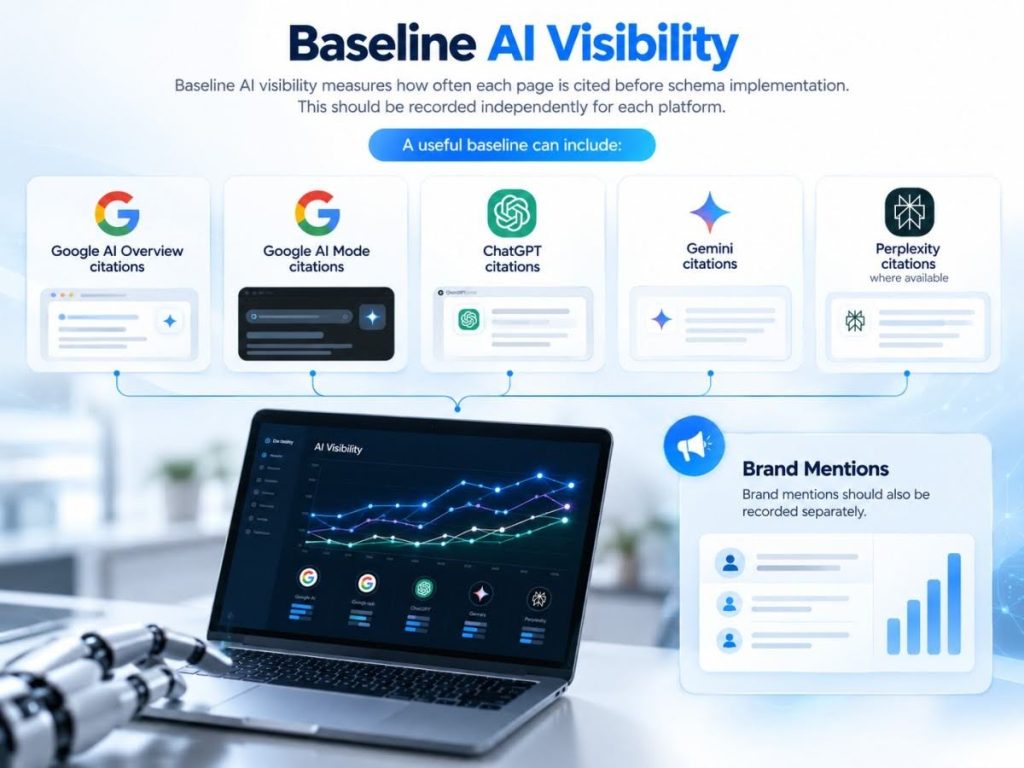
Baseline AI visibility measures how often each page is cited before schema implementation.
This should be recorded independently for each platform.
A useful baseline can include:
- Google AI Overview citations
- Google AI Mode citations
- ChatGPT citations
- Gemini citations
- Perplexity citations where available
Brand mentions should also be recorded separately.
A brand can be mentioned without its website being cited, which represents entity visibility rather than source visibility.
Without a baseline, any post-implementation citation can easily be attributed to schema even when the page was already appearing naturally.
Schema Implementation
Schema implementation should accurately represent the content already present on the page.
JSON-LD is generally placed within the page’s HTML and contains structured properties describing the relevant entity or content.
For an organisation page, this might include the company name, website and other legitimate organisation details.
For an article, it can describe the headline, author, publication information and associated organisation where appropriate.
The implementation should be validated technically.
However, validation confirms that markup is syntactically understandable. It does not confirm that the page will rank better or receive AI citations.
This distinction needs to remain clear throughout the test.
Post-Implementation Measurement
Post-implementation measurement should compare treated pages with controls over the same period.
The purpose is not simply to ask whether citations increased.
The correct question is whether pages receiving schema improved more than comparable pages that did not receive the change.
Ahrefs used this type of matched methodology in its 2026 structured-data experiment. It tracked 1,885 pages adding JSON-LD between August 2025 and March 2026 and matched them against 4,000 control pages before evaluating citation changes.
The study found no substantial positive citation effect attributable to adding schema.
This kind of control design is much stronger than observing that many AI-cited pages happen to contain structured data.
Google Search Results
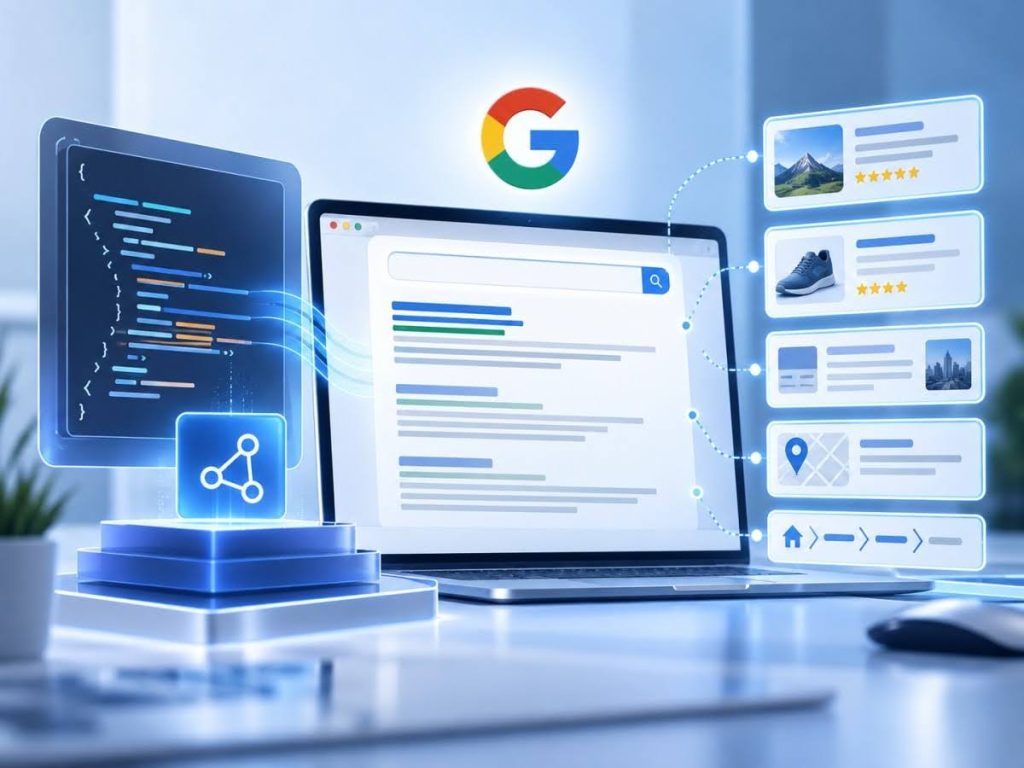
Schema can still have legitimate value within Google Search even when it does not independently increase AI citations.
Structured data is commonly used to help Google understand specific page information and determine eligibility for certain enhanced search presentations.
However, schema should not be interpreted as a substitute for ranking fundamentals.
The 2026 empirical study found that organic rank position remained substantially more predictive of AI citation than schema characteristics after statistical correction.
For SEO teams, the implication is clear.
Schema belongs within technical optimisation, but ranking performance still depends on wider factors such as relevance, content quality, authority and accessibility.
Google AI Overview Results
Available experimental evidence does not show a clear positive effect from adding schema to pages already receiving AI citations.
In the Ahrefs matched study, Google AI Overview citations for treated pages declined by approximately 4.6% relative to controls. The researchers cautioned that the result should not be interpreted as proof that schema harms AI visibility because platform-wide citation behaviour was also changing during the period.
The important finding is therefore not that the schema reduced visibility.
The stronger conclusion is that the experiment did not demonstrate a positive citation uplift.
This challenges the assumption that adding JSON-LD is a straightforward AIO SEO tactic.
Businesses should therefore avoid reporting schema implementation itself as an AI Overview optimisation success unless subsequent visibility data supports the claim.
Google AI Mode Results
Google AI Mode showed no statistically meaningful citation improvement attributable to schema in the same Ahrefs study.
The measured effect was approximately +2.4%, but it was statistically indistinguishable from zero.
This means the difference was not strong enough to conclude that schema caused an improvement.
For AI SEO optimisation, this is an important distinction.
A small positive number can appear attractive when removed from its statistical context.
However, experimental evidence should be interpreted according to whether the observed effect is reliably distinguishable from normal variation.
The appropriate conclusion is therefore neutral: no clear citation benefit was established.
ChatGPT Results
ChatGPT citations also showed no statistically reliable increase after JSON-LD implementation in the Ahrefs experiment.
The measured effect was approximately +2.2%, which the study described as statistically indistinguishable from zero.
This suggests that adding structured data alone is unlikely to be a reliable strategy for increasing ChatGPT citations on pages that are already visible enough to enter the retrieval environment.
The result does not prove that schema can never play any indirect role.
It simply means the tested pages did not receive a measurable citation advantage from implementation alone.
Businesses should therefore focus more heavily on whether their content provides useful information that ChatGPT can retrieve and cite.
Gemini Results
Gemini-specific schema evidence is more limited in controlled before-and-after testing, but cross-sectional research provides useful context.
The 2026 empirical study examining both ChatGPT and Gemini citations found no independent predictive relationship between schema presence and AI citation once important confounding factors were controlled.
The study analysed 730 citations across 75 commercial queries and 1,006 unique webpages.
Schema presence, entity-richness scoring and schema-to-query alignment were not statistically significant predictors in the corrected models.
Organic ranking position was substantially more predictive.
This does not establish exactly how Gemini processes every page. It does provide evidence against the claim that generic schema implementation is independently driving citations.
Perplexity Results
Reliable controlled schema experiments for Perplexity remain more limited than the available evidence for Google AI features and ChatGPT.
This means claims about schema directly improving Perplexity citations should be treated cautiously.
The absence of strong evidence does not mean structured data has no value.
It means there is insufficient basis to claim that adding JSON-LD produces a measurable Perplexity citation advantage.
The appropriate AI SEO approach is therefore experimental.
Businesses can implement valid schema for its established technical purposes while independently monitoring Perplexity citations before and after the change.
If citation visibility improves, the result should still be compared against controls and other concurrent website changes.
Entity Recognition Observations
Schema can explicitly describe entities, but entity recognition depends on more than JSON-LD.
A business entity is represented through a wider set of information.
This can include:
- Visible business content
- Organisation naming
- Service descriptions
- Internal relationships
- Third-party mentions
- External citations
Schema can reinforce these relationships when implemented accurately.
However, an Organisation schema block cannot create external authority or replace inconsistent brand information across the web.
For GEO and AI SEO, the broader objective should be entity clarity.
Structured data can support that objective, but it is one component rather than the complete strategy.
Did Citations Actually Increase?
Current controlled evidence does not support the conclusion that adding generic JSON-LD schema causes a meaningful increase in AI citations.
This is the central finding businesses should understand.
Ahrefs initially observed that AI-cited pages were substantially more likely to contain JSON-LD than non-cited pages. Its larger observational dataset covered millions of URLs.
That observation could easily be interpreted as evidence that schema improves AI visibility.
The controlled follow-up study told a different story.
When pages that added schema were compared with matched controls, AI citations did not meaningfully improve.
This is a useful example of why AI SEO recommendations need experimental validation.
Why Cited Pages Often Have Schema
AI-cited pages can have schema more frequently because schema implementation is associated with other website-quality characteristics.
Well-maintained websites are more likely to implement technical SEO comprehensively.
They may also have:
- Better content
- Stronger organic rankings
- More authority
- More backlinks
- Better site maintenance
- Stronger editorial processes
These factors can increase both organic and generative visibility.
Schema can therefore appear statistically associated with citations even when it is not the factor causing them.
Ahrefs explicitly highlighted this confounding problem when explaining why its observational finding did not translate into a causal result.
Correlation vs Causation
Correlation shows that two things occur together. Causation requires stronger evidence showing that changing one variable produces the other outcome.
Schema and AI citations provide a useful example.
If 53% of AI-cited pages contain structured data, that may initially look like evidence that schema generates citations.
However, those pages may also belong to stronger domains with better content, rankings and authority.
Ahrefs’ controlled follow-up found no meaningful positive citation effect after the schema was actually added.
The cross-platform academic study reached a similar conclusion after controlling for ranking position and other variables.
This is why AI SEO strategies should distinguish observational patterns from causal evidence.
Schema and Organic Rankings
Schema should not be viewed as a direct shortcut to stronger organic rankings either.
Its primary role is to communicate structured information and support eligible search features where applicable.
A webpage still needs to satisfy the broader requirements of traditional SEO.
These include:
- Relevant search intent
- Strong content quality
- Crawlability and indexability
- Website authority
- Useful internal linking
- Good user experience
The relationship between traditional search and AI visibility remains important because strong organic ranking can improve the probability that content enters AI retrieval environments.
This makes conventional SEO a higher-priority foundation than schema experimentation alone.
Schema and Machine Readability
Machine readability refers to how clearly systems can interpret the information and relationships represented on a webpage.
Structured data can contribute to machine readability by explicitly labelling entities and properties.
However, visible HTML content remains essential.
The actual article, service description, product details or company information should be understandable without relying entirely on JSON-LD.
This creates a useful implementation principle.
Schema should confirm and structure visible information rather than contain critical information that users cannot see.
For AI extraction, clear headings, direct answers, descriptive content and accessible HTML remain important regardless of structured data.
Article Schema
Article schema can describe information about an article, including its headline, author and publication details.
This can help systems identify key metadata.
However, Article schema does not make generic content more citation-worthy.
A research article with original evidence is fundamentally different from a rewritten summary even if both implement perfect structured data.
For AI SEO, information quality should therefore come first.
Schema should then represent that information accurately.
This sequence matters.
Creating excellent markup around weak content optimises the description of the weakness rather than solving it.
Organisation Schema
Organisation schema can help describe the company represented by a website.
For Singapore businesses, accurate implementation can reinforce information such as the organisation name and relevant official details.
This can support entity consistency.
However, Organisation schema should not be treated as proof of authority.
AI systems can also encounter information about the business through external sources.
A company described consistently across its own website, industry sources, media coverage and relevant directories creates a stronger entity environment than one relying solely on structured data.
The organisation schema is therefore supportive rather than sufficient.
FAQ Schema
FAQ content can be useful because real questions and concise answers create clear informational structure.
The value of FAQ content should be separated from the value of FAQ schema.
An AI system can understand a well-written visible question-and-answer section even without relying on its structured-data markup.
Adding FAQ schema should therefore not be treated as an automatic AI citation tactic.
The more important factors are whether the questions reflect real user needs and whether the answers provide accurate, self-contained information.
For GEO content, useful FAQs can improve extractability.
The benefit comes primarily from the quality and structure of the visible answer.
Product Schema
Product schema can describe structured properties associated with products.
This can be useful for ecommerce search experiences.
For AI SEO, however, product visibility can depend on much more than the presence of markup.
Relevant factors can include:
- Accurate product information
- Availability of useful descriptions
- Reviews and reputation
- Merchant information
- Supporting content
- Overall website authority
Product schema should therefore complement complete product information.
Businesses should not assume that adding Product markup alone will make the product appear more frequently in AI-generated recommendations.
JSON-LD and AI Extraction
JSON-LD is widely used because it separates structured data from the visible page content in a machine-readable format.
This makes implementation manageable for many websites.
However, its presence should not be confused with direct AI extraction.
The controlled citation evidence currently available shows no clear citation uplift from adding JSON-LD alone.
This suggests that AI SEO teams should focus first on visible information quality and retrieval relevance.
JSON-LD should remain part of sound technical implementation rather than being promoted as a standalone generative optimisation tactic.
Where Schema Still Matters
Schema still matters because technical SEO is broader than AI citation acquisition.
Structured data can improve clarity about entities and page properties and can support eligible search enhancements.
It also encourages businesses to maintain cleaner information architecture.
For example, implementing Organisation schema often requires the SEO team to clarify official brand naming and relevant organisational details.
Implementing Article schema requires accurate publication and authorship information.
These benefits can support overall website quality.
The correct conclusion is therefore not “schema does not matter”.
The more accurate conclusion is “schema should not be expected to independently produce AI citations”.
Traditional SEO Remains the Foundation
Traditional SEO remains fundamental because AI search systems still need useful, discoverable web content.
The 2026 empirical schema study found organic rank position to be the strongest citation predictor within its tested dataset.
This reinforces the importance of fundamentals.
Businesses should continue prioritising:
- Search intent
- Content usefulness
- Website authority
- Technical accessibility
- Internal linking
- Original information
Structured data fits within this foundation.
It should not replace it.
Schema and Information Gain
Information gain describes the useful information a page contributes beyond what is already widely available.
Schema cannot manufacture information gain.
A page containing original Singapore market data has information value because the data itself is distinctive.
Adding Dataset, Article or Organisation structured information may help describe that resource, but the structured data is not what makes the findings valuable.
This distinction is particularly important for AI SEO.
Generative systems need source material worth retrieving.
The stronger strategy is therefore to invest in unique information first and implement accurate schema second.
Schema and Content Structure
Content structure determines how information is presented to readers and machines.
Clear headings, concise definitions, tables and direct answers can make information easier to understand.
Schema can reinforce the underlying relationships, but it does not replace visible structure.
A useful AI-focused page should therefore contain:
- Clear section headings
- Answer-first paragraphs
- Self-contained explanations
- Supporting evidence
- Appropriate tables where needed
These characteristics improve readability even if an AI platform never reads the JSON-LD.
This makes them more durable optimisation priorities.
Schema and Topical Authority
Topical authority is created through useful coverage of related subjects, not through the volume of structured data implemented.
A website can have perfect schema and still lack meaningful topic depth.
For example, an AI SEO agency needs more than Organisation schema to establish topical authority.
Its site may need complementary content about:
- AI citations.
- AI visibility measurement.
- GEO.
- AEO.
- AI Overviews.
- Generative source selection.
Each page should address a distinct user need.
Schema can clarify what those pages represent, but the topical authority comes from the information architecture and quality of the content.
Schema and Entity Consistency
Entity consistency means the organisation is represented accurately across different sources.
Structured data can contribute by using consistent organisation naming and legitimate relationships.
However, inconsistency elsewhere can weaken the broader picture.
Examples include different brand names across directories, outdated company descriptions, conflicting service information or inconsistent author attribution.
For Singapore businesses, entity optimisation should therefore include both owned and external information.
Schema is one controlled source within that wider ecosystem.
It should align with visible website content and credible third-party information.
Testing Schema on Your Own Website
Businesses interested in measuring schema’s AI SEO impact can conduct controlled tests rather than relying entirely on industry studies.
A practical experiment can follow five steps.
- Select similar test and control pages.
- Record baseline AI citations.
- Add relevant schema only to the treatment group.
- Avoid major concurrent content changes.
- Compare citation movement after an adequate observation period.
This mirrors the logic behind the Ahrefs experiment, which matched treated pages with controls to separate schema effects from broader platform trends.
The test should still be interpreted cautiously because AI outputs can vary.
Repeated measurement is more reliable than a single observation.
What Should Be Measured After Implementation?
Post-schema measurement should include more than citation count.
A useful framework can include:
Metric | Purpose |
Organic rankings | Checks traditional visibility |
Search impressions | Measures search exposure |
AI citations | Measures source visibility |
Brand mentions | Measures entity visibility |
Rich-result eligibility | Measures search-feature impact |
Crawl/index status | Checks technical accessibility |
This makes it easier to determine whether schema produced any measurable benefit even if AI citations remain unchanged.
Technical improvements can be useful without becoming AI citation factors.
Common Schema Testing Mistakes
Schema tests often produce misleading conclusions because several variables change simultaneously.
A page may receive new schema, rewritten content, stronger internal links and new backlinks at the same time.
If visibility improves, it becomes impossible to know which change contributed.
Another mistake is using pages with no baseline visibility.
A page that has never been retrieved by AI may remain uncited regardless of schema.
Businesses should also avoid testing only one URL and treating the outcome as universal.
A controlled group of comparable pages produces more useful evidence.
Recommendations for AI SEO
The evidence supports a balanced approach to schema within AI SEO optimisation.
First, implement a schema when it accurately describes content and supports legitimate search objectives.
Second, do not promise citation improvements solely because structured data has been added.
Third, prioritise visible content quality, original information and traditional SEO fundamentals.
Fourth, monitor AI citations independently.
Fifth, test significant technical assumptions with control groups whenever practical.
This avoids building AI SEO strategies around attractive but unverified correlations.
W360's Recommended Schema Priorities
W360 Group Pte Ltd’s recommended approach is to treat schema as a supporting technical layer.
The first priority is correctness.
Structured data should accurately reflect visible page content.
The second priority is relevance.
Only schema types appropriate to the page should be implemented.
The third priority is consistency.
Organisation, authorship and page information should align with the wider website and external entity signals.
The fourth priority is measurement.
SEO teams should evaluate search visibility and AI visibility after implementation without assuming positive results in advance.
The fifth priority is content quality.
No schema implementation should take priority over improving weak or generic information.
Study Limitations
Current schema research has important limitations.
The Ahrefs study focused on pages already receiving substantial AI citation activity before schema was introduced. The researchers acknowledged that the findings may not fully represent pages with no prior AI visibility.
The analysis also combined several schema types rather than establishing separate causal effects for each implementation.
Its main measurement period focused on approximately 30 days after treatment.
The academic cross-platform study also had limitations. It examined 75 commercial queries across selected categories and focused on ChatGPT and Gemini rather than every generative platform.
These limitations mean the evidence should not be interpreted as proof that schema can never affect AI systems.
The more defensible conclusion is that generic schema implementation has not been shown to independently increase AI citations.
Frequently Asked Questions
Schema can support technical SEO and make certain page relationships more explicit, but current controlled research does not show that adding generic JSON-LD reliably increases AI citations. It should be implemented for valid technical reasons rather than treated as a guaranteed GEO tactic.
Current controlled evidence does not show a statistically meaningful ChatGPT citation increase after adding JSON-LD. Strong visible content, relevance and authority remain important.
The available Ahrefs experiment did not find a positive AI Overview citation effect from adding schema. Treated pages actually declined slightly relative to controls, although the researchers did not claim that schema caused the decline. Schema should therefore not be considered a guaranteed AIO visibility lever.
There is no proven schema type that guarantees AI citations. Businesses should implement schema appropriate to the actual page, such as Organisation, Article or Product markup where relevant.
Current research does not establish JSON-LD as an independent AI citation factor. Its value lies primarily in structured technical communication rather than guaranteed generative visibility.
Schema can make entity relationships more explicit, but entity recognition also depends on visible website content and consistent third-party information. It should therefore support a broader entity strategy.
No. Structured data should be used where an appropriate schema type accurately represents the content. Adding unnecessary markup simply to increase the amount of structured data is not a sound AI SEO strategy.
Available research suggests that traditional ranking strength, useful content and broader authority are more important areas to prioritise than generic schema implementation alone. AI visibility should still be measured directly because no single factor guarantees citation.
Structured Data Helps Describe Content, Not Create Authority
Schema markup remains a useful technical SEO component, but current evidence does not support positioning it as a shortcut to AI citations.
The strongest controlled study available tracked 1,885 pages adding JSON-LD and found no meaningful positive citation uplift in ChatGPT or Google AI Mode. A separate cross-platform study found no independent citation effect for schema presence after controlling for important variables.
This distinction matters for AI SEO optimisation.
Structured data can describe entities and page information more explicitly, but it cannot manufacture authority, topical relevance or information gain.
Singapore businesses should therefore use schema correctly while prioritising the factors that make a webpage genuinely useful: clear intent, strong content, original information, credible authority and sound technical SEO.
The correct strategy is not to remove schema.
It is to stop expecting schema alone to solve an AI visibility problem.
Test Structured Data Within a Wider AI SEO Strategy
Businesses implementing structured data should measure whether it improves search features, technical clarity and actual AI citation visibility rather than assuming a direct benefit.
W360 Group Pte Ltd. can evaluate schema implementation alongside content quality, technical SEO, entity signals and generative search visibility through its AI SEO optimisation approach. Businesses that want to review how structured data fits into their broader search strategy can get a quote from W360 Group Pte Ltd.