The application of AI in SEO has changed how businesses need to think about off-page authority. Traditional SEO has long treated backlinks as an important signal of website credibility and prominence, but AI search introduces additional forms of visibility such as brand mentions, citations and recommendations.
This creates an important question: do backlinks still matter for AI SEO, or are brand mentions becoming more important?
Current evidence suggests that the answer is not binary. Backlinks remain relevant to traditional search authority, and traditional ranking strength can still overlap with AI citations. However, recent large-scale AI visibility research also shows that raw backlink volume has a much weaker relationship with AI brand visibility than broader brand mentions across the web.
AI citations, brand mentions and backlinks should therefore be measured as related but separate signals.
For Singapore businesses, this means off-page AI SEO should not be reduced to traditional link building. A stronger strategy combines relevant backlinks, credible independent coverage, branded mentions, first-party information and content that can function as a useful source.
Research Question
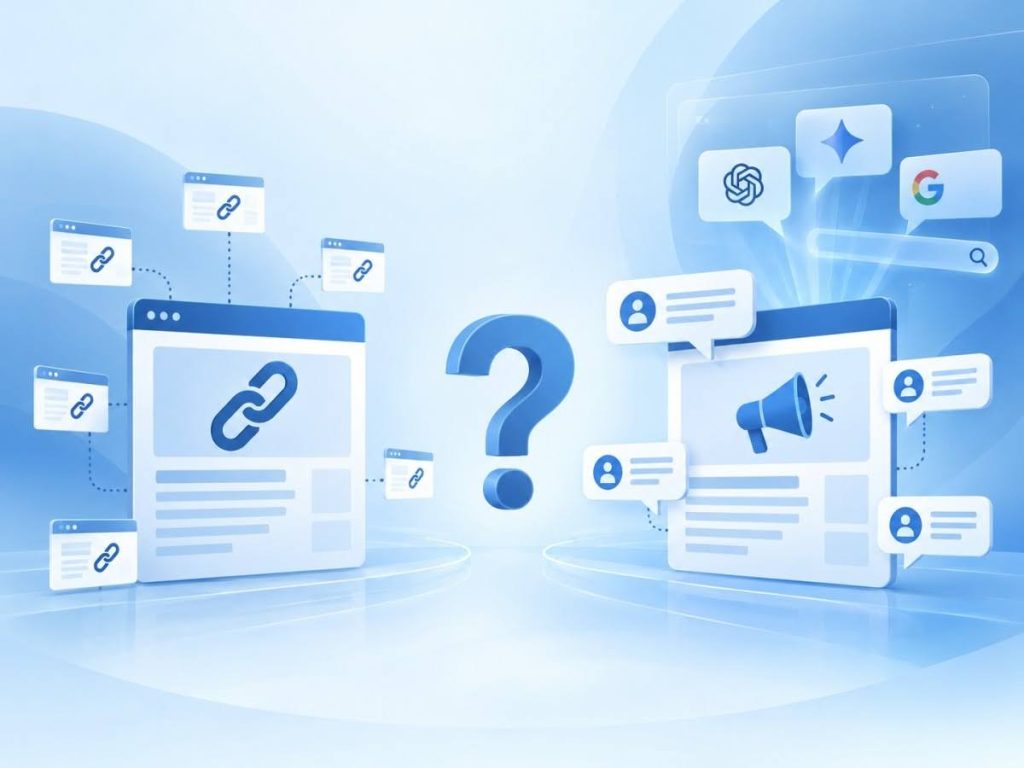
The core research question is whether websites with stronger backlink profiles are more likely to be cited or mentioned by AI search platforms.
A related question is whether brand mentions provide a stronger relationship with AI visibility than traditional link metrics alone.
These questions need to be separated because an AI citation and a brand mention are not the same thing.
A citation occurs when an AI platform references a webpage or domain as a source. A brand mention occurs when the company or product name appears in the generated response. A brand can receive one without the other.
Recent research illustrates the difference clearly. Ahrefs analysed more than 31,000 mentions of its own brand across six AI platforms and found that many brand mentions were not accompanied by a link to the Ahrefs website. The proportion varied significantly by platform.
This means off-page AI SEO should evaluate both source authority and brand recognition.
Study Methodology
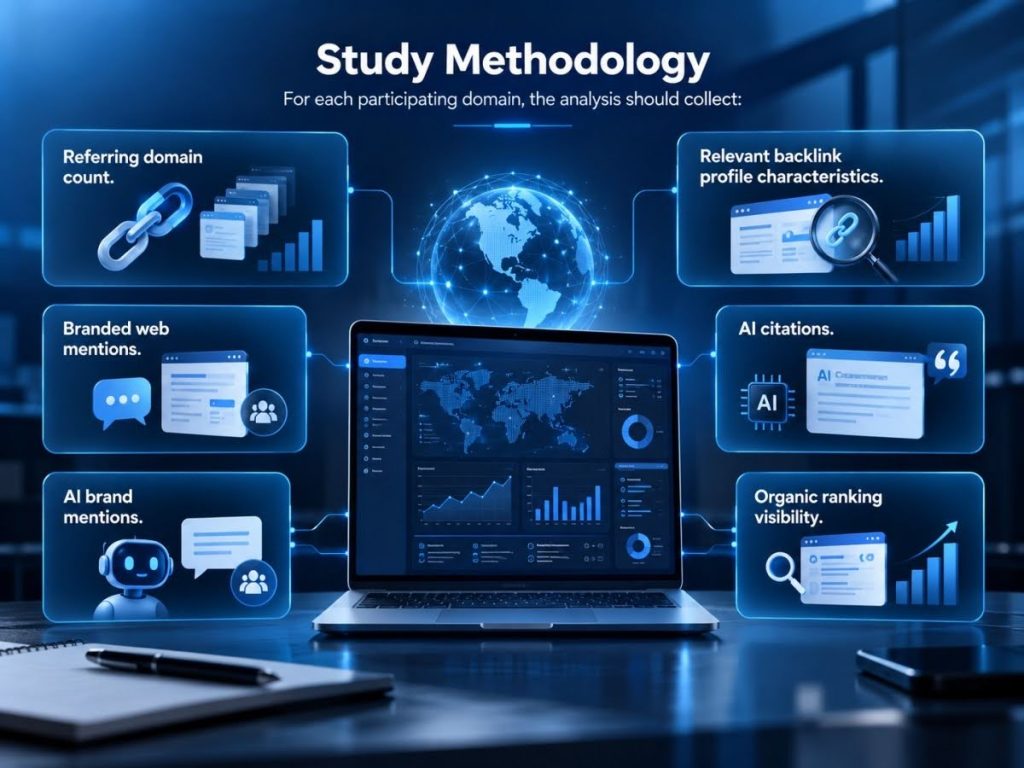
A backlinks-versus-citations study should compare websites across the same commercially relevant prompt set.
For each participating domain, the analysis should collect:
- Referring domain count
- Relevant backlink profile characteristics
- Branded web mentions
- AI citations
- AI brand mentions
- Organic ranking visibility
The AI dataset should then be separated by platform.
ChatGPT, Gemini, Perplexity and Google AI Overviews should not be combined into one undifferentiated citation number because source-selection behaviour can vary significantly.
The comparison should also use both domain-level and page-level metrics.
A strong domain can contain individual pages that rarely appear in AI answers, while a relatively modest website can have one research article that receives repeated citations.
This distinction is important when interpreting whether links to the domain or links to the specific page are associated with AI citation visibility.
Websites and Queries Analysed

The website sample should contain businesses competing for similar commercial and informational topics.
A broad cross-industry dataset can be useful for general patterns, but industry-specific comparison is more actionable for individual businesses.
For Singapore AI SEO analysis, websites should be grouped according to genuinely comparable categories.
The query set should include a mixture of:
- Informational searches
- Commercial discovery prompts
- Comparison questions
- Recommendation prompts
- Problem-solving queries
This creates a more balanced dataset.
A website that performs strongly for informational citations but never appears in commercial recommendations has a different visibility profile from a brand that is frequently recommended but rarely used as a factual source.
Backlinks vs AI Citations
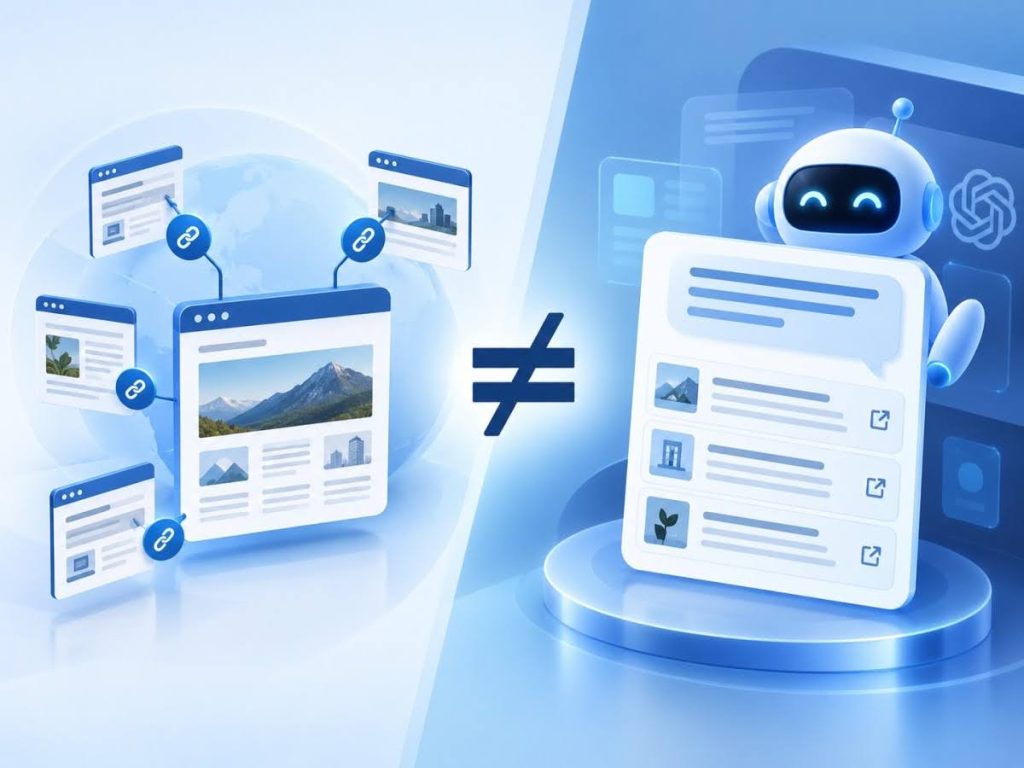
Backlinks and AI citations should not be treated as equivalent signals.
A backlink is an external webpage linking to another webpage. An AI citation is a source reference presented within an AI-generated answer.
Backlinks can contribute to broader organic authority and discoverability, but available research does not establish that acquiring more backlinks automatically produces more AI citations.
Ahrefs analysed approximately 75,000 brands and reported that backlink quantity and URL-level link strength showed only weak correlations with brand mentions across the AI systems studied. By contrast, branded web mentions displayed a stronger relationship with AI visibility.
This does not mean links have become irrelevant.
It means link volume alone is not a reliable proxy for generative visibility.
A website with many backlinks can still have poor AI visibility if the brand is not strongly associated with the topic being asked about.
Referring Domains vs AI Citations
Referring domains measure the number of unique websites linking to a domain or webpage.
This metric is usually more useful than raw backlink count because thousands of links from one website do not represent the same breadth of external validation as links from many independent domains.
For AI SEO, domain analysis should focus on quality and relevance rather than quantity.
The comparison should ask:
- Are citing domains relevant to the business’s topic?
- Are they authoritative within the industry?
- Do they mention the brand in context?
- Do they link to useful source material?
- Are important pages earning links directly?
A relevant editorial link that explains why a company is associated with a specific service can create both link authority and entity context.
That may be more valuable than a large number of unrelated links.
Domain Authority Patterns
Domain authority metrics can provide useful context, but they should not be interpreted as direct AI ranking factors.
Tools such as Ahrefs Domain Rating estimate backlink-profile strength. They are third-party metrics, not proprietary scores used by ChatGPT, Gemini or Google.
Recent AI citation research nevertheless suggests that conventional search authority still matters indirectly.
A 2026 cross-platform study analysing 730 AI citations across 75 commercial queries found that Google organic ranking position was the strongest predictor within its model, while generic schema signals were not independently predictive.
Since backlinks remain one contributor to conventional organic authority, their influence on AI search may often operate through a wider search ecosystem rather than as a simple direct citation factor.
This is an important distinction.
Brand Mentions vs AI Citations
Brand mentions indicate how strongly a company is recognised within the information environment around a topic.
A mention can occur on news websites, industry publications, directories, review sites, forums, video transcripts and other third-party sources.
Ahrefs’ study of 75,000 brands found that broader branded web mentions correlated more strongly with AI visibility than traditional backlink metrics.
This finding suggests that AI visibility is partly a brand and entity problem, not only a link-authority problem.
However, correlation still does not prove that adding mentions will directly cause AI systems to recommend a brand.
Well-known companies naturally receive more search demand, press coverage, links and mentions.
The practical implication is that businesses should strengthen credible brand presence across the web rather than attempting to manufacture mentions as isolated ranking signals.
Unlinked Mentions
An unlinked mention occurs when another webpage names a business without linking to its website.
Traditional SEO often gives greater attention to linked mentions because they pass users directly to the destination and contribute to link authority.
AI search changes the importance of the distinction.
A relevant unlinked mention can still contribute contextual information about what a brand does, where it operates and which topics it is associated with.
This makes unlinked coverage worth monitoring.
Examples can include a Singapore industry publication mentioning a specialist provider, an expert quotation attributed to a company representative or a third-party comparison including a business by name.
The value comes primarily from credible contextual association rather than from simply increasing mention counts.
Authority of Mentioning Sources
Not every brand mentioned should carry equal strategic weight.
A relevant mention from a respected industry publisher is fundamentally different from a mention placed on an unrelated low-quality website.
The authority of the mentioning source should therefore be analysed according to several factors.
These include:
- Topical relevance
- Editorial credibility
- Audience relevance
- Independent reputation
- Context of the mention
For a Singapore B2B company, recognition from a respected trade publication or industry association can provide more meaningful corroboration than dozens of generic directory references.
AI SEO therefore strengthens the case for quality-led digital PR rather than volume-led mention acquisition.
Cited vs Non-Cited Domain Comparison
A cited-versus-non-cited comparison can help identify characteristics that frequently accompany AI source visibility.
The comparison should analyse domains matched as closely as possible by industry and query relevance.
Variables can include:
Factor | Cited Domains | Non-Cited Domains |
Organic rankings | Compare | Compare |
Referring domains | Compare | Compare |
Branded mentions | Compare | Compare |
Topic coverage | Compare | Compare |
Content originality | Compare | Compare |
Third-party references | Compare | Compare |
The purpose is not to identify one guaranteed ranking factor.
It is to determine whether combinations of signals repeatedly differ between visible and non-visible websites.
This is more useful than looking at backlink count alone.
ChatGPT Findings
ChatGPT visibility should be measured through both citations and mentions because the platform does not always link to a brand when discussing it.
Ahrefs’ own brand study found that, within its dataset, only 26.9% of ChatGPT responses mentioning Ahrefs also linked to the company’s site. The percentage was specific to that brand and dataset and should not be generalised into a universal ChatGPT citation rate.
This demonstrates an important measurement principle.
A company can have meaningful ChatGPT brand visibility without receiving equivalent owned-domain citation visibility.
For off-page AI SEO, the analysis should therefore ask two separate questions:
Is the brand being recognised?
Is the website being used as a source?
Different actions may be required depending on the answer.
Gemini Findings
Gemini should also be measured through mentions and citations separately.
The same Ahrefs case analysis found a substantial difference between brand mentions and linked mentions within Gemini, again demonstrating that recognition does not automatically lead to owned-site citation.
A separate Semrush study published in 2026 likewise found that mentions and citations frequently do not occur together across AI search platforms. Its dataset showed substantial variation between platforms in how often brands were named and their websites cited.
For businesses, this reinforces the need for dual measurement.
Improving branded presence on the web may support entity recognition, while strengthening owned content can improve the website’s ability to function as an attributable information source.
Perplexity Findings
Perplexity tends to make source attribution highly visible, which makes it useful for analysing citation behaviour.
In Ahrefs’ brand-specific 2025 analysis, Perplexity linked to Ahrefs more frequently when mentioning the company than the other AI systems included in that study.
This should not be interpreted as a universal citation percentage for every brand.
Different subjects and industries can produce different results.
The useful lesson is that platform behaviour varies substantially.
Perplexity may expose the value of source-worthy content more visibly because users can easily inspect supporting references.
Businesses should analyse which individual pages receive Perplexity citations and whether those pages also attract backlinks or editorial references.
Google AI Overview Findings
Google AI Overviews provide a particularly useful environment for examining the relationship between traditional SEO and AI citation visibility.
Ahrefs reported in March 2026 that approximately 38% of pages cited in its AI Overview dataset also ranked in Google’s top ten for the same queries.
This figure demonstrates meaningful overlap, but also substantial divergence.
Many sources used by AI Overviews were therefore not top-ten organic results for the exact original query.
This supports a broader interpretation of off-page authority.
Strong traditional rankings remain useful, but businesses also need pages capable of supporting related parts of an AI-generated response.
Authority, relevance and information specificity can all contribute to that broader source opportunity.
Backlinks vs Entity Recognition
Backlinks can contribute to authority, but entity recognition concerns whether a system clearly understands what a brand represents.
These are related but distinct concepts.
A website can accumulate links without developing strong topic associations.
For example, links acquired from unrelated sites may strengthen some conventional authority metrics while providing little contextual evidence about the company’s actual expertise.
Entity-focused off-page signals are more contextual.
Useful signals can include:
- Branded editorial mentions
- Expert attribution
- Industry citations
- Relevant review coverage
- Consistent company descriptions
These references reinforce associations between the business and its subject matter.
For AI SEO, relevance of recognition may therefore matter more than merely maximising link count.
Where Digital PR Fits
Digital PR fits into AI SEO because it can create both authoritative links and credible brand mentions.
A well-executed digital PR campaign can produce third-party evidence that connects a company with a specific subject.
The strongest campaigns usually begin with something genuinely worth referencing.
Examples include:
- Original research
- Proprietary datasets
- Industry surveys
- Expert analysis
- Useful market findings
These assets can earn links, mentions and editorial coverage at the same time.
This is materially different from distributing generic press releases solely for backlink acquisition.
For Singapore businesses, one substantive announcement or research-led campaign can be more useful than frequent low-value PR submissions.
Why Generic Press Release Distribution Has Limits
Generic press release distribution can create mentions, but mention quantity alone should not be confused with meaningful brand authority.
If the same announcement is reproduced across many low-engagement sites, the resulting references may add little independent context.
For AI SEO, third-party corroboration is more useful when the source provides genuine editorial or industry relevance.
This is why a single legitimate company announcement can be appropriate when there is actual news, while ongoing authority-building should focus on stronger channels.
Useful alternatives can include expert commentary, LinkedIn thought leadership, original research, partnerships and editorial outreach.
These activities can create richer entity signals than repeatedly syndicating essentially the same release.
What Still Matters in Off-Page AI SEO
Off-page AI SEO still requires authority, but the definition of authority is broader than traditional backlink acquisition.
The strongest strategy combines several elements.
First, businesses should continue earning relevant backlinks because traditional SEO remains important.
Second, they should increase credible brand mentions across independent sources.
Third, they should publish information worth citing.
Fourth, they should build consistent associations between the brand and its core services.
Finally, they should monitor how those signals translate into AI mentions, citations and recommendations.
This makes off-page AI SEO closer to integrated brand authority building than conventional link acquisition alone.
Link Relevance Matters More Than Link Volume
Link relevance describes how closely the linking source relates to the topic or industry of the destination page.
This has always been important in quality-focused SEO, and AI search provides another reason to prioritise it.
A contextually relevant link can simultaneously provide:
- Referral traffic
- Search authority
- Topical association
- Brand context
- Independent validation
A large volume of irrelevant backlinks lacks much of this contextual value.
Singapore businesses should therefore evaluate whether their backlink profiles actually reinforce the subjects for which they want to be known.
The number of links should not be the only KPI.
Brand Authority Is Broader Than Link Authority
Brand authority includes the broader recognition of a company across search, media, communities and industry sources.
Link authority represents only one component of this environment.
A brand can build wider authority through:
- Search demand
- Media coverage
- Customer discussion
- Expert participation
- Original research
- Industry partnerships
These signals increase the amount of reliable information available about the business.
AI systems can encounter these references across different retrieval contexts.
For this reason, the application of AI in SEO increasingly connects search optimisation with brand-building activity.
The Role of Original Research
Original research can support both backlink acquisition and AI citation potential.
A genuinely new dataset gives other publishers a reason to reference the website.
It also gives AI systems a distinctive source when a generated answer requires supporting evidence.
The research needs to be credible.
Methodology should explain:
- Sample size
- Data source
- Study period
- Analysis method
- Limitations
This transparency helps distinguish first-party research from unsupported marketing claims.
For Singapore businesses, original local research can be particularly useful when international datasets do not answer local market questions.
Links to the Homepage vs Links to Research Pages
Links to individual source pages can serve a different purpose from general homepage links.
Homepage backlinks contribute to overall domain authority and brand discovery.
Links to a research page directly reinforce the authority and visibility of that specific resource.
For AI citation analysis, page-level authority should therefore be examined separately.
If an original research article earns substantial relevant coverage, it may become a stronger candidate for source visibility than a commercial page with few contextual references.
A healthy off-page strategy should therefore support both the domain and strategically important source pages.
AI Citations Without Brand Mentions
AI citations do not always create visible brand recognition.
Semrush reported in a 2026 study that 61.7% of the appearances it analysed were “ghost citations”, where a source was cited but the brand name was not included in the generated answer.
This distinction has important strategic implications.
A cited webpage can provide source authority while the user remains largely unaware of the company behind it.
Businesses should therefore optimise for both citation visibility and brand clarity.
Clear authorship, organisation naming and consistent entity references can help strengthen the association between useful information and the company that produced it.
Brand Mentions Without Citations
The reverse situation also occurs: an AI response can mention a brand without citing its website.
Ahrefs’ analysis of its own visibility found that this pattern occurred frequently across several major AI platforms.
Brand mentions without citations still matter because they can influence awareness and consideration.
A user who sees a company recommended may later search directly for the brand.
This visibility may therefore contribute to branded search demand even if analytics records no AI referral.
For measurement purposes, however, mention visibility should not be presented as citation performance.
Both need distinct KPIs.
Correlation vs Causation
Correlation indicates that two signals tend to occur together. It does not establish that one caused the other.
This is particularly important when analysing backlinks and AI citations.
High-authority websites often have:
- More backlinks
- More branded mentions
- Better rankings
- More original content
- Greater brand awareness
If those websites also receive more AI citations, it is difficult to isolate which factor caused the outcome.
The 2026 SSRN citation study illustrates this complexity. Traditional organic rank position remained the strongest observed predictor in its model, while other apparently promising signals weakened once confounding factors were considered.
AI SEO should therefore avoid turning every correlation into a new ranking-factor claim.
W360 Off-Page AI SEO Framework
W360 Group Pte Ltd.’s off-page AI SEO framework treats links, mentions and citations as separate but interconnected layers.
Layer 1: Traditional Link Authority
The first layer measures backlinks and referring domains. The emphasis should remain on relevance, quality and editorial legitimacy.
Layer 2: Brand Mention Authority
The second layer measures how often credible third-party sources discuss the brand within relevant contexts. Linked and unlinked mentions should both be monitored.
Layer 3: Entity Corroboration
The third layer evaluates whether independent sources consistently describe the business in ways that reinforce its core topics and services.
Layer 4: AI Citation Visibility
The fourth layer measures whether owned pages are being selected as sources across ChatGPT, Gemini, Perplexity and Google AI.
Layer 5: AI Brand Visibility
The final layer records whether the brand is mentioned or recommended regardless of whether its website is cited. These layers provide a more useful picture than backlink volume alone.
Measuring Off-Page AI SEO
Off-page AI SEO measurement should combine conventional authority data with generative visibility metrics.
A practical reporting table can include:
Metric | What It Measures |
Referring domains | External link breadth |
Relevant editorial links | Link quality and context |
Brand mentions | Wider recognition |
Unlinked mentions | Entity presence |
AI citations | Owned-source visibility |
AI brand mentions | Generative brand recognition |
Recommendation share | Commercial AI visibility |
These metrics should be analysed over time.
The most important question is not whether one metric increases in isolation.
It is whether broader authority begins translating into stronger visibility across both conventional and generative search.
Recommendations for Singapore Businesses
Singapore businesses should continue building backlinks, but link acquisition should form part of a broader authority strategy.
The first priority is to protect traditional SEO foundations.
Relevant editorial links, strong referring domains and authoritative coverage remain useful for organic search and wider discoverability.
The second priority is to strengthen brand mentions.
Businesses should seek credible third-party environments where expertise can be demonstrated naturally.
The third priority is to create original source material.
Research, statistics, expert commentary and useful datasets can attract both citations and editorial references.
The fourth priority is to measure AI visibility directly.
A backlink campaign cannot be assumed to improve ChatGPT or Gemini visibility unless the actual prompts and citations are monitored.
Finally, businesses should distinguish between brand recognition and website citation visibility.
Both contribute to AI SEO, but they represent different outcomes.
Frequently Asked Questions
Yes, backlinks still matter because they remain relevant to traditional SEO, authority and discovery. However, current research does not support treating raw backlink volume as a direct or guaranteed AI citation factor. AI SEO should measure backlinks alongside brand mentions, citations and wider entity authority.
Some large-scale studies have found stronger correlations between branded web mentions and AI visibility than between conventional backlink metrics and AI brand mentions. This does not prove that mentions directly cause AI visibility, so both should remain part of a broader authority strategy.
Unlinked mentions can contribute contextual information about a brand, particularly when they appear on relevant and credible third-party sources. They should be evaluated as entity and brand signals rather than treated as guaranteed ranking factors.
No. A backlink is a hyperlink from one webpage to another. An AI citation is a source reference used within a generated answer, so the two represent different forms of visibility.
Yes. AI platforms can mention or recommend a brand without linking to its website. This is why brand mentions and citation rates need separate measurement.
No. Domain Rating is a third-party metric measuring backlink-profile strength and is not an AI-platform ranking score. It can provide useful comparison context but should not be treated as a direct citation factor.
Digital PR can support AI SEO when it produces genuine editorial coverage, authoritative mentions and relevant backlinks. Original research and expert commentary are generally stronger authority assets than repetitive low-value press release distribution.
No. Relevant links continue to support traditional SEO and broader website authority. The strategy should evolve from maximising link volume towards building credible links, mentions, entity associations and source-worthy content.
Authority in AI Search Is Broader Than Backlinks
The application of AI in SEO does not make backlinks obsolete. It changes how off-page authority should be evaluated.
Backlinks remain part of the search ecosystem, especially because traditional organic visibility continues to overlap with AI source selection. However, raw link volume alone provides an incomplete picture of generative visibility.
Brand mentions, entity associations, third-party corroboration and useful source material have become increasingly important to measure.
The strongest off-page strategy therefore does not choose between links and mentions.
It builds relevant backlinks, credible brand references, original information and consistent topic associations while measuring whether those signals translate into actual AI citations and recommendations.
For Singapore businesses, this approach provides a more durable foundation than chasing one assumed AI ranking factor.
Strengthen Authority for Both Search and AI Discovery
Businesses evaluating off-page AI SEO should review more than their backlink counts. The stronger benchmark includes relevant links, third-party brand mentions, AI citations, recommendations and the quality of sources connecting the company with its core topics.
W360 Group Pte Ltd. can assess these signals as part of an integrated AI SEO strategy covering conventional search and generative visibility. Businesses that want to evaluate their current authority profile can get a quote from W360 Group Pte Ltd.